

Resentful Nostalgia against the West: The Sahra Wagenknecht Alliance
by Mario Möller

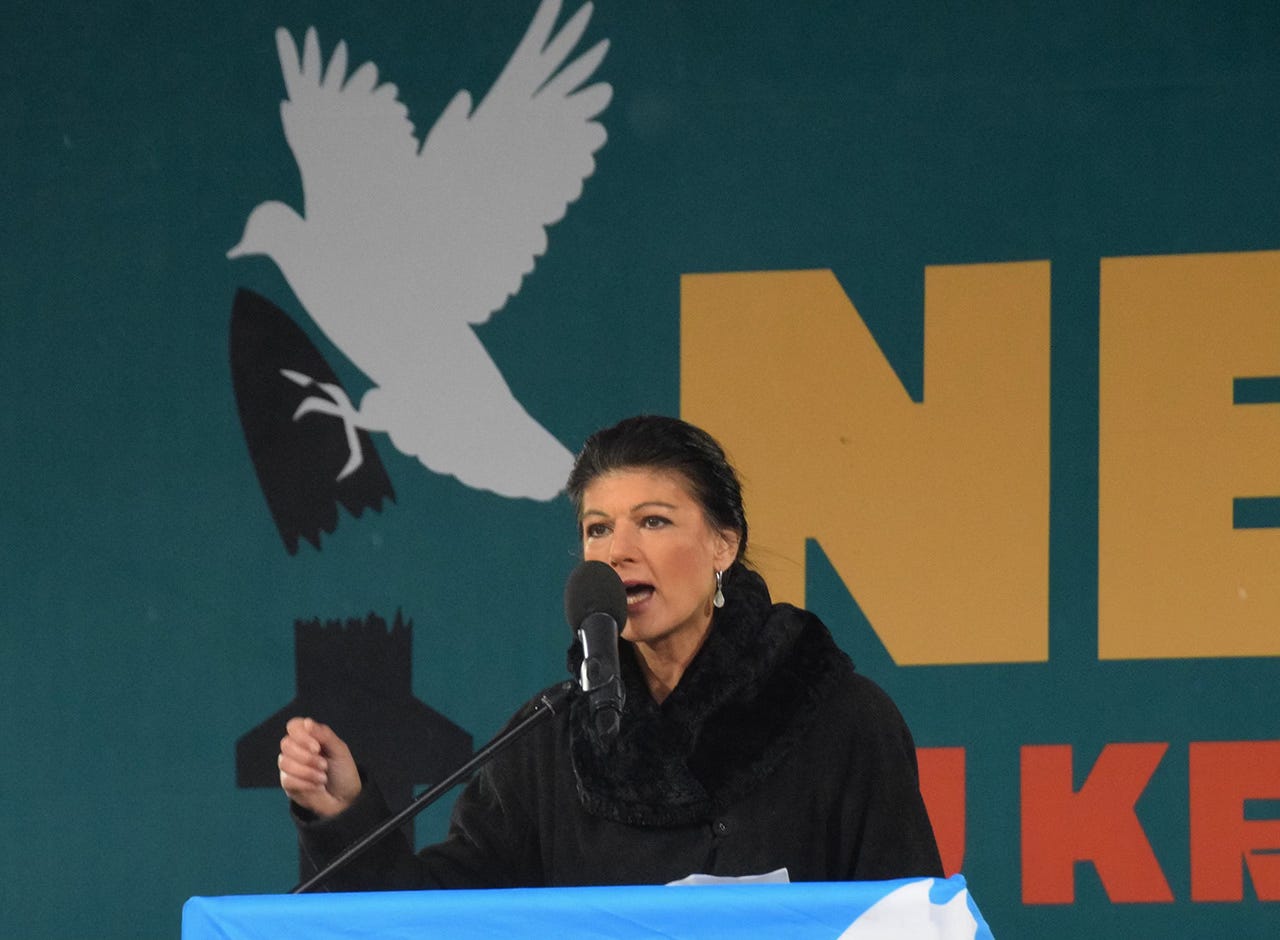
This essay originally appeared in German as “Ressentimentgeladene Nostalgie gegen den Westen,” in Bahamas 95 (November 2024): 10–15. Translated by Jakob Blumtritt.
Editor’s note: When this text first appeared in Bahamas magazine, the newly founded left-wing populist party Bündnis Sahra Wagenknecht – Vernunft und Gerechtigkeit (BSW) (Sahra Wagenknecht Alliance – Reason and Justice) had performed well in state elections. Since then, however, in the federal election in February, it missed the five-percent electoral cutoff by a few thousand votes. After recently failing to legally challenge the election results, the party will not acquire a seat in parliament in this legislative period.
The BSW’s persistence, and the fact that they are represented in the governing coalitions of the states of Thuringia and Brandenburg, shows that this party isn’t going anywhere, and neither is left-wing populism in Germany in general. It shouldn’t be overlooked that another left-wing populist party, Die Linke, made a surprising comeback in this election cycle, garnering 8.8 percent of the vote.
While these two parties have strong disagreements on some key issues, especially when it comes to immigration, they share a common resentment toward the United States and Israel. Counting the votes of the BSW and the Left Party together, left-populist parties received 13.7 percent of the vote—more than the 11.6 percent received by the Greens and not far behind the SPD’s 16.4 percent.
It might also be of interest for Telos Insights readers that Wolfgang Streeck, a sympathizer of the BSW and widely regarded as a key source of its ideas, spoke on one of the panels at the recent TPPI-sponsored conference on postliberalism. Between the lines of his presentation, attentive listeners may have noticed anti-Western sentiments very similar to those that underpin much of BSW’s political worldview.
With all this in mind, it becomes clear that there are still plenty of reasons to examine the ills of that party, as does this text from a magazine that is known for its unsparing criticism of the antics of the left, staying true to its roots in first-generation Frankfurt School Critical Theory.1
—Julius Bielek, ed.
On October 23, 2023, the media-star front woman of the Left Party, Sahra Wagenknecht, and nine other members of the German parliament announced their resignation, including the former parliamentary leader Amira Mohamed Ali. At the same time, they announced at the Federal Press Conference that they wanted to found a new party. According to Wagenknecht, such a party is sorely needed because the majority of the population no longer feels represented by any party.
In fact, a study previously published in the Politische Vierteljahresschrift, a quarterly journal of political science, concluded that a party under her leadership could be attractive to those who no longer hide their dissatisfaction with the real existing political establishment. In addition, Wagenknecht could achieve the feat of winning over “economically left-wing and culturally right-wing voters.”2
The founding meeting of the party finally took place behind closed doors in a Berlin hotel on January 8, 2024. Since then, the new alliance, which, in its own words, has been joined by police officers, theologians, trade unionists, entrepreneurs, nurses, city dwellers, and villagers,3 has been operating under the name “Bündnis Sahra Wagenknecht – Vernunft und Gerechtigkeit” (BSW) [Sahra Wagenknecht Alliance – Reason and Justice], led by a dual leadership consisting of Wagenknecht and Mohamed Ali. Its goals are ambitious: it wants to establish itself as a people’s party in the coming years and “represent the center of society.”4
A Pioneering Spirit
The first party assembly took place on January 27, 2024, in the former East Berlin cinema Kosmos and was dominated by the vote on personnel and program. In addition to these formalities, the staging of the founder’s political swan song also played an important role: “When Sahra Wagenknecht and Oskar Lafontaine entered the room at 10:01 a.m., it was clear that two people were celebrating the completion of their life’s work. Both have left their old parties behind in anger. Wagenknecht recently left the Left Party, Lafontaine left the SPD (Social Democratic Party of Germany) in 2005 and then also the Left Party in 2022.”5
This appearance made it clear that “the new political project is a family affair”6 whose undisputed foundation is “the political program of the couple”:7 “Critical of NATO and the United States, against green moralism, for a higher minimum wage and higher pensions, against unlimited migration, and for a return to the peace and foreign policy of the 1960s.”8
The reference to times long past was also reflected in the auditorium. The “impression of a strange backwardness” was evident “not only from the almost complete absence of young people” but also from the fact that the majority were “people in their so-called prime, who visibly had little desire for internal strife.” They had joined the party “mainly because of Sahra and came to Berlin for the founding party conference.”9
Whether the leadership and entourage had agreed on a dress code is unknown. But the role model effect of Sahra Wagenknecht, who, as a “political businesswoman,”10 is always elegantly dressed, while exuding the charm of a well-heeled grandmother in a Rosa Luxemburg mode—as well as the repeatedly expressed view of those present that they were witnesses and, at the same time, participants in a historic event—may have influenced the choice of wardrobe. Many members “had thrown on suits or skirts. . . . [C]olorful hair or worn jeans jackets like at party conventions of the left . . . are not to be found—the BSW presents itself visually through a serious, rather conservative image.”11
In terms of political positions, however, Oskar’s and Sahra’s speeches were less restrained. Lafontaine explained that there is no party represented in the Bundestag that “consistently advocates good wages, good pensions, good social services” and at the same time votes against “war and militarization.” They want to fill this “gap in the party system.”12
Sahra Wagenknecht really got the crowd going: “We have to talk again about social inequality,” which finds expression in the “expropriation of the hardworking.”13 Furthermore, she criticized the “spoiled young politicians” of the so-called Ampelkoalition (traffic light coalition), which she called “the stupidest government in Europe,” and which was responsible for the “irresponsible arms exports”14 to Ukraine, “so that Zelensky will soon be able to attack even Moscow with German weapons.”15
She added that it was unacceptable that the AfD, of all parties, was perceived as a peace party. On the contrary, she said, this party must be fought. But abstract fulminations against the right would not contribute to its weakening. Instead, one should demonstrate concretely for “14 euros minimum wage, higher pensions, and affordable energy”16 to break the blue wave (blue is the color of the AfD).
After this sweeping blow, which once again emphasized that the BSW would not be a Left Party 2.0, “the hall [was] united in rhythmic clapping for minutes” and “the feeling of departure [was] tangible.”17
Defiant Communist
Even if Wagenknecht always emphasizes that the BSW wants to be a “party of togetherness”18 based on tolerance and respect, not even the party members would contradict the obvious perception that it is a “one-woman show.”19 Despite being seen as aloof, and as someone who creates a certain distance from others by displaying her cleverness, she also enjoys a high level of popularity outside of her immediate fan base and is able to fill entire halls and win over the audience.20
The acclaim she receives is by no means self-evident given her biography. In the DDR, Wagenknecht was refused admission to study philosophy and was offered a job as a secretary instead. Yet her world collapsed with the fall of the Berlin Wall. Her biographer, Christian Schneider, reports that the young Sahra did not visit the West after the fall of the Wall, almost out of defiance, because for her it embodied “evil, the bad.” In her own words: “Capitalism is a society where everyone sees their material advantage and mercilessly indulges in selfishness. I wanted a society in which money is not the measure of all things, in which not everything revolves around making more money out of money.”
In the days of the fall of communism, Wagenknecht was convinced that the collapse of the workers’ and peasants’ state was not yet sealed. She joined the Socialist Unity Party (SED) “because now the opportunists are leaving. I had hoped that the DDR could be reformed, that democracy would work. And in such a way that [it] is there for the people and not for those with economic power.”
From then on, the young comrade received increased attention from the party, in which it was an advantage that she did not have the old cadre’s aroma but also did not look like a typical alternative Western leftist. Wagenknecht qualified for membership in the Communist Platform, an association within the Party of Democratic Socialism (PDS)—the Federal Republic of Germany’s successor party to the SED—with statements such as “I would rather have the DDR with a wall than the social conditions we have today,” and she became a figurehead of this extremely active sect. It was the “traditional cabinet of the DDR,” and it appealed to people who were concerned with the defense of the DDR up to and including Stalinism.
In her early text “Marxism and Opportunism,”21 which appeared in the Weißenseer Blätter in 1992, Wagenknecht argued that real existing socialism had not perished because it had been too Stalinist but rather because it had opened up to the West too opportunistically. In doing so, she openly opposed people like Gregor Gysi, another prominent, long-standing figure of the Left Party, who saw a future for socialism only if it freed itself from its Stalinist history.
With her positions, Wagenknecht took on the role of an outsider, which she enjoyed and used to her advantage. She found her support in a cohort of older comrades who were formative for the membership structure of the PDS at the time. Stefan Liebich, a member of the Bundestag for the Left Party from 2017 to 2021, noted in retrospect, “The 60/70-plus generation, they loved Sahra Wagenknecht. They were her troops, they stood behind her.”
The strategists in the party acknowledged that she enjoyed considerable support within the party, but they had concerns about whether this would also pay off at the ballot box.
Dietmar Bartsch, the last co-chairman of the Left Party faction in the Bundestag, described the situation before the 1998 federal election. At that time, he noted, “Sahra Wagenknecht would not have had a chance in the East. No constituency in the East would have put her forward,” so she was advised to stand in a West German constituency, of all places.
Regardless, she consolidated her position within the PDS in relation to the so-called reformers and made it clear that if “we enter into a coalition, we have to take responsibility for a policy framed by the constraints of capitalist society as apparent decision-makers. Then we are integrated into the power structures of this system.”
A Break with the Left
After the 2002 federal election, the existential question for the party was whether its failure to re-enter the Bundestag had sealed its fate as an East German regional party. Therefore, it was discussed whether a joint election platform could be formed with the Electoral Alternative for Labor and Social Justice (WASG), which was founded by disappointed SPD members and trade unionists, in order to gain a foothold in western Germany as well. After all, with Oskar Lafontaine, the WASG had a popular figure in its ranks in the old federal states.
Sahra Wagenknecht was extremely skeptical of such ideas: “I see myself as an anti-capitalist. I don’t see Oskar Lafontaine . . . representing socialist perspectives.”
In 2007, the PDS and WASG finally merged to form the Left Party. From then on, Wagenknecht recognized in Lafontaine a “father figure” (Bodo Ramelow) who was crucial in her rethinking, which promoted “Sahra Wagenknecht’s rise to become what she is today” (Dietmar Bartsch).
The publicist Albrecht von Lucke speaks of a “win-win situation” for both sides. “In a sense, it was the new dream team of the left.”
The result was that Wagenknecht “began quoting not Stalin and Lenin, but Ludwig Erhard and the ordoliberal classics of the social market economy,” so that she became an uncompromising advocate of the “classical social-democratic welfare state model,” as historian Thorsten Holzhauser added.
Under the influence of Oskar Lafontaine, her criticism of the Left Party intensified. That she no longer represented the party line on crucial issues became apparent at the 2018 party conference in Leipzig, when Wagenknecht sought open confrontation on the issues of migration and open borders.
However, this did not (yet) entail a break with the political left.
Rather, in the same year she played a leading role in founding the collective movement Aufstehen (Stand Up), which was modeled on Jean-Luc Mélenchon’s La France insoumise and Jeremy Corbyn’s (Labor) Momentum Campaign. In the founding call, whose demands largely correspond to what can be read in the programmatic statements of the BSW today, the initiators write that there are “majorities in the population for a new policy: for disarmament and peace, for higher wages, better pensions, fairer taxes, and more security. For higher public investment in education and infrastructure. But there is no party coalition capable of winning a majority that stands for such policies.”22 The aim was to reach as “many different supporters as possible . . . because the movement should be broadly based. We want to appeal to members of the SPD and the Greens as well as to nonpartisans and people who turned their backs on politics years ago.”23
At the time, Wagenknecht’s intention was to create the basis for a “social power option.”24 After Wagenknecht turned her back on Aufstehen, the association almost completely disappeared from the scene. It “failed” mainly “because I had the illusion that movements organize themselves,” she said in the ARD documentary Trotz und Treue—Das Phänomen Sahra Wagenknecht. “You can’t just become a member [of the BSW], you have to apply. The party should grow slowly, each new admission is scrutinized.”25 The BSW also does not see itself as part of the Left, as Wagenknecht made clear during the federal press conference on the occasion of the party’s founding, because the label “left” is associated with gender issues and lifestyle topics, whose advocates she criticized not entirely without reason in her bestseller The Self-Righteous (Die Selbstgerechten).26
Extension of the Zone of Conflict
Despite this distancing from the left-wing political spectrum, the BSW’s political agenda and associated rhetoric is largely based on Chantal Mouffe’s 2018 book For a Left Populism. In this work, the author starts from her diagnosis of the times, made with Ernesto Laclau in 1985, according to which the socialist and social democratic parties were becoming less and less attractive to the traditional electorate. At that time, the social democratic-Keynesian welfare state model of the postwar order, which was also characterized by a compromise between capital and labor due to systemic competition with the Eastern Bloc, had reached its peak.
In order to overcome the crisis of Fordism, the political powers implemented a paradigm shift and henceforth relied on the neoliberal accumulation regime. Deregulation, privatization, deindustrialization, and the promotion of technological change were now regarded as suitable measures for generating new growth potential. In the course of globalization, the differences between the winners and losers of this process became more pronounced.
Under these circumstances, it initially seems absurd that Mouffe accused the parties of the parliamentary left of focusing too much on the contradiction between capital and labor. This was evidence of an “inadequate understanding of politics,” which she called “class essentialism.”27 The end of Fordism had not only led to a partial dissolution of the classical industrial proletariat; it had also enabled Margaret Thatcher, through her neoliberal crisis management, to win over parts of this milieu to her policies. Moreover, “new forms of subordination . . . emerged that [lay] outside the production process” (6).
Against this background, an “anti-essentialist approach” (2) could be used to extend “the field of social conflict” (3). Mouffe therefore argued for the “formation of a ‘chain of equivalence’ that gives expression not only to the demands of the working class but also to those of the new movements” (2), i.e., feminism, the gay and lesbian movement, anti-racism, ecology.
Fifteen years later, Mouffe had to realize that the modernization of the parliamentary left she had called for had taken place, but in a different way than she had imagined. The majority of the relevant parties had abandoned their former orientation in favor of the label “center-left party” (4) and now operated as New Labour or Third Way—as a “social democratic version of neoliberalism” (Stuart Hall)
The talk of the left-wing party spectrum that began at the same time meant that the “confrontational debate between parties,” which was still recognizable to some extent, was replaced by “a technocratic variety of politics,” which saw itself merely as the “neutral management of public affairs” (4).
In this “post-political situation,” “a real choice that citizens could have made between different political projects . . . no longer had a place,” which was the “cause of the process of increasing alienation from democratic institutions” (5). In this seemingly hopeless constellation, however, the author also recognizes an opportunity and, following Lenin’s remarks on a revolutionary situation, refers to a “populist moment,” which is characterized by the fact that the“prevailing hegemony is destabilized under the pressure of political and socio-economic upheavals,” and the “existing institutions no longer [succeed] in . . . defending the existing order” and “securing the loyalty of the people” (21). Right-wing populism recognized this dissatisfaction early on and used it to its advantage. It is therefore the order of the day for the classic left-wing parties to “bring the confrontational nature back to the fore” (15).
Mouffe thus anticipated the BSW’s strategy of creating “a serious address” for those “who vote AfD out of anger without being right-wing.”28 Their “feeling of being left behind and their longing for democratic recognition, which they previously expressed in xenophobic language,” could be “formulated with a different vocabulary and directed against a new competitor” (23). A strategy that “builds a political front line by dividing society into two camps and calls for the mobilization of the ‘disadvantaged’ against ‘those in power’” is promising (11f.). However, one would have to “bid farewell to the myth of communism as a transparent and reconciled society” (13).
Yet if the “discursive construction” (80) of the people against those in power is not based on the rational recognition of objective structural laws of capitalist society, the “affects . . . play a crucial role” (76). After all, “no collective will can be constructed without common affects crystallizing in some form” (76).
The fact that “the affective bond to a charismatic leader . . . [would] play an important role in this process” (70) was also recognized by the creators of BSW, and this principle was deliberately taken to extremes. They are counting on the party leader to act as a “resentment machine” due to “her reach and her intensification,” which “tracks down and intensifies social inflammation and translates it into political antagonisms,” as Oliver Nachtwey noted in the FAZ.29
Unlike Chantal Mouffe, however, Wagenknecht is not interested in an “anti-essentialist approach,” which she made clear already when she was still trying to save the left with Aufstehen. It is true that “minority protection . . . is important. But the decisive issue is the fight against economic inequality,” Wagenknecht states. “It is our task to stand up for the losers of capitalist globalization and not to defame them.”30
New Power Factor in the East
Commentators initially disputed whether the strategy of entrusting a charismatic leadership figure with the establishment of a political front line, which had now been elevated to a program, would be successful, although it was stated that “the BSW . . . could open up a previously free space in the political offering.”31 According to a study by the Economic and Social Science Institute of the Hans Böckler Foundation (WSI), the BSW’s chances of being elected are “significantly above average,” particularly among respondents from eastern Germany, people without a high school diploma, workers, and people with a migration background. The study concluded that “a low income, a lack of financial reserves, high levels of stress and economic worries, as well as a low level of trust in institutions—especially in the public legal media and the federal government—[are] associated with an increased tendency to vote for the BSW.” Accordingly, it cannot be ruled out “that the BSW could compete with the AfD, especially in its strongholds in eastern Germany.”32 The last European elections represented an initial success in which the new party, starting from nothing, achieved a result of 6.2 percent. As expected, the share of votes in eastern Germany was more than double the national average. After the last state elections in Thuringia, Saxony, and Brandenburg, the forecast that Wagenknecht and Co. could become “a power factor in the east”33 was also confirmed.
However, the BSW was not only voted for by those in precarious circumstances, as the electorate was made up of all ages and occupational groups, with a slightly above-average preference for pensioners. If there was one commonality, it was that the party was particularly successful in constituencies away from the major cities.34 The BSW benefited from the widespread perception that, as a hard-working and rule-abiding inhabitant of “the zone” (that is, the East), it was being taken advantage of by the West German state. This was once again confirmed by the surveys conducted during the state elections: the overwhelming majority of East German voters still consider themselves to be second-class citizens and dominated by the West, regardless of their party preference.35
The Left Party, which for a long time fueled the East German ideology based on hatred of the West, has long since ceased to benefit from this mood. The outgoing co-chair of the Left Party, Martin Schirdewan, reacted “emphatically calmly” to the founding of his ex-comrade’s party, as it was “not a new left-wing formation”36 that could pose a threat to his party. The figures speak a different language. Although the Wagenknecht team was the only party to win voters from the AfD, the pull effect that many had hoped for failed to materialize.
Instead, the BSW caused a considerable loss of votes for the Left Party, which means that its insignificance in the East can no longer be halted. [But it now looks like the BSW is losing votes again, while the left is gaining votes.] The Karl Liebknecht House is also likely to have noticed that the Left Party has fallen victim to its own ideology, as both the BSW and the AfD are benefiting from its groundwork. The PDS/Left Party is partly responsible for the fact that “an unbelievable potential for anger” has been able to establish itself in the East, which is now a “cross-class phenomenon,” where “it makes no difference whether someone is socially left behind or blithely racing through the countryside in their expensive SUV,”37 as the historian Ilko-Sascha Kowalczuk aptly put it. Wagenknecht and Höcke, an East German AfD politician on the right fringe of the party, therefore no longer need to go to great lengths to position those who are actually or supposedly disadvantaged against “those in power.”
The Old Federal Republic
In the introductory passage of the party program, the claim is formulated that BSW wants to be a representative for the many people who “rightly [have] the impression that they no longer live in the country that the Federal Republic [of Germany, BRD] once was.”38 This nostalgic reference to the old model of the BRD forms the content-related bracket of all BSW positions.
The reference to the Bonn Republic—where supposedly people weren’t blathering about cosmopolitanism, which critics within the new party consider particularly reprehensible—is unmistakable when it comes to migration. The BSW program states that the claim to asylum is not questioned, “but that immigration and the coexistence of different cultures” are only “an enrichment” as long as “the influx remains limited to a level that does not overburden our country and its infrastructure, and as long as integration is actively promoted and successful.”39
It is true that Wagenknecht also does not seem to recognize individuals, but only collective subjects that are irrevocably part of a culture. Nevertheless, it is significant that even questioning how individual asylum seekers can be cared for, or suggesting that only successful integration enables social participation, elicits accusations of being right-wing by the friends of open borders, especially as the party rejects right-wing extremist and racist ideologies. The left-wing coordinate system has been completely disrupted by people with a migration background who sympathize with the BSW because of its migration policy statements, according to the study by the WSI mentioned earlier.
For example, Jessica Tatti, formerly of the Left Party and now a BSW member of parliament from Baden-Württemberg, whose parents come from Sardinia: “As far as the refugee numbers are concerned, migrants simply see it the same way as many others: The numbers are too high, they overburden local authorities and make it difficult to integrate those who are genuinely seeking protection from political persecution.” These migrant groups have invested a great deal for themselves and their children, with great difficulty, in order to integrate, learn the language, and gain a foothold in the labor market, and they “expect [the same] from others who come to Germany after them,” said Tatti.40
Honest Work
Especially when it comes to economic and social policy, the BSW strikes a chord with East Germans, for whom the old Federal Republic has always been a place of longing. With reunification, DDR citizens had hoped to become part of the economic and social order they thought they knew from West German television. In reality, however, they had to realize that the golden years of the prosperous postwar period, in which, for example, “production workers . . . could afford a certain amount of advancement with effort,”41 had long been a thing of the past by the time they joined the scope of the Basic Law.
The BSW’s demands are so well received in the former DDR because they resonate with “a specifically East German milieu that believes in values such as performance, property, rules, and social justice, but sees itself cheated or bullied by the state.”42
Wagenknecht’s success in the East is also due to the fact that she has renounced the socialist perspectives that were still being used against Oskar Lafontaine years ago. Instead, the BSW’s economic and socio-political positions are aimed at reviving Rhineland capitalism in view of the entirely correct diagnosis that the promise of upward mobility of the old Federal Republic no longer works. No one in the Wagenknecht party would deny that their program, true to the original, ultimately boils down to “a system of corporatist structures aimed at consensus, which are constituted within a democratic constitutional state that protects the free-market order and is aimed at allowing broad sections of the population to participate in overall economic value creation via an expanded welfare state.”43
The problem is not that the BSW wants to relieve people of their most urgent financial hardships and enable them to participate in society. When it is stated with regard to wages that an expansion of collective bargaining coverage could be beneficial for the positive development of salaries, empirical evidence already supports such a demand.
It also corresponds to reality that the diagnosed “privatization and commercialization of existential services, for example in the areas of healthcare and housing,”44 come at the expense of citizens. Therefore, the appeal to (re)transfer areas of existential care to the public sector is entirely plausible.
Yet with the plea for a “society in which the common good is more important than selfish interests, and in which it is not tricksters and gamblers who win but those who make an effort and do good, honest, and solid work,”45 it becomes clear that the social issue is ultimately to be solved on the basis of resentment. By mobilizing affective envy, a deeply antisocial social character is served, which is directed against the unproductive wealthy and the corrupt state, which wastes taxes on “billions in subsidies [to] corporations from overseas”46 and deprives the little man of the equivalent he is entitled to because, according to Wagenknecht, it “attracts new refugees with high benefits for asylum seekers” instead of “using these funds for higher pensions and better healthcare for its own population.”47
Ultimately, the Wagenknecht team pits Rhenish capitalism, based on productive work, against the “unleashed capitalism that destroys traditions and ties,”48 i.e., financial capital and its profiteers in the person of the “yield hunters,”49 and is thus in the tradition of German ideology.
Self-Confident Europe
Against this backdrop, it comes as no surprise that the BSW explicitly refers to “Europe in the postwar period,” in which the “once strong European welfare states” were the guarantors of “decades of upswing and peace.”50 Accordingly, they argue for a “reindustrialization of Europe that brings back jobs and prosperity,”51 which goes hand in hand with the demand that the EU must limit the “power of Big Tech, Big Pharma, Big Finance, and other multinational corporations”52 in favor of small and medium-sized enterprises, and ensure that “collective agreements and local wages are defended against cheap competition.”53
In addition, the party pursues “an integration-critical orientation in European policy” and wants to strengthen nation-states:54 “Our goal is a self-confident Europe of sovereign democracies, which does not come together through the centralization of power at the EU Commission, but through equal cooperation, joint economic projects, a single internal market with fair rules, and cultural exchange.”55 Even if the BSW avoids the AfD slogan “Europe of fatherlands,”56 its objective corresponds almost literally to the AfD position of a “European community of sovereign, democratic states that cooperate for the benefit of their citizens in all those tasks that can be better accomplished together.”57
Both formulations sound initially like a consistent interpretation of the principle of subsidiarity, to which there is no fundamental objection. But the BSW’s suggestion that the EU must in the future guarantee the member states “budgetary, social, and economic sovereignty”58 isn’t the end of the story. Rather, the talk of a self-confident Europe has an anti-American and therefore anti-Western thrust, which the publicist Daniela Dahn, who appeared as a guest speaker at the BSW party conference, summed up with her formulation that the EU is currently acting as a “transatlantic branch of the United States and NATO.”59
The aim is therefore to ensure “that the European Union focuses on its political, economic, and security policy independence, and thus primarily represents the interests of the citizens of the member states of the Union. Europe must become an independent player on the world stage instead of being a pawn in the conflict between the major powers and subordinating itself to the interests of the United States.”60
The AfD also wants nothing to do with ties to the West and notes that the “geopolitical and economic interests of the United States . . . increasingly differ from those of Germany and other European states.” For this reason, “Germany . . . should not allow itself to be drawn into conflicts as a result of decisions by the United States to make way for other powers. The foreign and security policy of the United States forces Germany to formulate its interests independently.”61 This applies in particular to relations with Russia, which “has been a reliable supplier and guarantor of an affordable energy supply for decades, which is the Achilles’ heel of the German economy due to our energy-intensive industry. The restoration of undisturbed trade with Russia includes the immediate lifting of economic sanctions against Russia and the repair of the Nord Stream pipelines.”62
The BSW would probably not disagree with these statements, and it is almost superfluous to point out that it is a matter close to the hearts of both associations to “orient themselves toward Germany’s real political interests in their relationship with China.”63 The BSW warns urgently against tying oneself too closely to the United States, because then “there is a risk of losing the most important trading partner in China. The People’s Republic is not only an indispensable supplier of raw materials and primary products, it is also one of the largest sales markets.”64
This is why Michael Lüders, a publicist and long-standing president of the German-Arab Society, who was elected to the BSW’s extended party board and has so far been “extremely empathetic toward the Islamic world,”65 argued that China should not be the only trading partner, and that Germany and the EU should adopt a “middle position” in order to act as an honest broker between China and the United States, as “American subservience” had only led to the energy crisis becoming the “mother of all the problems facing the local economy.”66
Peace Madness
As both the AfD and the BSW want to “close ranks with the Kremlin and abandon Germany’s ties to the West,”67 the ex-leftists never tire of trying to prove that they are the authentic, i.e., most anti-Western, peace party. In doing so, they refer to Willy Brandt and Mikhail Gorbachev, “who opposed thinking and acting in the logic of the Cold War with a policy of détente, reconciliation of interests, and international cooperation.”68
In contrast to this, “what the West, what NATO has done since the end of the Cold War . . . can be summarized as change through confrontation, exclusion, and demarcation. A change that could lead the world to the brink of a third world war.”69 They manage to interpret Russia’s attack on Ukraine as a preventative action motivated by security policy concerns against a state that is inferior in all respects and that confidently turned to the West and NATO, invoking its sovereignty. However, according to the great Chairman Wagenknecht, “its leading power,” America, has “invaded five countries in the past few years in violation of international law and killed more than 1 million people in these wars,” which has triggered “feelings of threat and defensive reactions”70 among the Russians.
This completely insane reasoning is reminiscent of a passage from “Elements of Anti-Semitism” in Adorno and Horkheimer’s Dialectic of Enlightenment: “The blindly murderous have always seen in the victim the persecutor from whom they were desperately driven to self-defense, and the most powerful empires have perceived the weakest neighbor as an unbearable threat before they fell upon him.”71 According to Wagenknecht, the Soviet Union, in contrast to the bellicose West, geared its policy entirely altruistically toward the preservation of world peace: a gross distortion that she now simply transfers to Russia. Wagenknecht cannot understand that, in addition to Ukraine, the former Soviet republics of the Baltic states and neighboring Poland in particular feel threatened by Russia based on historical experience and that their rational defensive reaction is to move closer to the West. The “peace negotiations”72 called for by the BSW would only make sense if Ukraine were on an equal footing, i.e., if it could present a credible military defense plan to rule out future attacks.
This is not an argument for Wagenknecht. Her longing for peace culminates in the abstruse demand that the West should motivate the aggressor to enter into peace talks by initiating an “immediate stop to all arms exports” and blocking “further support and the payment of aid money”73 until the Ukrainians finally give in. Instead, there are “still . . . no serious efforts by the West” to end the war “through negotiations.” To prove this, she has been peddling the half-truth for years that the possibilities of a negotiated solution, “which did exist,” were “thrown to the wind”74 by the West.
This is true insofar as the offer made by the BSW to the Ukrainian state would have been tantamount to an act of submission, as it would have had to renounce international security guarantees to protect it from further attacks and “cede more than a fifth of its territory to Russia,”75 which Wagenknecht regarded as a comprehensible condition on the part of the Russians.
German Ideology after Auschwitz
Wagenknecht’s statements on Israel show that she has her difficulties with defensive wars, which can sometimes also be of a preventative nature. She, who described the Gaza Strip as an “open-air prison,” misses “the clear criticism . . . of the Netanyahu government and its barbaric war”76 from the Central Council of Jews—which she apparently sees as a branch of the State of Israel—a war that has long since ceased to be a defensive war, but a campaign of extermination against the Palestinian population, as Wagenknecht announced both in Die Welt and during her election campaign appearances.77
Wagenknecht is not alone at BSW in this interpretation. Michael Lüders, a well-known enemy of Israel and the West, is a trendsetting figure who achieved the best result of all the candidates standing for election to the party executive.78 In an interview for Südwestrundfunk radio just three days after the massacre by Hamas and its ilk, Lüders railed that he considered Israel’s retaliatory measures to be wrong and described them as war crimes.79 His diagnosis that the West was ultimately responsible for the Hamas attack, as it had ignored the situation of the Palestinians, is also likely to be a consensus within the party.
Last but not least, Oskar Lafontaine stands for the anti-Israeli path, fulminating about the “right to life of the Palestinians,”80 which must be protected, although no one has ever questioned that. This path is supposedly required by German culpability, i.e., “from the murder of six million Jews,” which “led not least to the expulsion of the Palestinians, to the founding of the State of Israel. And that is why we also have an obligation to these people.”81 The “First Husband” of the BSW also revealed in his speech at the party conference what his main problem with the AfD is. He said that the AfD “stands by Israel like no other party, even now in this war against Gaza. There is not a critical word about the Israeli army. I consider this position to be completely untenable. For me, what is happening in Gaza is a war crime that we must denounce, without any qualification.”82
Even if the BSW leader has thrown her socialist perspectives overboard, she has remained true to herself in one respect, and that is her obsessive hatred of the West. Her profession of faith in peace is based on this. When she seriously poses the question of whether “a war has ever been ended by the supply of weapons” and with conviction answers “no,”83 one could even agree with her at first glance, as the weapons supplied must also be used.
But apart from this quibble, any halfway historically aware contemporary would think of the Holocaust, and “that it was by no means German pacifists who ended the peaceful murder of German non-military authorities in the extermination camps,” but rather the armies of the Allies, “who were supported by the violent, bloody resistance of the partisans in Yugoslavia, Greece, and France.” Wagenknecht deliberately ignores the fact that Germany “in practice demonstrated and empirically proved that there can be worse things than war—that horrors are possible that only a strong army can relieve.”84
Topics: Israel Initiative • TPPI Translations
Mario Möller studied sociology, political science, and economics at the Friedrich Schiller University in Jena. The title of his final thesis was “The Tradition of Social Relations in the Labour Market in East Germany.” He writes regularly for Bahamas magazine.
Some previous texts from Bahamas and its authors have appeared here on Telos Insights. See Lisa Wegenstein and Justus Wertmüller, “The Zone of Interest: How Auschwitz Became an Oscar-Winning Crack against the Jews”; and Jan Gerber, “The Competition of Victims: On Postcolonialism and Holocaust Remembrance.”
Jürgen P. Lang, “Wagenknecht: Mischt sie jetzt das Parteiensystem auf?,” BR24, October 23, 2023, https://www.br.de/nachrichten/deutschland-welt/wagenknecht-mischt-sie-jetzt-das-parteiensystem-auf,TtDtlbe.
“Wagenknecht-Partei tritt gegen Ampel und AfD an,” MDR, January 28, 2024, https://www.mdr.de/nachrichten/deutschland/politik/bsw-wagenknecht-parteitag-berlin-100.html.
“Links, Rechts, Politik für die Mitte: Das BSW startet,” Zeit Online, January 8, 2024, https://www.zeit.de/news/2024-01/08/links-rechts-politik-fuer-die-mitte-das-bsw-startet.
Andrea Maurer and Christiane Hübscher, “Wagenknecht-Partei: ‘Wer, wenn nicht wir?,’” ZDF, January 27, 2024, https://www.zdf.de/nachrichten/politik/deutschland/bsw-parteitag-wagenknecht-neue-mitglieder-afd-ampel-100.html.
Sahra Wagenknecht and Oskar Lafontaine married in December 2014.
Christine Dankbar, “Gründung des BSW: Die seltsame Friedenspartei der Sahra Wagenknecht,” Frankfurter Rundschau, January 29, 2024, https://www.fr.de/politik/buendnis-sahra-wagenknecht-bsw-gruendung-partei-berlin-russland-ukraine-krieg-kommentar-zr-92799938.html.
Maurer and Hübscher, “Wagenknecht-Partei.”
Dankbar, “Gründung des BSW.”
Ibid.
Boris Hermel, “Wagenknecht im Scheinwerferlicht ihrer Partei,” rbb24, January 27, 2024, https://www.rbb24.de/politik/beitrag/2024/01/berlin-brandenburg-gruendung-parteitag-buendnis-sahra-wagenknecht.html.
“Wagenknecht-Partei tritt gegen Ampel und AfD an.”
“Wagenknecht holt zum Rundumschlag aus,” n-tv, January 28, 2024, https://www.n-tv.de/politik/Wagenknecht-holt-zum-Rundumschlag-aus-article24693842.html.
Hermel, “Wagenknecht im Scheinwerferlicht ihrer Partei.”
Karin Christmann, “BSW-Gründungsparteitag in Berlin: Wagenknecht und die Waffen für Moskau,” Tagesspiegel, January 27, 2024, https://www.tagesspiegel.de/politik/bsw-grundungsparteitag-in-berlin-wagenknecht-und-die-waffen-fur-moskau-11103790.html.
“Wagenknecht-Partei tritt gegen Ampel und AfD an.”
Ibid.
Christmann, “BSW-Gründungsparteitag in Berlin.”
Dankbar, “Gründung des BSW.”
All quotes not marked otherwise are taken from the ARD documentary Trotz und Treue—Das Phänomen Sahra Wagenknecht, episode 3, “Die Wandelbare,” Das Erste, June 13, 2024.
Sahra Wagenknecht, “Marxismus und Opportunismus: Kämpfe in der Sozialistischen Bewegung gestern und heute,” Weißenseer Blätter 4 (1992): 12–26.
“Gründungsaufruf,” Aufstehen website, https://aufstehen.de/web/gruendungsaufruf/.
Marc Felix Serrao, “Neue linke Bewegung: ‘Wir wollen Mitglieder der SPD und der Grünen genauso ansprechen wie Parteilose,’” interview with Sahra Wagenknecht, Neue Zürcher Zeitung, June 15, 2018, https://www.nzz.ch/international/wir-wollen-mitglieder-der-spd-und-der-gruenen-genauso-ansprechen-wie-parteilose-ld.1395089.
“Linker Zeitgeist,” Der Spiegel, August 3, 2018, https://www.spiegel.de/politik/linker-zeitgeist-a-5de073a8-0002-0001-0000-000158733122.
Oliver Nachtwey, “Der unheimliche Erfolg des BSW und das Phänomen Sahra Wagenknecht: Rechte Politik ohne Rechte,” Frankfurter Allgemeine Zeitung, September 1, 2024, https://www.faz.net/aktuell/feuilleton/debatten/der-unheimliche-erfolg-des-bsw-und-das-phaenomen-sahra-wagenknecht-19952350.html.
Sahra Wagenknecht, Die Selbstgerechten: Mein Gegenprogramm—für Gemeinsinn und Zusammenhalt (Frankfurt am Main: Campus Verlag, 2022).
Chantal Mouffe, For a Left Populism (London, New York: Verso, 2018), pp. 1, 2. Subsequent references will be cited parenthetically within the text.
Lang, “Wagenknecht: Mischt sie jetzt das Parteiensystem auf?”
Nachtwey, “Der unheimliche Erfolg des BSW und das Phänomen Sahra Wagenknecht.”
Serrao, “Neue linke Bewegung.”
Heike Emmler and Daniel Seikel, “Wer wählt ‘Bündnis Sahra Wagenknecht’?,” Wirtschaft- und Sozialwissenschaftliches Institut der Hans Böckler-Stiftung, report no. 94 (June 2024), p. 8, https://www.wsi.de/fpdf/HBS-008875/p_wsi_report_94_2024.pdf.
Ibid., pp. 26, 27.
Martin Hoffmann, “Im Osten ein Machtfaktor,” Tagesschau.de, June 12, 2024, https://www.tagesschau.de/inland/innenpolitik/buendnis-sahra-wagenknecht-108.html.
See Infratest Dimap’s analyses of the state elections in Saxony and Thuringia, in Holger Schwesinger, “Woher die Stimmen für AfD und BSW kamen,” Tagesschau.de, September 1, 2024, https://www.tagesschau.de/inland/innenpolitik/analyse-wahlen-sachsen-thueringen-100.html.
Ibid.
Daniel Bax, “Die vage Welt der Wagenknecht,” taz.de, January 8, 2024, https://taz.de/Wagenknecht-Partei-gegruendet/!5982170/.
Marc von Lüpke, “‘Deswegen ihre Affinität zur blutrünstigen Diktatur Putins,’” interview with Ilko-Sascha Kowalczuk, t-online.de, September 27, 2024, https://www.t-online.de/nachrichten/deutschland/gesellschaft/id_100487176/afd-und-bsw-woher-kommt-der-erfolg-im-osten-experte-erklaert-die-wut.html.
BSW, “Unser Parteiprogramm” [Our Party Platform], p. 1, archived at https://web.archive.org/web/20250308043332/https://bsw-vg.de/wp-content/uploads/2024/01/BSW_Parteiprogramm.pdf.
Ibid., p. 4.
Albrecht Meier, “BSW im Umfrage-Hoch: Wagenknecht-Partei punktet vor allem bei Deutsch-Türken,” Der Tagesspiegel, August 31, 2024, https://www.tagesspiegel.de/politik/bsw-im-umfrage-hoch-wagenknecht-partei-punktet-vor-allem-bei-deutsch-turken-12107564.html.
Nachtwey, “Der unheimliche Erfolg des BSW und das Phänomen Sahra Wagenknecht.”
Gunnar Hinck, “Tief verwurzelter Populismus,” taz.de, August 24, 2024, https://taz.de/Parteien-in-Ostdeutschland/!6028126/.
Lars Castellucci, “Zur Zukunft des ‘Rheinischen Kapitalismus,’” Aus Politik und Zeitgeschichte 6–7 (2001): 20.
BSW, “Unser Parteiprogramm,” p. 3.
Ibid., p. 4.
Ibid., p. 2.
Carsten Janz, “‘Wir brauchen eine konsequente Asylwende,’” t-online, September 14, 2024, https://www.t-online.de/nachrichten/deutschland/innenpolitik/id_100488864/wagenknecht-fordert-asylwende-314-milliarden-fuer-gefluechtete.html.
Serrao, “Neue linke Bewegung.”
BSW, “Unser Parteiprogramm,” p. 3.
BSW, “Programm für die Europawahl,” pp. 1–2, archived at https://web.archive.org/web/20250304235508/https://bsw-vg.de/wp-content/uploads/2024/02/BSW_Europawahlprogramm_2024.pdf.
Ibid., p. 3.
Ibid.
Ibid., p. 4.
Emmler and Seikel, “Wer wählt ‘Bündnis Sahra Wagenknecht’?,” p. 6.
BSW, “Programm für die Europawahl,” p. 4.
AfD, “Europawahlprogramm 2024,” p. 28, https://www.afd.de/wp-content/uploads/2023/11/2023-11-16-_-AfD-Europawahlprogramm-2024-_-web.pdf.
Ibid., p. 8.
BSW, “Programm für die Europawahl,” p. 3.
Christmann, “BSW-Gründungsparteitag in Berlin.”
BSW, “Programm für die Europawahl,” p. 3.
AfD, “Europawahlprogramm 2024,” p. 29.
Ibid.
Ibid.
BSW, “Programm für die Europawahl,” p. 11.
Till-Reimer Stoldt, “Wagenknecht als Wunderwaffe gegen die AfD?,” Die Welt, February 2, 2025, https://www.welt.de/regionales/nrw/article249886382/BSW-Wagenknecht-als-Wunderwaffe-gegen-die-AfD.html.
BSW VG Fan-Club, “BSW Michael Lüders Gründungsparteitag 27.01.24,” YouTube video, January 28, 2024.
Von Lüpke, “‘Deswegen ihre Affinität zur blutrünstigen Diktatur Putins.’”
BSW, “Unser Parteiprogramm,” p. 3.
Sahra Wagenknecht, “Krieg in der Ukraine – wie geht es jetzt weiter?,” YouTube video, February 25, 2022.
BSW, “Unser Parteiprogramm,” p. 4.
Max Horkheimer and Theodor W. Adorno, Dialectic of Enlightenment: Philosophical Fragments, trans. Edmund Jephcott (Stanford, CA: Stanford Univ. Press, 2002), p. 140.
BSW, “Programm für die Europawahl,” p. 15.
Ibid.
Ibid., p. 14.
Pascal Siggelkow, “Auf Linie mit der russischen Propaganda,” tagesschau.de, July 31, 2024, https://www.tagesschau.de/faktenfinder/bsw-wagenknecht-ukraine-russland-100.html.
“Wagenknecht empört sich über Israelhass-Vorwurf von Zentralratschef Schuster,” Der Spiegel, August 26, 2024, https://www.spiegel.de/politik/deutschland/sahra-wagenknecht-empoert-sich-ueber-judenhass-vorwurf-vom-zentralrat-a-02f6dc04-e15c-4790-908e-73fe58717d59.
“Wagenknecht reagiert auf Kritik des Zentralrats der Juden,” Jüdische Allgemeine, August 26, 2024, https://www.juedische-allgemeine.de/politik/wagenknecht-reagiert-auf-kritik-des-zentralrats-der-juden/.
Matthias Meisner, “Die Gretchenfrage,” Jüdische Allgemeine, February 1, 2024, https://www.juedische-allgemeine.de/politik/die-gretchenfrage-5/.
Ibid.
Michael Thaidigsmann, “Wagenknechts Pantoffelheld und Israels ‘Kriegsverbrechen,’” Jüdische Allgemeine, January 29, 2024, https://www.juedische-allgemeine.de/meinung/wagenknechts-pantoffelheld-der-holocaust-und-israels-kriegsverbrechen/.
Ibid.
Ibid.
“ARD-Sommerinterview: Markus Söder,” Bericht aus Berlin, ARD, August 25, 2024, video, at 07:28.
Wolfgang Pohrt, “Der Krieg als wirklicher Befreier und wahrer Sachwalter der Menschlichkeit,” in Gewalt und Politik (Berlin: Edition Tiamat, 2017), p. 126.