

The Parties Are Over: On Hyperpolitics in Times of Institutionalized Activism against the Right
by en arrêt! Berlin

Authors’ note: This essay by the political group en arrêt! Berlin originally appeared in German, in slightly modified form, as “Die Parties sind vorbei: Über Hyperpolitik in Zeiten von Correctiv und dem Kampf gegen Rechts,” in Bahamas 94 (Spring 2024): 24–28. It has been translated by en arrêt! Berlin, except for the passages from Freud and Baudrillard, where the English text is quoted.
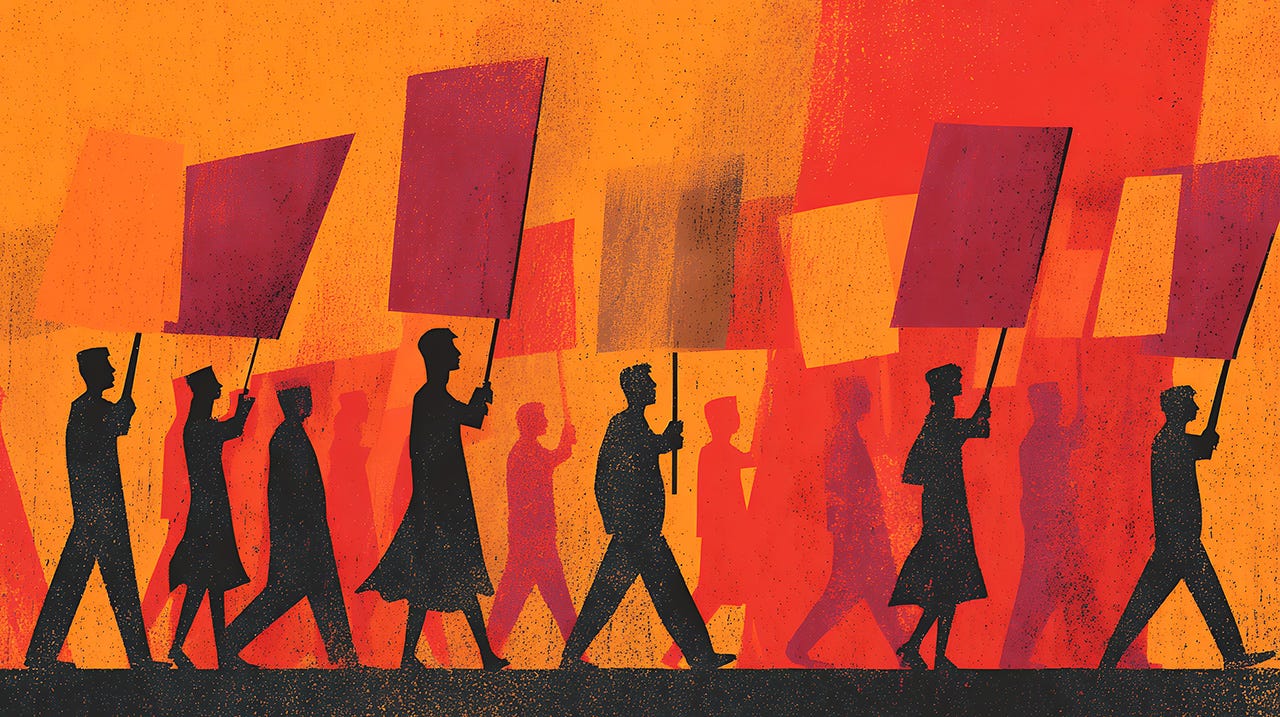
The article discusses the mass demonstrations that followed the media coverage of a meeting of right-wing politicians and activists in Potsdam in November 2023. The media coverage and the subsequent demonstrations started in January 2024 after an article by the NGO Correctiv was released, in which the meeting was labeled a “secret gathering” of politicians allegedly working on a plan to “deport” millions of foreigners. Correctiv, a fact-checking and self-described investigative journalism website, also drew parallels to the Wannsee conference of 1942, where Heydrich and Eichmann organized the Holocaust. Even though most of the report turned out to be false or highly exaggerated, Germany saw some of the largest demonstrations of the last twenty years following its release. The authors describe this as a form of “hyperpolitics” that goes along with the German NGO complex that has its roots in the Schröder years of the SPD–Green coalition government from 1998 to 2005.
The reason why the article is republished at this point is because of the recent events surrounding the 2025 federal election in Germany. Shortly before the election, the current ruling party, the CDU, had voted together with Alternative for Germany (AfD) in favor of a resolution that became known as the “five-point plan.” It called for “immediate, comprehensive measures to end illegal migration, secure Germany’s borders, and consistently deport persons who are required to leave the country, especially criminals and dangerous individuals.” This came in the wake of a wave of attacks and terrorist acts that had shaken the Federal Republic in the days and weeks before, almost all of which were committed by migrants.

The joint vote was interpreted as “cooperation with right-wing extremists” on the part of the CDU, which had allegedly violated the “Brandmauer” (firewall), an informal commitment not to cooperate with the AfD. This was followed by renewed widespread protests within supposed “civil society,” which also took place in front of the CDU party headquarters in Berlin and portrayed the CDU as a facilitator of fascism. The protests were organized by an alliance of NGOs and various associations, some of which are financed in part by the state via the program “Demokratie leben!” (Live Democracy!), which “facilitates projects all over Germany which develop and trial [sic] new ideas and innovative approaches in promoting democracy, shaping diversity and preventing extremism.”1 The attacks against a future governing party, as well as against the biggest opposition party, the AfD, from state-financed circles gave new relevance to the question of the workings and background of the NGO complex in Germany, which will continue to occupy the German debate. In fact, 182 million euros was allocated to the program “Demokratie leben!” in the 2023 fiscal year.2 An increase in funding to 200 million euros was approved by the federal parliament for 2024.3 Against this backdrop, an inquiry by a CDU-CSU parliamentary group in the Bundestag in spring 2024 caused considerable discontent among the protagonists of the projects funded by the program and the surrounding milieu. The group sought detailed information about which NGOs receive state funding through this and similar programs, and how much they receive. Critics accused the CDU-CSU of using the inquiry to intimidate civil society actors for political reasons.
These developments might also be interesting for Telos Insights readers, as the United States is currently tackling problems with its own network of NGOs, some of which likewise receive federal and state grants and contracts. This network might at times even be considered to be an example of “artificial negativity,” as described by Telos founder Paul Piccone. In any case, the complex the authors describe is made up of an activist class that has the means and the will to try and shape public opinion in its favor, in Germany as well as in the United States.
—en arrêt! Berlin
The return of politics came as a shock. At least for those who had proclaimed the end of history and settled into the illusion of post-political times. In 2016, Brexit, Trump, and the rise of the AfD encountered a social class that found it difficult to come to terms with the breach of the supposed consensus of the liberal order. The “basket of deplorables” (Hillary Clinton) revolted, its grievances became vocal, and politics returned: “The eschatological rumor that politics was dead has been disproved. For now, however, it seems as if the patient has jumped out of a coma and landed directly in hyperkinesis without ever having dealt with the previous symptoms.”4 So we have arrived in the age of hyperpolitics: hyper-excited, hyper-fleeting, hyper-erratic. Anti-political revolt on the one side, panic-driven activism on the other. Are these the new class antagonisms?
The diagnosis that “the ‘secret meeting’ in Potsdam is a wake-up call that is rousing many from collective lethargy and passivity”5 roughly sums up what the Cologne-based Rheingold Institute, a market research firm with a psychological bent, found out about the motivation of participants in the anti-right-wing demonstrations in January 2024. The institute’s founder, Stephan Grünewald, is somewhat more precise: “Demonstrators describe how they . . . were shaken out of their lethargy and passive resignation, which they had felt in recent months in the face of multiple crises.” Mood, wake-up call, lethargy: while a market research institute may not be a psychoanalytical association, it has correctly identified a recurring motif in a hyper-political society, namely, the “exhausted self” (Ehrenberg) attempting to break out of its melancholy.
The fact that such statements repeatedly refer to a “wake-up call” should strike not only readers who are attentive to such linguistic nuances. The metaphor of a sleeping majority that is finally being roused to a state of emergency and of politicians who must finally take action against the right wing is part of an inner monologue of self-talk. It is dog-whistling to the subconscious. When the left-wing daily newspaper TAZ in all seriousness expressed its delight over the demonstrators’ belated anti-fascism in the words “Deutschland erwacht” (Germany awakens), this not only revealed the intellectual void of its social media editors, but also clearly demonstrated the dual role of reporting and mobilization. “The only referent which still functions is that of the silent majority,”6 wrote Jean Baudrillard about politics in the late twentieth century. In 2024 Germany, it is not supposed to have a minute’s silence.
A (Not So) Secret Plan
The fabricated scandal surrounding a meeting of right-wing figures and the media campaign that followed is therefore by no means coincidental; rather, it was intended by everyone involved. It is a deliberate self-deception, driven by activism, political calculation, and that very “inner wake-up call.” Even avowed supporters of this campaign readily admit this when they emphasize the significance of the demonstrations in the big election year of 2024. This reveals a tactical understanding of the protests. But let’s start at the beginning.
The scandal is fabricated primarily because it is based on false claims and completely dishonest exaggerations in the media and political discourse. This can now be gleaned in many places, albeit no longer in headlines and hourly updates; it appears instead in marginal notes that are hardly noticed by the public. When the article “Secret Plan against Germany” appeared on January 10, 2024, there was widespread talk of “plans to deport millions of people from Germany” (Correctiv), a “deportation summit” (Der Spiegel), and “deportation fantasies” (Amadeu Antonio Foundation). A week later, the first stage adaptation of the investigation premiered, co-produced with the Berliner Ensemble. This meant that the Potsdam meeting was reenacted on a theater stage, with the decisive advantage for the authors that problematic (i.e., unproven) statements could later be excused as “artistic freedom.” The framing of the secret meeting, at which “AfD politicians, neo-Nazis, and wealthy entrepreneurs” allegedly came together, remained unchanged. The claim that the “deportation of millions of people” had been discussed—and even planned—was later quietly deleted and denied by Correctiv.7 What remains is little more than the AfD’s association with Martin Sellner, whose proposals for “remigration” are by no means secret but have even been published as a book that he himself authored. But by then, the genie was already out of the bottle. The first large demonstrations took place on the weekend after Correctiv’s investigation was published. The question of the truthfulness of Correctiv’s story quickly faded into the background. A recurring theme of the demonstrations was references to 1933 and the equation of the AfD with the Nazi Party. Two weeks later, there was already talk of ongoing mass demonstrations. “Almost everyone knows someone who was at the protests,”8 reported extremism researcher Julia Ebner on the German news program Tagesschau. These were the largest demonstrations in Germany in twenty years. The government, the opposition, and the population acted in solidarity, which must have pleased the increasingly unpopular government representatives above all.
The fascination with the mass demonstrations was immense. As a collective experience, they became an integrative act, reinforced and prolonged by benevolent media coverage. The delusional projection of preventing a “new ’33” through participation illustrates its manic character. This includes the appropriation of the slogan “Never again is now,” which shortly before had served as a call for solidarity with Israel after October 7 and has now been reinterpreted as a “feel-good slogan”9 against the right. Jungle World author Svenna Triebler describes her manic rush in the face of the new sense of unity at the large demonstrations with the metaphor “as if someone had thrown open the windows in an unbearably stuffy room.” She was not the only one who had let the lack of oxygen get to her head. Even those who had previously remained silent on the subject of Israel suddenly found their voices when there was nothing at stake and political protest became risk-free.
Sigmund Freud describes the shift from melancholy to mania as a “liberation.”10 This liberation applies to the object of suffering, in this case the “collective lethargy . . . in the face of multiple crises.”11 “Moreover, the manic individual plainly demonstrates his liberation from the object which was the cause of his suffering, by seeking like a ravenously hungry man for new object-cathexes,”12 Freud continues. This new object, the “sense of unity” of the demonstrations and the attempt to transfer it to the abstract idea of democracy, cannot be permanent. For the next melancholic phase is always on the way. Melancholy and mania, in the Freudian sense, are two interconnected, opposing states that form two sides of the same coin and, in the worst case, repeatedly turn into one another. This “cyclical madness” forms the basis of the new mode of politics, driven by viral panic and a network of increasingly sophisticated apparatuses that fill the void left behind by the mass organizations of the twentieth century.
From Mass Politics to Post-Politics
The political cycle has changed. The end of the end of history is now being proclaimed.13 Anton Jäger, a historian in the service of the new socialist left, has introduced the term “hyperpolitics” to describe the current cycles of outrage that pass for political expression: it is intended to “enable us to understand a form of politics that followed the mass politics of the late nineteenth and early twentieth centuries, the post-politics of the ‘very long’ 1990s and the anti-politics of the 2010s.”14 Jäger distinguishes between four different phases of social politicization, which he links to the degree of institutionalization, i.e., the degree to which those involved in politics are bound to parties, associations, or unions. The starting point for such a genealogy is the age of mass politics, which Jäger dates to between 1848 and 1914. This forms the first phase: people were integrated into political structures, and their everyday lives were largely determined by places and situations of political negotiation and opinion-forming. Parties and trade unions were able to mobilize their members on a regular basis. How they did this can be read not only in diaries and other memoirs but also in contemporary prose. The novel Barrikaden am Wedding (Barricades at Wedding [Wedding is a neighborhood in Berlin.—ed.]), a mixture of communist feel-good literature and milieu study, describes the pub Zur Roten Nachtigall (The Red Nightingale), where local KPD members spent their evenings: “Various communist newspapers and magazines hung neatly on hangers on the walls. Above them were large boards decorated with photographs of the workers’ sports clubs that met here. At the side of the front room was a bar with a glass cabinet for sausages, and behind it a large, mirrored cabinet with beer glasses, schnapps bottles, etc.”15 Whether anyone would want to drink their beer at this place is beside the point. But the novel, which describes the events of the so-called “Blutmai” of 1929 from the perspective of organized communists, refers in this passage to the now-lost “third places” and their relevance for political life in the age of mass politics. In its colloquial rhetoric and revolutionary pathos, it illustrates a way of life in which politics was the starting point for social relationships and consistent ideologies provided the basis for personal action.
Post-politics, on the other hand, indicates a retreat from these structures, along with their possibilities for association and collective action. Jäger links the economic basis for the break with the era of mass politics to the worsening crisis of capital growth that began in the 1970s: increasing surplus value could only be achieved through the intensified exploitation of labor, i.e., by reducing the wage share, which required breaking the power of the unions. In addition, the so-called “Volcker shock” between 1979 and 1981, when key interest rates in the United States were raised from 11 to 20 percent, triggered a massive recession that drove up unemployment and accelerated deindustrialization.16 The end of the organized working class also wrecked Fordism. The shift to a service- and financial market-oriented form of capitalism created the urgently needed avenues for new capital accumulation, which were accompanied by a dual movement of state action. Even though it is true that the welfare state was systematically dismantled, talk of a retreat of the state in the name of neoliberal deregulation is nothing more than a persistent left-wing fantasy that ignores the state’s imperative to take preventive action and its subsidization of civil society. Jäger conveniently ignores this simultaneity. Highly sophisticated NGOs have long been acting as extensions of the state, propagating precise codes of personal conduct in the name of anti-racism or climate change. This paved the way for Correctiv and similar ideological enterprises.
I Just Believe in Parties
This development has been noticeable in the United States since the 1970s and in Germany a little later. Instead of old membership organizations with local branches, organizations such as think tanks, foundations, and other NGOs have moved to the center of the clash of interests, with professionals taking over political work. The academic world has long been tailored to training their future recruits. These employees are drawn from an educational elite that is tied to a specific class and is haunting sociological debate under the term “professional-managerial class.” In the new organizational forms of political work, powerful donors in the United States or, in the case of Germany, the state itself are replacing the financial contributions of traditional organization members. Moreover, the implementation of political measures increasingly falls within the remits of politically active players that have never been elected by the people, such as central banks or the European Commission. The debate between different milieus, in which opinions are formed between antagonistic interest groups, has been increasingly relegated to the media sphere. The culture war blossoms in the logic of the internet.
In the age of post-politics, this class was able to go about its work relatively undisturbed. In the course of this, the “catch-all parties” known in Germany as Volksparteien (people’s parties) “finally transformed in the 1970s into ‘cartel parties,’ for whom access to the levers of state power was more important than competition with ideological opponents, from whom they were becoming less and less distinct and with whom they soon cooperated in various constellations in order, to put it bluntly, to at least keep their jobs in the ministries.”17
The absence of politics in people’s everyday lives has rarely been celebrated as much as in the American TV series Sex and the City, which ran on HBO between 1998 and 2004. The series is about four successful women in New York who talk about their love lives, the hottest restaurants, and other crucial everyday matters. Samantha, who combines self-confident quick-wittedness with an uninhibited zest for pleasure, sums up the prevailing mood of those years when she proclaims: “I don’t believe in the Republican Party or the Democratic Party. I just believe in parties.” The celebration of indulgence, pleasure, and permissiveness, which favors momentary excess over the restraints of abstract justice and the future, has long been viewed with suspicion. In the reboot of the series, titled And Just Like That…, Samantha has disappeared, and instead the protagonist Carrie has a podcast with a “queer, non-binary Mexican-Irish diva,” which programmatically stands in for the contemporary renovation of a series that is now considered “problematic.” Now it’s all about woke instead of Vogue: the post-political generation is entering a new era. The parties are over.
As classic organizations like unions and political parties have been weakened, they have been replaced by organizations that enforce state doctrine and prevailing morals in people’s private lives. After all, what do BLM, QAnon, and the mob that stormed the Capitol have in common? “They don’t keep membership lists, they’re not very permanent, and they have trouble imposing discipline on their followers.”18 In Germany, it should be noted that groups like the Amadeu Antonio Foundation, Campact, and Correctiv, while they do not keep membership lists, do keep payrolls and are designed to be indefinitely funded by the state. Their supporters adhere to the work ethic of true believers who feel they are working for a noble cause.
Jäger interprets this politicization of the liberal class as a reaction to the anti-political movements that celebrated their greatest triumphs in Brexit and the election of Donald Trump. Hyperpolitics is therefore a class-specific term and appears more as an expression of a general mood than a “mode of viral panic typical of the accelerated internet age with its short hype and outrage cycles.”19 The “previously rather passive, post-politically socialized liberal center [reacted] with a kind of reactive shock politicization.”20 The barriers to entry for this shock-driven politics are low: it takes little effort, no membership fees are required, and one can quickly climb or descend the career ladder and exploit one’s activism for personal gain. Consequences exist only in the apocalyptic hallucinations of the hyperpoliticized, who nevertheless do not have to leave their oasis of inconsequentiality.
Volatile Opinions
Hyperpolitics is thus “first and foremost an eminently market-conforming variant of politics, both in form and content. Markets offer exit options and are inherently short-term in nature. Trading algorithms have no concept of the future.”21 Instead, a concept of information born from the logic of financialized capital is prevalent in public debate. As Joseph Vogl writes in his book Capital and Ressentiment, stock market information presents itself as an
indistinguishable conglomerate of genuine news, assumptions, conjectures, rumors, opinions, as well as opinions about opinions, provoking judgments not only about the value of news, but also about how others value news, and thus about how “a reliable judgment about the prevailing currents” of opinion can be formed. On the one hand, stock market trading is therefore no stranger to “science” in order “to arrive at the right conclusion in the face of important news.” . . . On the other hand, such knowledge is plagued by adversities that erase the difference between what is known and what is meant, and that run counter to the logical principles of sufficient reasons and mutually exclusive opposites: in a reversal of the scholastic cessante causa cessat effectus, the “cessation of the cause” does not necessarily mean the “cessation of the effect” on the stock market.22
Once the news is out there, no amount of corrections—such as those made repeatedly by Correctiv, which certainly lived up to its name—can stop it. For even if trading algorithms have no future, the internet has an unfathomable past that continues to haunt us. Thus, people are still talking about “planned mass deportations,” even though the story has long since been exposed as sensationalist scaremongering.
This is because the starting point and the arena for political debate have shifted from the “third places” described by Neukrantz to the filter bubbles of digital communication. Here, every expression of opinion simultaneously produces information that is incorporated into the cycle of capitalist valorization. However, opinion itself is subject to immediate verification in the volatile business of such communication; feedback loops of mutual reinforcement or rejection kick in immediately, as is familiar to everyone who uses social networks. In every judgment, the expected reaction is thus at least partially already factored in: “Marketable opinion is formed according to what the average person thinks the average opinion might be, and the basis of judgments lies in the assumption that a majority of judgments converge in them. Or, to put it another way: what we are dealing with here is an endless game of mirrors with no fixed point of reference.”23
The internet is the antechamber to this form of political debate, in which the marketable concept of information has short-circuited with public debate. Capital has incorporated the act of speech into its process of valorization and thus forced it to comply with its structural laws. For “information is knowledge minus proof and justification, but knowledge itself is subject to the uncertain outcome of verification procedures. The end of justifications can only lie in the renunciation of further justifications. ‘The experts never get to the end of anything,’ as Robert Musil once said.”24 Activists, on the other hand, start from the ending and operate with information that can cause short-term swings in public opinion, which then take an uncertain course. If the mood is right, the German state will foot the bill.
Living and Rewarding Democracy
Since 2015, around 100 million euros in project-related funding has been spent yearly in Germany on NGOs through the “Demokratie leben!” (Live Democracy!) program alone. This is because “democracy thrives on people who get involved on a daily basis and stand up for democratic values. The Federal Ministry for Education, Family Affairs, Senior Citizens, Women and Youth promotes this commitment with the federal program ‘Demokratie leben!’”25 And people who get involved in these organizations on a daily basis make a living off democracy.
The predecessor organizations of “Demokratie leben!” date back to 2001 and were founded in the wake of the “uprising of the decent.” At that time, Chancellor Gerhard Schröder urged non-governmental organizations and courageous citizens to mobilize civil society at the local level against the far right. There was then still a rudimentary form of political division of labor, as the 200,000 rebels at the height of the movement followed the call of a professional politician who politicized the masses in response to current events.
The narrative published by Correctiv ignores this division of labor. Correctiv provided the facts and evidence, together with journalistic commentary and an appeal to the general public. This orchestrated new uprising illustrates the historical shift from post-politics to hyperpolitics, because where just under twenty-four years ago speeches were given and foundations were subsidized to mobilize people in post-political times, Correctiv knew that it could rely on a far-reaching network of numerous initiatives, foundations, projects, and a hyperpolitical population that is easily stirred up by the media and ready for immediate action. Unlike Schröder, Correctiv did not speak into the void of a depoliticized society hoping for a response, but into the dense political and media network of foundations, NGOs, opinion journals, and news formats of which it is itself also a part. When Schröder was still trying to address both his old social democratic base and the post-politically isolated, while having to reactivate or reestablish forms of organization that no longer existed in any meaningful form, he stood at the end of an irrevocably fading era.
But history, as we know, repeats itself as farce. The fact that within a few hours and days the so-called “Correctiv investigation” attained the status of an established truth, and the ensuing protest the status of an edict, would have been impossible without the broad structures of civil society. This highlights the weakness of the liberal concept of hyperpolitics, which distinguishes between good and bad mass mobilization and proclaims the perpetuation of protests as the solution. Jäger proposes mass mobilization as a way out of the predicament, calling for a return to personal engagement and institutional association.26
Clowns and Journalists
From the outset, Correctiv’s self-image has blurred the line between journalism and activism: “We conduct our research free from political and economic dependencies. Our reporters are guided by the common good.”27 The financial contributions to Correctiv show that political and economic independence is not a major priority: in 2023, over half a million euros came from public funds, with the rest (around €4.2 million) coming from private donors and foundations. These are journalists who have never felt particularly comfortable within the confines of mere research. Their understanding of the common good ultimately boils down to identifying “fake news,” for which they themselves determine the relevant criteria. And they draw the line between fake news and possible satire based on their own taste. Their activist stance precedes the first step of research, financed by clients such as Meta, which use automated “detection technologies” to short-circuit the research process in similar cases. The circle of activism and journalism is now complete. This can be seen in biographies like that of Jean Peters, who has been writing for Correctiv since 2022, previously wrote columns, then jokes for television satirist Jan Böhmermann, and once threw a cake in AfD politician Beatrix von Storch’s face while dressed as a clown. He summed it all up on his website as follows: “I used to combine art and journalism for performative actions.”
Philipp Ruch, who has been active since 2009 in the name of “political beauty,” likewise prefaces his books with the following statement: “His works deliberately blur the boundaries between fiction and reality.” But while Ruch has never claimed to have rediscovered this boundary, Peters already speaks in the present perfect tense. Ruch aims to be “a reverse Claas Relotius case for art”28 by delivering reality instead of the fiction that is expected, but he still understands this reality as a “counter-reality” that is tied back to his concept of art. Peters, on the other hand, claims to be committed solely to reality. And yet his constant switching between art, journalism, and political action, which is a sign of stunted abilities in all three areas rather than their ingenious combination, has by no means come to an end with his activism. The research he provides is not simply written down and presented to politicians and society; it is immediately transformed into theatrical plays and educational lessons. Just eight days after Correctiv’s publication, it was staged at the Berliner Ensemble, live streamed and broadcast on RBB. There seems to have been no doubt in the fee-financed programming department whether an artistic adaptation of the article initiated by the authors themselves should be shown uncommented and in full on RBB’s evening program.
In order to bring the thin plot to the theater stage, director Kay Voges resorted to meta-commentary on the events: “The actresses will partly slip into the role of the journalist and try to analyze what is happening. But they will also perform a kind of reenactment and recite texts as they were spoken at the Landhaus Adlon.”29 On the stage of the Berliner Ensemble, this is how it sounds from the mouth of actor Andreas Beck: “I am the stage character Gernot Mörig, and I welcome you once again. What I am about to say here is not what I said word for word, but some terms and expressions have been passed down through memory logs. This is important in order to convey the extent of my fascist language.” In this deliberate confusion of both spheres—journalism that is fictional enough to pass as art; art that is presented seriously enough to pass as journalism—the subsequent ignorance of the participants in the anti-AfD protests about what exactly they are outraged about and why they are on the streets is already present and conveyed. Is it just a meeting in Potsdam, is it a threat of revolution, is it the danger of fascism? The multiple self-corrections made by Correctiv, from “deportation” to “expulsion,” from “Germans with a migrant background” to “people,” etc., find their artistic counterpart in the evening at the Berliner Ensemble in Constanze Becker’s red alarm button, which she presses in the event of statements that are not covered by journalism. When even the “stage characters” are constrained by a further level of commentary, ultimately anything can be claimed. This does not correspond to the ideal of independent art, because the storylines should find their way back into reality. For an independent work of art, the ensemble performance is too clear; the audience is not looking for mysteries, but for the sermon of the day.
The Anti-AfD Complex
A survey conducted by the University of Konstanz30 confirmed what must have been clear to any observer of the demonstrations and the circumstances surrounding their emergence: the uprising was not that of a “silent majority,” but of the green-ideological milieu of those who had been in power and better off for years, both politically and culturally, and who masqueraded as civil society. Even taking the nature of the issue into account, 61 percent of demonstrators who last voted for the Greens and 65 percent who identify as center-left are considerable numbers that do not match their self-description as civil society. The demonstrations were held to preserve a cultural and ideological hegemony that is evident in the deliberate merger of state and society and is expressed not least in the upcoming Democracy Promotion Act, which will finally ensure that civil society agencies no longer function as front organizations of the state, but rather as an extension of the state into society. The very history of the draft law was marked by efforts to strengthen its supporters’ own milieu. Minister for Family Affairs Lisa Paus sees Germany as “primarily threatened and attacked by right-wing extremist groups,”31 but also includes threats “below the threshold of criminal liability,” i.e., everything “that just about falls under freedom of expression.”32 It would seem that there is enough to do above the threshold of criminality, yet Paus finds those who venture below it so annoying that financial subsidies for non-governmental organizations appear almost imperative. The fact that the state is using money to meddle in an area that does not fall within its remit hardly seems to bother the left-wing demonstrators. It is obvious that Paus does not see them as a political threat outside the realm of criminal law, but rather as potential voters.
The Correctiv stunt finally achieved its stated purpose when it was used by the immigration authorities in Potsdam to impose a general ban on entry into Germany on the Austrian Identitarian brawler Martin Sellner. The argument presented was based on the Correctiv story, which was what made him famous in the first place. In the words of the Potsdam authorities in their decision against Sellner: “The so-called secret meeting is proof that your personal presence in the Federal Republic of Germany contributes significantly to introducing and spreading your ideologies in the public discourse.”33 As wrong as Sellner’s understanding of remigration may be, and as much as he may be aiming for a völkisch rather than a Western objective, there is little in the way of actual legal grounds against him. Even Die Zeit admits that “Sellner has not committed any crime.”34 And yet, here, in the aforementioned realm below the threshold of criminal liability, an entry ban and, in the event of noncompliance, deportation have been imposed. Both have since been suspended. The fact that Sellner is not just someone who is politically unwelcome, but that the state-civil society complex is pursuing a right-wing figure who, in a sense, is still pursuing extra-parliamentary politics in the classic sense, is more than just a side note. The message that those who operate outside the designated, state-approved institutions with the appropriate financial resources are finding their room for maneuver increasingly restricted is likely to have been understood. This was never about Sellner alone. The panic-driven activists’ definitions of their enemies are as vague as they are interchangeable. The fact that they are nevertheless becoming influential would be inconceivable without the backing of politicians and the media. It is only in this environment that organizations such as Correctiv can thrive. Germany offers the perfect breeding ground for such developments, and it is pursuing a unique, special path into hyperpolitics. In the words of former Federal Minister Franziska Giffey: “There is no other European country that has a program of this magnitude, with a budget in the hundreds of millions, dedicated to promoting democracy and preventing extremism.”35 Germany prides itself on state-funded efforts to silence unwelcome voices.
Federal Ministry for Family Affairs, Senior Citizens, Women and Youth, “Demokratie leben!,” p. 2, https://www.bmfsfj.de/resource/blob/93488/e2475074ed5761fddd1bfa619e68d123/demokratie-leben-aktiv-gegen-rechtsextremismus-gewalt-und-menschenfeindlichkeit-englische-version-data.pdf.
Deutscher Bundestag, Parlamentsnachrichten, “182 Millionen Euro für das Programm ‘Demokratie leben,’” May 10, 2024, https://www.bundestag.de/presse/hib/kurzmeldungen-1002100.
Vianne Uhl, “200 Millionen für die Demokratieförderung,” mitmischen.de, February 15, 2024, https://www.mitmischen.de/parlament/geld/200-millionen-fuer-die-demokratiefoerderung.
Anton Jäger, Hyperpolitik: Extreme Politisierung ohne politische Folgen (Berlin: Suhrkamp, 2023), p. 119.
Stephan Grünewald, “Zwischen Weckruf und Bumerang—psychologische Wirkungen der Demonstrationen gegen Rechtsextremismus,” Rheingold Institut, January 31, 2024, https://www.rheingold-marktforschung.de/rheingold-studien/psychologische-wirkungen-der-demonstrationen-gegen-rechtsextremismus/.
Jean Baudrillard, In the Shadow of Silent Majorities or, The End of the Social and Other Essays, trans. Paul Foss, Paul Patton, and John Johnston (New York: Semiotext(e), 1983), p. 19.
“Nach kritischer Berichterstattung: Correctiv tilgt heimlich ‘Deportation’ von Homepage,” NIUS, January 29, 2024, https://www.nius.de/nachrichten/news/nach-kritischer-berichterstattung-correctiv-tilgt-heimlich-deportation-von-homepage/04c23bf1-2c08-4cb3-879d-c12a970b25e2.
Julia Ebner, “‘Fast jeder kennt jemanden, der bei Protesten war,’” tagesschau, January 22, 2024, https://www.tagesschau.de/inland/gesellschaft/demonstrationen-radikalisierung-afd-100.html.
“Nie wieder Deutschland! Nie wieder Gaza!,” AG “No Tears for Krauts,” January 27, 2024, http://nokrauts.org/2024/01/nie-wieder-deutschland-nie-wieder-gaza/.
Sigmund Freud, “Mourning and Melancholia,” in The Standard Edition of the Complete Psychological Works of Sigmund Freud, vol. 14 (1914–1916), On the History of the Psycho-Analytic Movement, Papers on Metapsychology and Other Works, ed. James Strachey et al. (London: Hogarth Press, 1957), pp. 237–58.
Grünewald, “Zwischen Weckruf und Bumerang.”
Freud, “Mourning and Melancholia.”
E.g., Alex Hochuli et al., The End of the End of History: Politics in the Twenty-First Century (Winchester: Zer0 Books, 2021).
Jäger, Hyperpolitik, p. 14.
Klaus Neukrantz, Barrikaden am Wedding: Der Roman einer Straße aus den Berliner Maitagen 1929 (Berlin: Manifest Verlag, 2028), p. 31.
Jäger, Hyperpolitik, pp. 70, 71.
Ibid., p. 15.
Ibid., p. 102.
Ibid., p. 100.
Ibid., p. 98.
Ibid., p. 21.
Joseph Vogl, Kapital und Ressentiment (Munich: C. H. Beck, 2021), p. 51.
Ibid., p. 54.
Ibid., p. 59.
Federal Ministry for Education, Family Affairs, Senior Citizens, Women and Youth, “Demokratieförderung, Vielfalt, Extremismusprävention. Bundesprogramm ‘Demokratie leben!,’” March 11, 2025, https://www.bmfsfj.de/bmfsfj/themen/engagement-und-gesellschaft/bundesprogramm-demokratie-leben--73948.
Jäger, Hyperpolitik, p. 111.
“Über uns,” Correctiv, https://correctiv.org/ueber-uns/.
Philipp Ruch, Schluss mit der Geduld: Jeder kann etwas bewirken: Eine Anleitung für kompromisslose Demokraten (Munich: Ludwig Buchverlag, 2019).
Kay Voges, “‘Theater ist der richtige Ort, um eine Schulung in Mündigkeit zu bekommen,’” rbb, January 17, 2024, https://www.rbb24.de/kultur/beitrag/2024/01/interview-regisseur-kay-voges-inszenierung-recherche-correctiv.htm.
University of Konstanz, “Protest der schweigenden Mehrheit?,” March 14, 2024, https://www.uni-konstanz.de/universitaet/aktuelles-und-medien/aktuelle-meldungen/aktuelles/protest-der-schweigenden-mehrheit/.
“Streit um staatliche Förderung: Das Demokratiefördergesetz liegt auf Eis,” deutschlandfunk, March 21, 2024, https://www.deutschlandfunk.de/demokratiefoerdergesetz-100.html.
phoenix, “‘Lauter Hass - leiser Rückzug,‘ Pressekonferenz mit Lisa Paus,” YouTube video, February 2, 2024.
Martin Sellner, “Mein Einreiseverbot: Wichtige Auszüge aus dem Potsdamer Bescheid,” Martin Sellner (Substack), March 22, 2024.
Christian Parth, “Ein Zeichen der Ohnmacht,” Zeit online, March 20, 2024, https://www.zeit.de/politik/deutschland/2024-03/martin-sellner-einreiseverbot-rechtsextremist-auslaenderbehoerde-potsdam.
Claudia van Laak, “Fördermittel für Demokratieinitiativen: Geld ist da, aber Dauerförderung ist verboten,” deutschlandfunk, November 14, 2019, https://www.deutschlandfunk.de/foerdermittel-fuer-demokratie-initiativen-geld-ist-da-aber-100.html.