


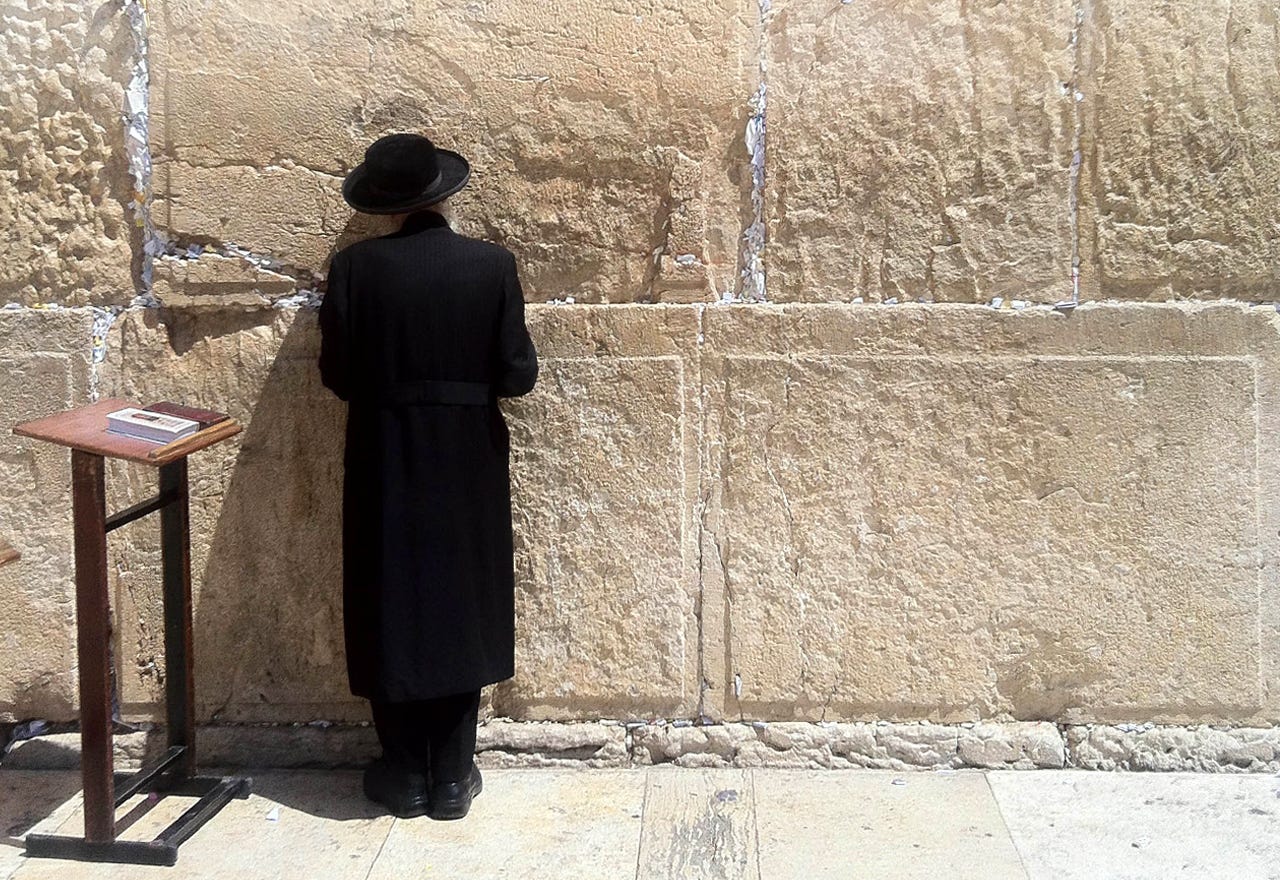
By chance this past January found me working on Leo Strauss’s “What Is Political Philosophy?” while sojourning in Jerusalem.1 It just so happens that it was “in this city, and in this land,” “on this sacred soil” and bearing “what Jerusalem stands for” ever in mind, that some seventy years earlier Strauss had originally delivered this essay as three lectures at the Hebrew University of Jerusalem.2 The cause of my situation was twofold. First, I had spent the first five days of January teaching the essay as part of the University of Austin’s yearly Symposium on Leo Strauss. I was also scheduled to deliver a paper in early February at Notre Dame’s Political Theory Colloquium. For the latter occasion, I had decided to prepare my own commentary on Strauss’s text, to be submitted for review toward the end of the month. So it happened that my January was to be entirely devoted to reading, teaching, interpreting, and writing on Strauss’s piece. The second cause was an invitation from my friend Titus Techera to join a group of academic and media-adjacent people for a study tour of Israel, with a focus on Jewish history and Israeli politics, scheduled for about a week between my return from Austin and the submission of my paper to the colloquium. January thus became overwhelmingly busy. Sensing the urgency of the situation, I hurried to write the paper as quickly as I could while still in Austin, up until the tour began, but my commentary on Strauss quickly ballooned, so that it was looking more and more like I was going to produce a short book rather than a long essay. Restricting myself to Strauss’s first lecture helped somewhat, but it quickly became evident that I would still have to spend some of my time in Jerusalem working on “What Is Political Philosophy?” Such was indeed the case: in the early mornings and late evenings, or while riding around the country by bus, I found the occasional hour to read Strauss, write my notes on his text, read related materials from Spinoza to Swift and beyond, and outline the remaining paragraphs of my essay. So did the world find me.

There was a second connection between the text and my trip, and that was famed Zionist and Israeli national hero Theodor Herzl, whom Strauss mentions briefly but pointedly in the first lecture, but whose name also graced the group that had organized my trip and on whose behalf Mr. Techera had invited me, The Herzl Institute. The Herzl Institute is home to a number of initiatives advancing Jewish thought, education, and history, all with the purpose of meeting “the challenges ahead through a more rigorous engagement with the riches of Hebrew Scripture and rabbinic sources.” The institute’s president is noted Israeli political theorist Yoram Hazony, who through the Edmund Burke Foundation, for which he serves as chairman, organizes the National Conservatism Conference. These activities, along with his books on the State of Israel, nationalism, and conservatism, have earned Dr. Hazony his well-deserved reputation as a prominent voice in the nationalist wing of the global conservative movement. It would be poor manners on my part not to express my gratitude for the great generosity of my hosts and the thoughtful care they put into the program, evident in every aspect of the week’s activities.
The week started with a lecture by Dr. Hazony on the Biblical roots of Israeli nationalism. He focused on two passages in particular, Deuteronomy 30 and Ezekiel 37, both of which attest that the return of the Jews to their land will be both a spiritual and a political affair. The spiritual return is obviously first in importance, if not also to be first in time, which in turn raises questions of great importance, if not of the highest importance, about the religious or spiritual depth and legitimacy of the State of Israel today and in its recent history. I do not here refer to the questions of identity that emerge between the secular left and the religious right in Israel. These questions are rather secondary to the more profound questions that typically arise only at the margins among the orthodox, between the religious right and the anti-Zionists among the Haredim or, as they are typically referred to in the West, “the ultra-Orthodox.” That these questions are asked only at the margins does not make them any less important. That impression is rather a product of the shallowness instilled in us by the modern, liberal state, and the narrow questions it compels us to ask. The deeper question, regarding the character of the return or teshuva, has dogged Zionism since its ascendancy in the late nineteenth century, and it is one with which Strauss, too, wrestled as a young Zionist in Germany.
Strauss recounted his struggle in his late autobiographical “Preface” to the 1965 edition of Spinoza’s Critique of Religion, originally published in 1928, that is, at the end of his Zionist period. Both here and in “What Is Political Philosophy?,” Strauss criticized the “strictly political Zionism” of Herzl and Leon Pinsker for paying insufficient attention to “the foundation, the authoritative layer, of Jewish heritage.” For that foundation does not present itself as purely political, nor even as cultural, and hence as a product of the human mind, but “as a divine gift, as divine revelation.”3 Strauss already saw early on that Herzl’s and Pinsker’s project of political and cultural Zionism presupposed a critique of divine revelation, such as Spinoza had purported to provide. Strauss eventually captured this realization in strikingly poetic language:
Considerations like [these] made one wonder whether an unqualified return to Jewish orthodoxy was not both possible and necessary—was not at the same time the solution to the problem of the Jew lost in the non-Jewish modern world and the only course compatible with sheer consistency or intellectual probity. Vague difficulties remained like small faraway clouds on a beautiful summer sky. They soon took the shape of Spinoza.4
In the wake of this realization, Strauss undertook what Herzl and Pinsker had ignored, and what Hermann Cohen and Franz Rosenzweig had, on his telling, recognized but understood inadequately and thus accomplished only incompletely, namely, a rigorous evaluation of the assumptions underlying Spinoza’s approach to Biblical criticism and a corresponding modification of its results. The insufficiency of political Zionism thus compelled Strauss, as a matter of “intellectual probity” and under the pressures of reason itself, to take seriously the possibility of orthodoxy and therefore the tenability of the apparently naïve belief in miracles and divine revelation.
Strauss alludes to this problem in “What Is Political Philosophy?,” though he is careful only to allude to it and not to state it outright—it was certainly a sensitive issue for his audience in 1954–55, much as it is for their heirs today. He mentions Herzl and Pinsker as examples of political theory, indicating that for the full elaboration of their position one must look beyond them, ultimately to Spinoza’s Tractatus Theologico-Politicus, specifically its third and sixteenth chapters. In the next paragraph, Strauss offers just a definition of political theology, though an admirably succinct one, as “political teachings which are based on divine revelation.”5 A mere glance at Herzl’s Judenstaat or Pinsker’s Auto-Emancipation suffices to reveal the total absence of references to “Hebrew Scripture and rabbinic sources.” Strauss, on the other hand, had opened “What Is Political Philosophy?” with a quote from Isaiah’s prophecy of the return of the Jewish people to their land.6 We do not mean to suggest that Strauss was of all things a political theologian. We mean only to indicate with what seriousness the political philosopher, in contrast with the political theorist, takes the claims of the righteous and the faithful, a seriousness far greater than the political theorist. I must add that, on this account, I am reluctant to call Dr. Hazony a political theorist, at least of Herzl’s or Pinsker’s type. His work in political theory seems instead ministerial to a project that falls more properly under the banner of political theology. Obscuring the situation is the fact that Dr. Hazony has not published his thoughts on the Biblical basis of the State of Israel. I will return to this fact near the end.
Naturally enough, then, did the issue of Herzl’s “secularism” arise during the question-and-answer period following Dr. Hazony’s opening remarks. And naturally, too, did he come prepared with a brief essay of Herzl’s relevant to this question, the “Menorah” of 1897.7 Dr. Hazony read at length, and to evident effect, Herzl’s description of an artist whose experience of unabating and growing antisemitism fills him with such “psychic torment” as to encourage in him a “return to Judaism.” Herzl represents the choice as between secularism and orthodoxy, and in particular an orthodoxy characterized by the conviction that the return to Judaism is “the only one way out of this Jewish suffering.” In the passages cited by Strauss, Spinoza had criticized the Biblical and divine basis of the election of the Jewish people and had supplied instead a natural basis to the modern liberal state, and a quasi-Hobbesian one at that. In the “Menorah,” Herzl evidently accepts, wittingly or not, Spinoza’s proposed natural basis for the modern state and attempts therefrom to envision a sort of return, if not to orthodoxy and to the promised land, at least to the beginnings of religious observance and practice. There is an all-too-obvious problem with his vision, not least in that Herzl roots the spiritual choice to return in the material necessity of physical survival. Herzl therefore has no response to the Haredim who refuse to end the Galut through human means. Or rather his response is too lacking in the sweet and sentimental tone found in “Menorah” to be included therein. The artist’s detractors are by and large secular skeptics, too much under the sway of the Spinozist justification for assimilation; thanks to “the courage of his conviction,” however, he is well-equipped simply to ignore them. Herzl can thus spare his artist the dirty work of addressing secularists and anti-Zionists directly—he instead takes that work upon himself. The most notorious of his addresses is his “Mauschel,” published only a few months earlier and in the same publication. There Herzl engages in what can only be called the character assassination of his opponents, returning again and again to the refrain: “No true Jew can be anti-Zionist.” To be sure, Herzl does attempt to carve out room for genuine criticism or even opposition, yet he is obviously inconsistent on this point. His inconsistencies suggest not a sophisticated or nuanced position so much as a moral discomfort with the unseemly passions his most determined opponents arouse in him. Need we even point out that he is willing to slander not just the apostate Spinoza with the derogatory term “Mauschel” but also those rabbis opposed to his project?
The heart of the matter concerns what state of the soul ought to govern the spiritual return of the Jews, and whether it should occur before or after the political return to the promised land. The latter question is not for me to answer, but the former, in any case, is a question of political psychology. Herzl’s vision—of fear for survival engendering sentimental affection, engendering practice and ritual, which are then deepened and made enduring in the next generations—is lacking in a crucial respect, the philosophic critique of the Enlightenment, more precisely, the philosophic critique of the Enlightenment critique of religion, still more precisely, the philosophic critique of Spinoza. The difficulty appears to be that those most competent to criticize Spinoza, the orthodox, are not inclined to spend much time on him, to say nothing of taking him deadly seriously, while those willing to take him quite seriously are not inclined to be persuaded back to orthodoxy. Something like this difficulty is at play throughout Strauss’s later “Preface” to Spinoza’s Critique of Religion, and it should deepen our appreciation for his rare combination of rigorous critique, on one hand, and openness to old and apparently outdated possibilities, on the other. Strauss aside, we see in this case that religious orthodoxy’s great friend and Enlightenment secularism’s great enemy is political philosophy—in other words, that political theology might find in political philosophy an ally, not to say a handmaid, in its critique of modernity. Orthodoxy of all kinds has proven stubborn to the Enlightenment project, a testament to modernity’s spiritual shortcomings, while political philosophy stands equipped to expose its rational shortcomings, if nothing else. In so doing, political philosophy opens the door to a reacquaintance with the deepest, most powerful longings of the human soul and so makes possible a spiritual return that would otherwise risk remaining unwittingly under the influence of modern ideas. Some such insight seems to me to inform Strauss’s critique of Herzl, whose wavering between the sentimental and the fearful betrays an unorthodox kinship with various trends of modern thought.
Political theology might better be understood, then, as a way of life, rather than as a primarily scholarly or academic pursuit. For it requires a certain diligence not just about how Scripture applies to the general situation a people finds itself in but also about how it inspires the various tasks each undertakes, day to day, week to week, year to year, and over one’s lifetime as a whole. This is what I saw every day as we made our way around Israel. A vintner in the West Bank proudly summarized his chosen way of life by quoting Scripture: “Thou shalt yet plant vines upon the mountains of Samaria” (Jeremiah 3:15). A farmer in the Golan Heights had us meet him beside his fields, and surveying their expanse he spoke of how he, as a modern farmer, diligently met the numerous strictures the Halakha places upon his work. The Torah commands the sacrifice of “a red heifer without spot, wherein is no blemish, and upon which never came yoke” (Numbers 19:2), and in case Israel should one day succeed in building a third temple, there wait near Shiloh, the ancient site of the tabernacle, a few such heifers, sourced from Texas. And I would be remiss to omit how every speaker or guest I encountered would enumerate their children and grandchildren, how many grandparents I met who were in their early 50s, how diligently, in short, all heed the command “Be fruitful, and multiply” (Genesis 1:28). Amid the proceedings Dr. Hazony attended the funeral of his uncle, whose children, grandchildren, and great-grandchildren numbered over a hundred. These examples, and many others besides, attest to how deeply and granularly Scripture and the Halakha pervade the daily existence of many modern Israelis, compelling them to the thoughtful integration of their ancient, prophesied destiny of return into every aspect of their modern lives—these are people convinced that the theological life is worth living. What makes their way of life especially political is the pervasive sense that each is doing his job in contributing to the national task of return and revival—also of defense. This was evident from a discussion of defense technologies by Dr. Yuval Steinitz of Rafael Advanced Defense Systems, all the more from a dinner we shared with some soldiers in the Israeli Defense Forces (IDF). We enjoyed a meal of grilled meats outdoors at their camp; it was a scene that, like many others in Israel, reminded one of Plato’s Republic. But I was reminded, too, of God’s command to Joshua and his troops: “Only be thou strong and very courageous, that thou mayest observe to do according to all the law” (Joshua 1:7).
The case for the secular left in Israel was made for us by Adam Shinar, Associate Professor of Law at the Harry Radzyner Law School at Reichman University. Prof. Shinar gave us his rundown of the controversy concerning proposed reforms to the Israeli Supreme Court; we also heard the opposing view from Simcha Rothman, the Knesset Member who has led the charge for judicial reform. Proposed by the Netanyahu government in January 2023, the reform and the controversy surrounding it are less important to me here than the question both parties admit is at stake in the issue: whether Israeli’s identity as a Jewish state is to take priority over its identity as a liberal democracy, or vice versa. On July 26, 2023, the New York Times published an op-ed penned by Shinar arguing against the proposed reforms, in which he expressed consternation about gender diversity and Palestinian and other minorities.8 Tensions between the left and right boiled over into protests that summer, yet it was all effectively neutralized when, on October 7, 2023, Hamas-led terror attacks initiated a war in Gaza that continues to this day. Hamas likely sought to exploit the existing political tensions in Israel, but much to their surprise—and to the surprise, too, of many Israelis—the attacks brought in their wake a marked uptick in religious sentiment and devotion among Israelis. It is not hard to see why. As they made their way out into the Gaza envelope, the attackers came upon a music festival, where they engaged in the rape, murder, and mutilation of nearly 400 of the young people in attendance. Those targeted were hardly members of the religious right—that’s obvious enough from how they had chosen to spend the holiday sabbath of Simchat Torah. That is, there could be no denial that the attackers did not seek freedom from their oppressors, as the narrative on the left typically goes, but were out for blood, for Jewish blood. Is it any wonder, then, that the secular left in Israel has lost power, to the point of nearly ceasing to exist?
Prof. Shinar is clearly an exception. As of the time of writing, his profile on the social media platform X still features his op-ed pinned to the top of his feed: the events of six weeks later have, it appears, not aroused an appreciable change of heart. In keeping with his liberal priorities, he complained, both during and after his remarks, about not being able to take public transportation on the Sabbath. In a land brimming with religious self-sacrifice, it is laughable to bristle so at such inconveniences. More distasteful, however, was his urgent desire to leave Jerusalem, where he had come to speak with us, and return to Tel Aviv, expressing without reservation and before his orthodox hosts his aversion toward his people’s ancestral home. I bring this up not to accuse him of poor manners but of gross contradiction, that he is at once devoted to his promised land but not to its holiest sites. This is typical, I have been told, of the left-leaning residents of Tel Aviv. I spoke with a young liberal woman while there, and she referred to Jerusalem as “our most violently treasured heap of stone and concrete.” She at least had enough taste for consistency of opinion that she was eager to emigrate to the United States. Had she Shinar’s devotion, or Shinar her consistency, they might have confronted the full weight of their souls’ commitment and asked themselves what sort of life it demands of them. They might have asked themselves, as Strauss had a century earlier, whether a return to orthodoxy is possible, and possible for them, whether their path, in other words, is one of assimilation, of flight, or of return.
Strauss faced a similar and starker version of this question during his emigration from Germany in the 1930s. In an interesting exchange with his old friend Jacob Klein, Strauss articulates with uncharacteristic frankness the extent of his religious devotion:
And even if we were to be huddled into the ghetto once again and thus be compelled to go to the synagogue and to observe the law in its entirety, then this too we would have to do as philosophers, i.e., with a reserve which, if ever so tacit, must for that very reason be all the more determined....[R]evelation and philosophy are at one in their opposition to sophistry, i.e., the whole of modern philosophy.
Chastising Klein for his “conversion to theism” in 1933 amid the Jewish emigration from Germany, Strauss bluntly stated his position: “there is no need to ‘crawl back to the cross,’ I mean, to speak of ‘God.’”9 It is from this ironic and consistent perspective that Strauss embraced Zionism, not from the confused devotion of Shinar, nor from the courageous conviction of Herzl’s artist. What the left in Israel might learn from Strauss is that their pretense of Enlightenment rationality amounts to little more than “sophistry”—they might learn, in other words, the high expectations modern atheism has of reason, in the face of reason’s much more limited powers. Strauss himself would years later speak of a “shipwreck” in his thinking that disrupted the tidy and confident picture he painted in his correspondence with Klein.10 His path from Spinoza led him to Maimonides, Al-Farabi, and the Socratics, while also forcing a deepened confrontation with modernity, in particular with Machiavelli, as articulating the alternative to the Socratic orientation by fundamental problems.11 Strauss thus placed an incredible onus on would-be atheists and secularists, a great burden of proof to earn their conclusions rather than follow them blindly as unquestioned convictions. Whatever one thinks of Strauss’s work on the problem of reason and revelation, however misguided one might find his inquiries, one cannot deny that he proves by his example, positively or negatively, the need to take orthodoxy seriously.
Shinar is in a way emblematic of the problem Strauss identifies in Herzl’s vision. The return that fear engenders risks being misinterpreted under the rubric of Spinozistic self-defense, according to which the alternatives of return or assimilation are a matter of practical judgment rather than prophetic vision and divine providence. Strauss summarized the consequences of Herzl’s position as follows:
Political Zionism, then, strictly understood was the movement of an elite on behalf of a community constituted by common descent and common degradation, for the restoration of their honor through the acquisition of statehood and therefore of a country—of any country: the land which the strictly political Zionism promised to the Jews was not necessarily the land of Israel.12
Strauss refers here to Herzl’s proposal of establishing a Jewish state in Uganda, an effort, I have been told, that still affects his reputation today, particularly among the Haredim. Why “in this land” and “on this sacred soil,” if not because it was promised to you by your God and His prophets? And if that promise still moves you and binds your soul, why not also His law, without your adherence to which His promise must needs remain unfulfilled? Dr. Hazony’s wife, Yael Hazony, told the story of traveling to Israel to stay with her future husband’s uncle and aunt. She recalled fondly how Dr. Hazony’s aunt one day looked out onto the land and said, “Isn’t it beautiful?” The future Mrs. Hazony then responded, “But it’s just a bunch of rocks.” “Yes, but they’re Jewish rocks,” she replied with evident gratitude and joy. Could a religious sentiment so admirably fond and grateful in its devotion to rocky soil ever arise in the souls of those who dismiss Jerusalem itself as a “heap of stone and concrete”?
I’ll conclude by returning to the subject of Dr. Hazony’s opening lecture, the Biblical roots of the State of Israel. Much of Dr. Hazony’s work involves a noble and quite successful effort to build and strengthen the often-faltering bridges between Israel and her Western allies, against the twin, and increasingly linked, threats of the secular left and radical Islam. His work on nationalism in particular has identified a deep kinship between the Biblical story of God’s chosen people, His nation, and those on the right across the West who wish to restore to their nation a healthy confidence in their common descent. On Dr. Hazony’s account, the American formula “one Nation under God” gives voice to a national and religious devotion that is Biblical in origin and global in significance.13 It is a striking feature of the nationalist movement that it is international in reach. The same could not be said of the German nationalists a century earlier. No doubt it is the postwar international liberal order’s indefatigable erosion of our particular devotions and commitments that has produced a global backlash. Dr. Hazony has the good sense to see that the events of the Second World War have tamed considerably the wilder passions of yesteryear’s nationalists. But my travels in Israel made me wish to hear him expound at greater length upon something everywhere evident but that he has not yet articulated sufficiently, namely, the political theology of the modern State of Israel. Dr. Hazony strikes me as better positioned than anyone else to offer an account, in terms of Scripture itself and with great theoretical clarity, of how the State of Israel today might fulfill its prophesied destiny, God’s ancient promise of return, on one hand, while remaining a modern, technological nation-state, if not also a liberal democracy, on the other. When I asked Dr. Hazony at the end of the week whether he has written on the Biblical foundations of the State of Israel, he said that he has not. I would be grateful for such reflections from his pen, and I trust the same is true also of his fellow Israelis.
Postscript on War
Another word is called for on Israel as a modern, technological state. October 7th had the spiritual effect described above, as well as the political effect of galvanization around the defense of Israel. Dr. Steinitz told the story of the Twelve-Day War between Israel and Iran, an engagement that was almost entirely technological in character. He told likewise of the incredible advances in military technology, namely, their Iron Beam laser defense system and Trophy active tank defense system. These terrifying wonders, awesome in their capabilities, are absolutely essential to the survival and success of the modern State of Israel, surrounded as she is on every side by her enemies—seven against Israel, as it were. It is therefore a matter of the highest existential importance that she settle the question of how an ancient religion can also be a modern technological state. Spinoza refers to the welfare of an imperium as the “highest law.”14 That the Halakah allows one to suspend strict obedience for the sake of national security and survival suggests some agreement between the Bible and modern philosophy when it comes to war. But there is also reason to suspect great disagreement. The classics, Strauss argued, “demanded the strict moral-political supervision of inventions,” that is, of technology. Thus,
the good and wise city will determine which inventions are to be made use of and which are to be suppressed. Yet they were forced to make one crucial exception. They had to admit the necessity of encouraging inventions pertaining to the art of war. They had to bow to the necessity of defense or of resistance....They had to admit in other words that in an important respect the good city has to take its bearings by the practice of bad cities or that the bad impose their law on the good.15
But today, when these necessities bear upon us with untold weight, is it still possible for Israel to retain its ancient conviction? What today provokes greater fear, reverence, or awe? Scripture or Leviathan?
I end with a Biblical example, the story of Naboth and Jezebel, a favorite of Strauss’s.16 Asked by King Ahab for his vineyards, the obedient Naboth refuses, as God has forbidden him to give away his ancestral inheritance (1 Kings 21:1–3). Ahab thwarted, Jezebel comes to his aid by falsely accusing Naboth of cursing both God and king, the result of which is Naboth’s death by stoning (vv. 9–14). Naboth does eventually receive justice with the ascent of Jehu, but his vengeance turns out to be shockingly morally suspect, not least in his following God’s Machiavellian advice, or rather command, to “eliminate the blood line of the prince” (see 2 Kings 9:6–8 and Machiavelli, The Prince, ch. 4). Jehu’s other morally suspect actions in this chapter include conspiracy (vv. 2, 14), deceit (vv. 11–12), inciting sedition (vv. 18–19), and killing a fleeing man from behind (vv. 23–24). We might excuse these actions as necessary to justice, or as matters of political necessity, but this is only to affirm the difficulty that it is not those without blame, like Naboth, who ensure justice perseveres, but those who recognize the necessity of morally suspect acts to righting the wrongs of this world. It is ultimately Jehu who stands up to the line of Ahab on Naboth’s soil (vv. 21, 24–25). Naboth may be blameless, but righteousness so pure makes one the victim of conspiracies and plots; it is rather Jehu’s willingness to plot, like Jezebel, but in service of God and his prophet Elisha, in service of God’s plan, that gives him, and not Naboth, the right to rule. But however much Jehu’s plotting, especially his elimination of Ahab’s line, may be in service of the Lord, it also makes his house deserving of divine punishment (see Hosea 1:4–5). Jehu’s line is punished for the very act that God’s prophet had commanded him to perform. The forbidden is necessary, the Bible concedes, but also necessarily punished. To which Machiavelli might well reply, “This point is deserving of notice and of being imitated by others.”
Topics: Israel Initiative
Alex Priou is Professor of Political Philosophy at the University of Austin and Roubos Sabbatical Scholar at the Benson Center for the Study of Western Civilization at the University of Colorado Boulder. He is the author of three books on Plato, most recently Musings on Plato's Symposium, as well as numerous articles on ancient Greek philosophy and poetry and the history of political philosophy. He writes regularly at The Close Read on Substack.
These remarks haven been written in the style of a reflective diarist upon the invitation and suggestion of Prof. Gabriel Ben-Zion Abramovich of the Telos-Paul Piccone Institute. I am grateful to Robert Berman, Ronna Burger, and Yiftach Ofek for their helpful comments on an earlier draft of this piece.
Leo Strauss, What Is Political Philosophy? And Other Studies (Glencoe, IL: Free Press, 1959), pp. 9–10, 5.
Leo Strauss, Spinoza’s Critique of Religion (New York: Schocken Books, 1965), p. 6.
Ibid., p. 15.
Strauss, What Is Political Philosophy?, p. 13.
Isaiah 1:26, quoted in ibid., p. 9. Strauss also comments on this passage in “Progress or Return?,” in Leo Strauss, Jewish Philosophy and the Crisis of Modernity, ed. Kenneth Hart Green (Albany: State Univ. of New York Press, 1997), pp. 87–88. See also Leo Strauss, The City and Man (Chicago: Rand McNally, 1964), p. 1.
This piece is available on the website of the Herzl Institute at https://herzlinstitute.org/en/theodor-herzl/the-menorah/.
Adam Shinar, “In Israel, the Worst May Be Yet to Come,” New York Times, July 26, 2023. The worst did come, but not as Prof. Shinar had anticipated.
Both quotes are from David Janssens, “Back to the Roots: The Correspondence between Leo Strauss and Jacob Klein,” Philosophical Readings 9, no. 1 (2017): 26.
See Joshua Parens, Leo Strauss and the Recovery of Medieval Political Philosophy (Rochester, NY: Univ. of Rochester Press, 2016), pp. 5, 108.
Compare, for example, Strauss’s Natural Right and History (Chicago: Univ. of Chicago Press, 1965), p. 32, with his Thoughts on Machiavelli (Glencoe, IL: Free Press, 1958), p. 14.
Strauss, Spinoza’s Critique of Religion, pp. 4–5.
See Yoram Hazony, The Virtue of Nationalism, 2nd ed. (New York: Basic Liberty, 2025), pp. 16–20.
Spinoza, Tractatus Theologico-Politicus, 16.7.8.
Leo Strauss, Thoughts on Machiavelli (Chicago: Univ. of Chicago Press, 1958), pp. 298–99 (emphasis added).
The opening verses of the story are quoted as the second epigraph to Natural Right and History. Strauss also uses it in his critique of positivism in “What Is Political Philosophy?”