


This essay first appeared in Die Welt on November 28, 2025, and is translated here by permission of the author. Translation and notes by Russell A. Berman.
The self-proclaimed angels of peace are now on the right—as the debate surrounding the war in Ukraine demonstrates. But if the West truly submits to Putin’s aggression, then the open society will have failed.
For decades, pacifism was primarily a left-wing project. The Green Party was largely founded on pacifist principles. The hippie movement during the Vietnam War propagated the idea just as passionately as the anti-nuclear power movement and the Easter marches.1 And from the first international peace congress in 1848 to Bertha von Suttner’s2 pacifist novel manifesto Lay Down Your Arms! (1889) to the platform of the Left Party, it was always primarily communists, socialists, or social democrats who embraced this seemingly attractive idea.
For some time now, however, pacifism seems to have switched sides.
While the German Greens have become some of the most ardent hawks, doves are suddenly appearing, especially in the conservative or far-right camps. Increasingly, one hears from the American or Hungarian governments, other right-wing populist parties in Europe, and not least the AfD, statements that one would have more readily attributed to John Lennon, Heinrich Böll, or Rudi Dutschke.3

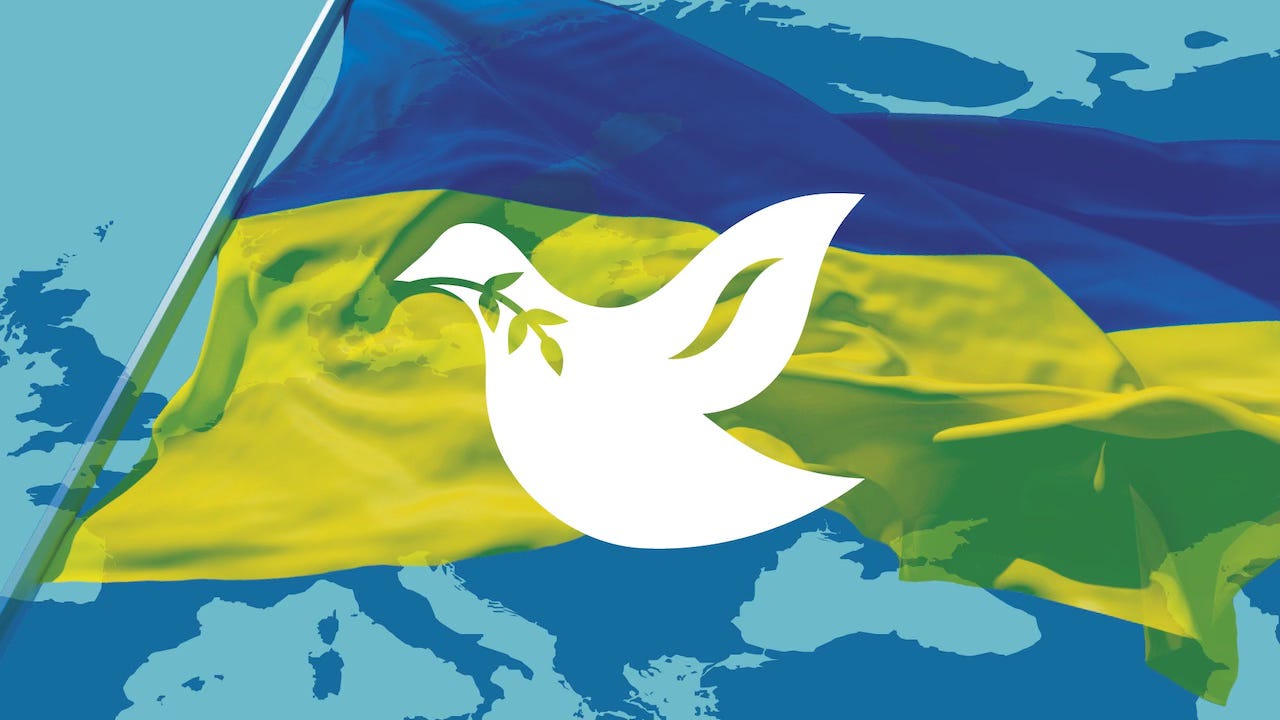
Björn Höcke has so far embodied the spearhead of pacifist rhetoric.4 Shortly after the start of the war of aggression, he spoke out against arms deliveries to Ukraine, arguing that such deliveries would only prolong the war. In his anti-war campaign, Höcke even invoked the 1970s motto of the peace movement, “Create peace without weapons,” and published an image featuring the symbol of the peace dove.
This is as surprising as it is dangerous. For in the guise of the peace dove, Höcke and his ilk are merely praising the right of the stronger. If there is one idea that has proven particularly unrealistic and false over the course of a century and a half, it is the notion that wars can be prevented or ended by renouncing armaments, weapons, and military strength.
“The dying must stop.”
Of course, every reasonably sensible person is against war as a means of politics. Almost everyone finds peace preferable to violence and prefers diplomacy to military conflict. The problem is that wars are always started by the few who see things differently: autocrats, dictators, or psychopaths. These are generally not deterred by peace doves, but only by military strength and deterrence. Or, if it’s too late, only slowed down by military intervention.
Therefore, in light of the war in Ukraine, it is surprising and disturbing to hear the phrase “the dying must stop” with increasing frequency. Of course, the dying on the battlefields in the heart of Europe must stop. And it would stop immediately if Vladimir Putin withdrew his troops. The dying should never have begun. But what this pious phrase unfortunately usually implies comes tacitly afterward: A war against Russia cannot be won anyway, Ukraine has no chance, and an escalation, let alone the possibility of a nuclear strike, must not be risked under any circumstances. Therefore, it would be better to hand over Crimea, the Donbas, and other occupied territories to Putin, as proposed in the 28-point plan supported by the United States. But that is not peace; it is capitulation.
What underlies the rhetoric of the new right-wing vulgar pacifism is not a yearning for peace, but for submission. Perhaps even subconsciously—frustrated by the unbearable slowness of democratic processes and compromises—a secret longing for the strong fist of the autocrat. Or simply fear.
The utopian vision of these self-proclaimed peacemakers has a dangerous side effect, disguised as economic pragmatism: To save the German people from the consequences of disastrous green climate policies, it is now essential to finally resume importing gas and oil from Russia. Only in this way, they claim, can German energy prices fall.
However, firstly: Germany is already circumventing the Russia sanctions—in Schwedt, a refinery is operating that, after coordination with the Americans, refines Kazakh oil from Russian pipelines, because otherwise the Berlin-Brandenburg region, including the airport, would be paralyzed.
And secondly: this thinking is akin to feeding the crocodile in the hope that it will eat you last. Sixteen years of government under Angela Merkel created an unnecessary dependence on Russian energy (and thus on Russian arbitrariness) through an irresponsible phase-out of nuclear power and an even more irresponsible import strategy from Russia: After Germany withdrew from nuclear power, the share of Russian gas imports increased from 36 percent in 2011 to 65 percent in 2020. This policy financed and empowered the very Putin whom the democratic world must now confront. It is therefore tasteless that the AfD has been demanding, for years in its party platform and most recently again in the major Bundestag debate, a return to increased Russian gas and oil exports. It is submission to an autocratic regime. It is the trivialization of a dictator and his war crimes. And it is yet another reason why the AfD must never assume governmental responsibility in Germany.
Of course, one can submit to an aggressor who kills people to occupy land that doesn’t belong to him, driven by short-term, opportunistic interests. One can also submit to the Iranian mullahs and their henchmen, Hamas, Hezbollah, and others, because it’s too exhausting to support the imperfect democracy in Israel with all means—including military ones—in the fight against terror. One can also submit to the Chinese, their clever and highly strategic trade wars against America and Europe, and their ruthless ambition to one day annex democratic Taiwan. One can do all this in the name of pragmatism and, more recently, in the name of pacifism (“the dying must stop”). But one must know the price.
The Idea of the West
The price is an open society. The price is democracy. Freedom. Freedom of expression. Freedom of lifestyles. In short, what we—not in a geographical sense—call the idea of the West. Nothing less is at stake in defending against Russian aggression in Europe and Islamism in the Middle East.
The statement that the war against Putin cannot be won is false. NATO, and even more so the so-called Ramstein Coalition, that alliance of 50 democratic states supporting Ukraine, is vastly superior to Russia, both financially and militarily.5 If this coalition had drawn clear lines at the beginning of the war, through maximum military support, Putin would never have gotten this far, and millions of lives could have been saved. Now the price is higher. But it is not too late. If we fail, Ukraine is only the beginning. Moscow will understand the encouragement.
The aggression against the open society can be ended. It simply requires the will to do so. However, with Europe’s currently weak, divided, and impotent stance, this cannot succeed.
Natan Sharansky, the Russian dissident who survived nearly ten years in the Soviet Gulag before becoming Israel’s deputy prime minister after his liberation, once surprised me with a remark.6 I was initially outraged, then unsettled, and finally convinced. He quoted the pacifist anthem, the beloved and celebrated line from John Lennon’s song “Imagine,” in which he envisions a different world: “Imagine . . . there is nothing to die for.”
Sharansky added: “What a nightmare.”
Matthias Döpfner is the CEO of Axel Springer SE.
The Easter marches in West Germany began in the late 1950s as pacifist demonstrations focusing on a range of topics: opposition to nuclear weapons, appeals for detente, protests against the Vietnam War, and, during the 1980s, against the stationing of the Cruise and Pershing missiles. These multiday marches over Easter weekend typically combined Christian with left-wing framings.
Nobel Peace Prize winner of 1905.
The AfD, the Alternative for Germany, is the far-right party and currently the largest opposition party in the Bundestag. Heinrich Böll (1917–1985) was a prominent postwar German author and winner of the 1972 Nobel Prize for Literature. Rudi Dutschke (1940–1979) was the iconic leader of the West German student movement of the 1960s.
Björn Höcke (born 1972) is a prominent AfD politician, viewed as a representative of the hard-right within the party.
The Ramstein Coalition first convened on April 26, 2022, at the Ramstein Air Base in Germany. The group coordinates aid, especially military aid, for Ukraine. It is not a formal alliance.
Natan Sharanksy, born 1948 in the Soviet Union, one of the most famous Jewish dissidents, was imprisoned from 1977 to 1986, much of that time in solitary confinement. Upon release he moved to Israel, where he served in multiple cabinet level roles, including deputy prime minister from 2001 to 2003. He is the author of The Case for Democracy (2004).