

Impotent Emperor and Imperialism: Notes on the Concept of Empire from Joseon, Qing, and Manchukuo
by Anthony Petros Spanakos

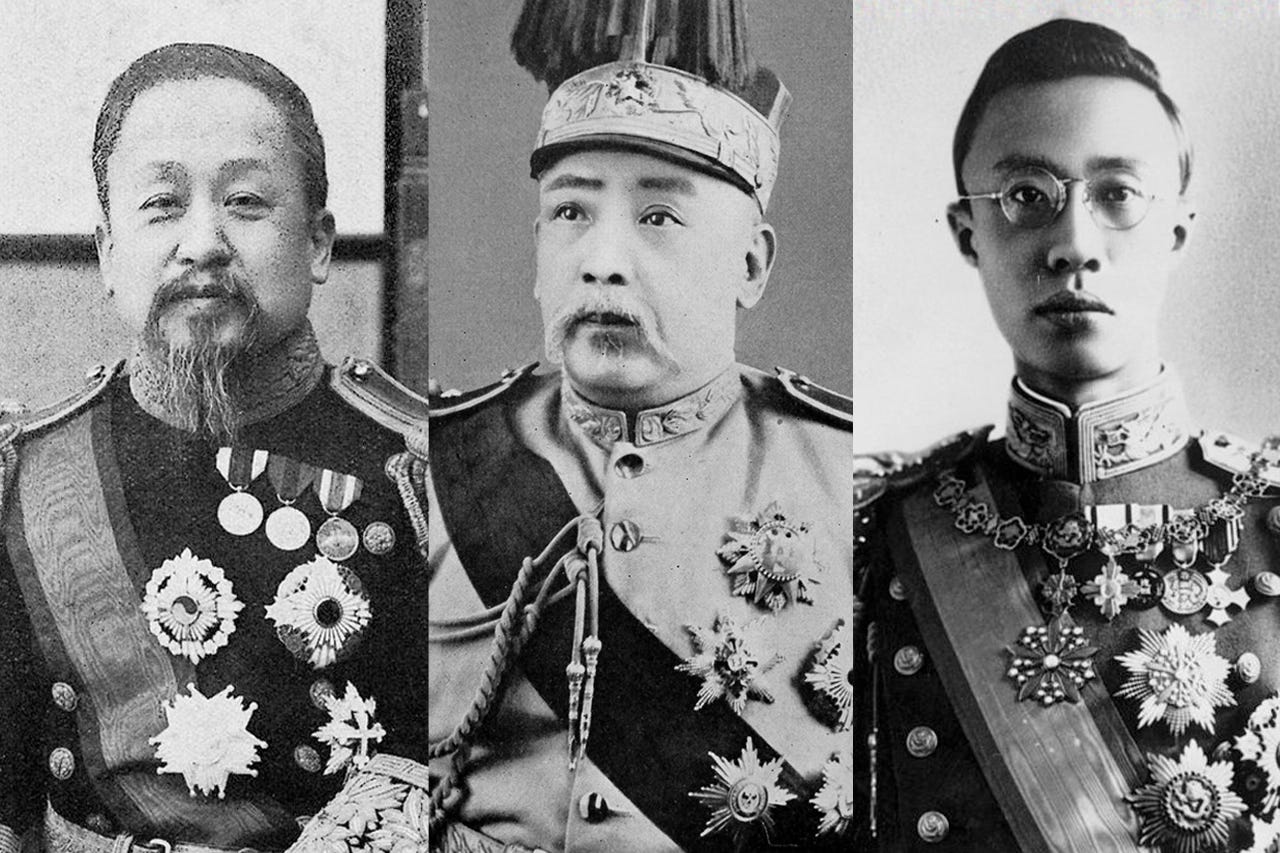


_-_Manchukuo_uniform.jpg)
Many of us were taught in graduate school to oppose, if not hate, the U.S. empire and to mock Reagan administration comments about the Soviet Union being an “evil empire.” Odd since both governments, at times, in rhetoric and practice, opposed and engaged in empire and imperialism. When Hardt and Negri’s Empire1 was published, there were many who felt that we finally understood empire. The publication of Niall Ferguson’s Empire2 offered a revisionist account of the term and its legacy.
Each of these was an attempt to make sense of a sort of extended rule from one polity into another, relying on the cognate terms imperialist, imperial, and empire. Like cognate terms from a foreign language, the similar etymological roots often belie complicated, if not different, meanings. Namely, imperialism generally refers to expansionist projects of sea- and land-based great powers in the long nineteenth century, if not later, that go beyond typical efforts to extend immediate territorial borders and diplomacy of balance of powers. Empire is normally understood as a type of polity that organizes a large territory within which a considerable diversity of people lives under a single ruler, though with high degrees of variation in status, rights, and legal categories. Scholars from different traditions have seen the nineteenth century as one in which either nationalism or imperialism arose, partially for the reason that empire and nation seem so very different. What recent scholarship has highlighted is what nation and imperialism are not. So then what?

It is interesting that discussions of empire and imperialism make little mention of emperors. They are often largely structuralist, whether Marxist, mercantilist, or geostrategic. We could not imagine a discussion of democracy without a demos, even if the claim is that the demos does not truly rule. But discussions of empire and imperialism feel no such compunction, even though an emperor is a necessary condition for empire and the term imperial makes reference to the emperor directly or indirectly. The removal of the emperor in such discussions may be more or less intentional, may represent an effort to move away from Great Man historiography, may be a relic of structuralist approaches to understanding power, or may be a convenience for commentators of different partisan stripes. There are still other possibilities, but I leave those to the imagination of the patient reader.
The talk I gave at the March Telos conference aimed to discuss four emperors and three empires that normally get little attention. The point of the investigation is not only to draw attention to cases of empire and imperialism that fall outside the typically studied set, and thereby to highlight the diversity and complexity of the concept of empire. It is also to make the claim that scholarly use of the term imperial/ist is misleading, and scholars should either conceive of a word with a clearer connection to the phenomena in question or be more forthcoming about the range of meanings in the word. Thus, scholars should be a bit careful before describing the U.S.-led military intervention in Afghanistan or Russian and Iranian support for the recently fallen Assad regime in Syria as “imperial adventures.” Similarly, this study may facilitate an understanding of Chinese efforts to reimagine imperial history as an alternative to Westphalian models.
Introduction
What are normally translated as “empire” (帝國, diguo) and “imperialism” (帝国主义, diguo zhuyi) are the subject of considerable debate among scholars. These debates make problematic earlier readings of the relationship between modernity and pre-modernity, nation-state and empire, and colonialism and imperialism along lines familiar to scholars of the social sciences and conceptual history.3 Much in these debates rests on the negative ethical connotation associated with empire, especially as a response to Nazi and Japanese imperialism,4 although the Sino-scholar-sphere has witnessed very different trends. Recently, there have been many efforts to see normative value in Chinese empires and to treat those empires as something very different.5 Indeed, the Qing Dynasty was not called an “empire” in Chinese until the 1895 Treaty of Shimonoseki.6 Diguo, at that moment, did not recognize the traditional Sinocentric order but was used to elevate Qing to the same status as the victorious Great Japanese Empire (dai Nippon Teikoku, 大日本帝國). But as Qing became an empire, the very first article of the treaty dealt a blow to its imperial status by terminating Choseon’s (Korea) tributary relationship with it. Thus, Qing was legally recognized as an empire by the Japanese empire when it released its claims of suzerainty over the monarch in Korea, who two years later declared itself an empire.
The same year as the Treaty of Shimonoseki, Japanese and Korean assassins, assisted by the father of Korean King Gojong, murdered the king’s wife, Queen Min. The king fled and took up lodging for nearly a year in the Russian legation. With considerable pressure from the populace, especially pro-independence politicians and civil groups, he returned to the palace and, in 1897, proclaimed the Great Han (Korean) Empire (대한제국, daehanjeguk, 大韓帝國). But the same Japanese empire that compelled Qing to recognize Korean sovereignty also forced a protectorate treaty on the newly independent country (1905) and then Gojong’s abdication (1907) to his son, Sunjong. The new emperor bore a title that was more confusing given the 1910 annexation of Korea.
In 1934, Manchukuo, which proclaimed its statehood two years earlier, was declared an empire (大滿洲帝國), with Aisin-Giro Henry Puyi, the former Qing emperor, as its emperor. This was his third time on a throne, having been twice on the throne in China (1908–12, 1917) with the establishment of the Republic in-between as well as the equally short-lived imperial rule of Yuan Shikai (1915–16). Yuan’s brief rule as emperor and Puyi’s twelve days in 1917 in China began with hope, among some at least, that the newly crowned emperor would be able to reverse the descent into disorder and rally the people together behind a government symbolized by a ruler in a traditional seat of authority. By the time Puyi became emperor of Machukuo, two years after it proclaimed its independence, it was clear that the emperor would have very little meaningful governing power, though like Yuan and Gojong, Puyi seemed to believe that the imperial title and throne would provide resources that could be used to resist the tide of political events.
These emperors hardly seem to be members of the same conceptual category as Yoshihito (Emperor Taishō, 1912–26), Tsar Alexander III (1881–94), Napoleon III (1852–70), Franz Joseph (1848–1916), the Qianlong Emperor (1736–96), and Sejong the Great (1397–1450). Similarly, when scholars and public intellectuals speak of empire, they generally mean that of the Nazis, the Japanese, or the United States. They do not imagine the Brazilian, the First or Second Mexican, or the Austro-Hungarian empires of the nineteenth century. Why not?
This essay aims to understand some of the diverse and shifting meanings of diguo (帝國, teikoku, 제국) in Northeastern Asia during the late nineteenth to mid-twentieth centuries by avoiding the streetlight effect that dominates discussions of empire and imperialism. That is, like the drunkard and the police officer who look for the former’s keys under the streetlight because “that is where the light is,”7 scholars seeking to understand empire and imperialism look at the great and terrible empires8 and give short shrift to others.9 In the unusual spaces, the darkness, of Choseon under increasing Japanese domination, Manchukuo, which was largely an extension of the Japanese imperial project, and early Republican China, this paper profiles emperors who were not imperial conquerors. Rather than seeking to expand, to match some concept of Lebensraum, these emperors sought to prevent the collapse of their governments and countries, and often to preserve their lives. Their power, status, and authority were tenuous and constantly undermined by political actors, both domestic and international.
This is rather important since empire and imperialism both assume an emperor (皇帝, tennō, 황제). An emperor need not be the most powerful actor in an empire or imperialist project, but the emperor must be, in some way, central to its normative self-understanding. So what could that have been for Emperors Gojong, Puyi, and Yuan? Or rather, do these emperors show that imperialism is far less about empire than about the propensity of polities with capabilities, opportunities, and specific visions to expand territorial control? If so, that may explain the relative ease in applying the term imperialist to emperor-less regimes that espouse anti-imperial rhetoric, such as the Soviet Union or the United States. Rethinking the role of the emperor in imperialism—and the appropriateness of the latter term—is helpful, as scholarship increasingly questions the assumption that the empire and the nation-state are diametrically opposed forms. The two are different, though both have shown a propensity to expand, contract, collapse, and reemerge.
Why Study Meaning?
Scholars have typically given close readings to the words and concepts used in discourse, high and low, and in intellectual and cultural canons. This is especially the case in modernity where there is a greater sense that history is not only something to be studied but something determined by a set of ideas, values, and tools that are themselves historically embedded.10 Carl Schmitt examined liberalism and dictatorship11 as polemical concepts that found meaning in opposing an alternative and then developed through historical (re)interpretations in intellectual work and political action. Dalmacio Negro Pavón followed suit in his study of the “statist mode of thought.”12
Similarly, not concerned with simple definitions or even etymological origins, Raymond Williams13 contributed to understanding the lexicon of the present. He assumed that relying on a definition would be insufficient to understand the meaning of the “class conflict” referenced in a newspaper article, how that was different from “partisan disagreements,” or even the taunting between football fans. This is because, as Reinhart Koselleck wrote, concepts have “historical depth.” Their elucidation contributes to public discourse not only by fostering a more careful discussion but by highlighting the ways in which concepts can contain multiple (ambiguous and/or contradictory) meanings that may change over time.14
The bulk of Begriffsgeschichte (conceptual history) was developed in the heart of the West,15 in Germany (Schmitt, Koselleck) and England (Williams, Skinner, Pocock), and focused on ideas that had their greatest impact and utility in understanding the modern Western world. In recent decades, building on the methodological and epistemological approaches of the above, admittedly a diverse group, scholarship has come to reimagine key conceptsby applying them more directly to moments tangential or foreign to the modern West. Given the rise of East Asia, especially China—whether understood as a space for geopolitical competition, a center of rapid economic growth and industrialization, or the core of a new transpacific world being shaped out of a transatlantic one—it is not surprising that concepts and words that are part of the critical vocabulary of East Asia and that contribute to its response and conversation with the West have received more attention.16 Noteworthy in this critical reevaluation and global dialogue is Eric Hendricks’s Telos-Paul Piccone Institute webinar series on “China Keywords.” The series of podcasts makes an important contribution by articulating concepts internal to China and Sinocentric East Asian history, as well as highlighting how such concepts may differ from Western alternatives and cognates.17
Empire and Emperor
Empire has come in for considerable (re)revision in recent years. The traditional separation of empire and nation as opposing forces, with the nineteenth century being the era of nationalism, has been displaced by a more realistic reconsideration, which insists that at the time of the Great War, if not until the end of World War II, the world was one of empires.18 If anything, the growth of the nation and empire seem very connected, although the ideal versions of each remain quite distinct.19 Leigh K. Jenco and Jonathan Chappell have argued that empire is something that is “co-produced” through intersecting histories and global interaction, which allows them to suggest that empire did not end with decolonization.20 But that assumes that empire is a mode of political and economic organization that does not need an emperor. Zheng Yongnian argued that the Chinese Communist Party in contemporary politics is an “organizational emperor,” and Hardt and Negri explained empire through a complex post-nation-state web that has elements of monarchy (the US, G7, IMF, NATO), oligarchy (multinational corporations), and democracy (UN, NGOs).21
Is empire the correct term for the above? For Frederick Cooper empire and imperialism are quite different,22 and Hardt and Negri clearly are thinking of the latter. Empire, after all, has been around for millennia and betrays a remarkable amount of diversity, while imperialism references more specific extractive and exploitive processes over a relatively short time horizon. Daniel Hedinger and Moritz von Brescius helpfully suggest that much of the explicit and implicit assumptions of imperialism—its form, its morality—are impacted by the disproportionate role of twentieth-century Nazi and Japanese imperialism.23 Others highlight American empire to emphasize immoral extensions of late capitalism.24
But is imperialism something that (only) empires do? Or, if it is, perhaps imperialism needs to be reexamined. In 1877, Queen Victoria was given the title “Empress of India” by the Disraeli government. The greatest sea power belatedly bestowed the title already held by the Kaisers (emperor, caesar) of Germany and the Austro-Hungarian Empire, half a century after Iturbide in Mexico and Pedro in Brazil. In 1905, when Emperor Gojong protested the Japan-Korea Treaty, which placed the Great Han Empire under Japanese control, he addressed letters of protest to presidents, kings, and emperors (President Fallières of France, Emperor Nicholas II of Russia, Emperor Franz Joseph of Austria and King of Hungary, Emperor Guangxu of China, Emperor Wilhelm II of Germany, King Edward VII of the United Kingdom, King Victor Emmanuel III of Italy, and King Leopold II of Belgium). One would be hard pressed to know from the title of the head of state or the name given to the regime whether it was involved, and to what degree, in “imperialism.” Moreover, his complaint might seem odd: an empire making a complaint about imperialist behavior to imperialists, even if the perpetrator was a rival imperial power.
The cases examined in this paper are interesting because they are not moments when an empire or the role of the emperor were diminished. Rather, they represent moments of imperial founding, where the role of the emperor was shaped rather than inherited. Although the reasons to elevate a king to emperor or to move from republic to empire might be identical to efforts to restore the role of a (fading) emperor, there is an important difference. In the cases under scrutiny here, there was a deliberate effort to call attention to a sort of regime change that was believed to have public and international impact. This may have been done in a situation of desperation, but that in no way detracts from the fact that the word “emperor” and its cognate “empire” were seen to give rhetorical and symbolic assistance to a broader process of international and domestic recognition, a reorganization of domestic politics, and a greater autonomy in international politics. In many ways Gojong, Puyi, and Yuan Shikai failed, but the idea that this strategy could be pursued in 1897 by Gojong in Korea and then in 1915 and 1917 by Yuan and Puyi in China, and again in 1934 by Puyi in Manchukuo attests to the enduring meaning of emperor and empire as status norms. Importantly, Yuan and Puyi were well-acquainted with the forlorn fate of Gojong and his sire. So why put “new clothes” on the polity? I will address this further in an forthcoming issue of Telos.25
Topics: China Initiative
Anthony Petros Spanakos is Professor of Political Science and Law at Montclair State University. He has been a Fulbright Scholar (2002 Brazil, 2008 Venezuela) and visiting researcher at the East Asia Institute (Singapore 2009, 2017). He is co-editor of Reforming Brazil (Lexington), Conceptualising Comparative Politics (Routledge), and “The Legacy of Hugo Chavez,” a special issue of Latin American Perspectives. His work examines questions in the areas of democratization, the use of concepts, international relations, and political theory, giving particular attention to Latin America, East Asia, and U.S. relations with these regions.
Michael Hardt and Antonio Negri, Empire (Cambridge, MA: Harvard Univ. Press, 2001).
Niall Ferguson, Empire: The Rise and Demise of the British World Order and the Lessons for Global Power (New York: Basic Books, 2002).
Wang Hui, China from Empire to Nation-State, trans. Michael Gibbs Hill (Cambridge, MA: Harvard Univ.Press, 2014); Leigh K. Jenco and Jonathan Chappell, “Overlapping Histories, Co-produced Concepts: Imperialism in Chinese Eyes,” Journal of Asian Studies 79, no. 3 (2020): 685–706; Helge Jordheim and Iver B. Neumann, “Empire, Imperialism and Conceptual History,” Journal of International Relations and Development 14, no. 2 (2011): 153–85.
Daniel Hedinger and Moritz von Brescius, “The German and Japanese Empires: Great Power Competition and the World Wars in Trans-Imperial Perspective,” in The Oxford World History of Empire, vol. 2, The History of Empires, ed. Peter Fibiger Bang, C.A. Bayly, and Walter Scheidel (New York: Oxford University Press, 2021).
Youngest Baik, “Implications of Chinese Empire Discourses in East Asia: Critical Studies on China,” Inter-Asia Cultural Studies 16, no. 2 (2015): 206–26.
Jenco and Chappell, “Overlapping Histories, Co-produced Concepts,” p. 693.
David H. Freedman, Wrong: Why Experts Keep Feeling Us (New York: Little, Brown, and Company, 2010).
Hedinger and von Brescius, “The German and Japanese Empires.”
This selection bias is unusual given the scholarly proclivity for exceptional cases and revisionism.
Reinhard Koselleck, Sediments of Time: On Possible Histories, trans. and ed. Sean Franzel and Stefan-Ludwig Hoffman (Stanford, CA: Stanford Univ. Press, 2018); Kari Palonen, “Four Times of Politics: Policy, Polity, Politicking, and Politicization,” Alternatives: Global, Local, Political 28, no. 2 (2003): 171–86.
Carl Schmitt, The Crisis of Parliamentary Democracy, trans. Ellen Kennedy (Cambridge, MA: The MIT Press, 1985); Carl Schmitt, Dictatorship: From the Origin of the Modern Concept of Sovereignty to Proletarian Class Struggle, trans. Michael Hoelzl and Graham Ward (Malden, MA: Polity, 2013).
Dalmacio Negro Pavón, Historia de la formas del estado (Madrid: El Buey Mudo, 2010).
Raymond Williams, Keywords: A Vocabulary of Culture and Society (New York: Oxford Univ. Press, 2014).
Reinhart Koselleck, Futures Past: On the Semantics of Historical Time, trans. Keith Tribe (New York: Columbia Univ. Press, 2004), p. 91.
The term “the West” is surely imprecise, however much it has a “you know what I am talking about character.” Here it refers to a broad civilization that developed over centuries, having much of its origins in continual reinterpretations of ancient Greek, Roman, and Christian legacies, reinterpretations that were colored by historic movements of peoples, theological and ecclesiological schisms and dialogues, reorganizations of the form of polities, wars and the development of inter-polity relations, industrialization, the development of modern financial organizations, maritime exploration, colonialism, and imperialism.
Yu Hua, China in Ten Words: Essays, trans. Allan H. Barr (New York: Pantheon Books, 2010).
The term “Sinocentric” is not meant in a normative sense. Rather, it is a recognition of the centrality of the Chinese empire as a shared and influential space, often a source, for intellectual, political, religious, cultural, and economic discussions in East Asia. For more on Eric Hendricks’s podcast series, see here.
Dominic Lieven, Empire: The Russian Empire and Its Rivals (New Haven, CT: Yale Univ. Press, 2001).
Jurgen Osterhammel, The Transformation of the World: A Global History of the Nineteenth Century, trans. Patrick Camiller (Princeton, NJ: Princeton Univ. Press, 2015).
Jenco and Chappell, “Overlapping Histories, Co-produced Concepts.”
Yongnian Zheng, The Chinese Communist Party as Organizational Emperor: Culture, Reproduction, and Transformation (London: Routledge, 2009); Hardt and Negri, Empire. Zheng’s claim echoes Gramsci’s reading of the party as modern prince. See Antonio Gramsci, Prison Notebooks, vols. 1–3, ed. and trans. Joseph A. Buttigieg with Antonio Callari (New York: Columbia Univ. Press, 1992).
Frederick Cooper, “Empire Multiplied, A Review Essay,” Comparative Studies in Society and History 46, no. 2 (2004): 247–72.
Hedinger and von Brescius, “The German and Japanese Empires.”
Greg Grandin is noteworthy here, though there is a long tradition of such in Marxist literature, even among conservative readers. See Greg Grandin, Empire’s Workshop: Latin America, the United States, and the Making of an Imperial Republic (New York: Picador, 2021); and Ferguson, Empire.
The author is grateful to Eric Hendricks and Mark S. Weiner for comments and for inclusion in this dialogue, Mishi Romo and David Clinton who gave comments early on, Jonathan Corrado and Chelsie Alexandre for discussions about Korean history and foreign policy, and Robert Richardson for his patience in publication.