


Introduction
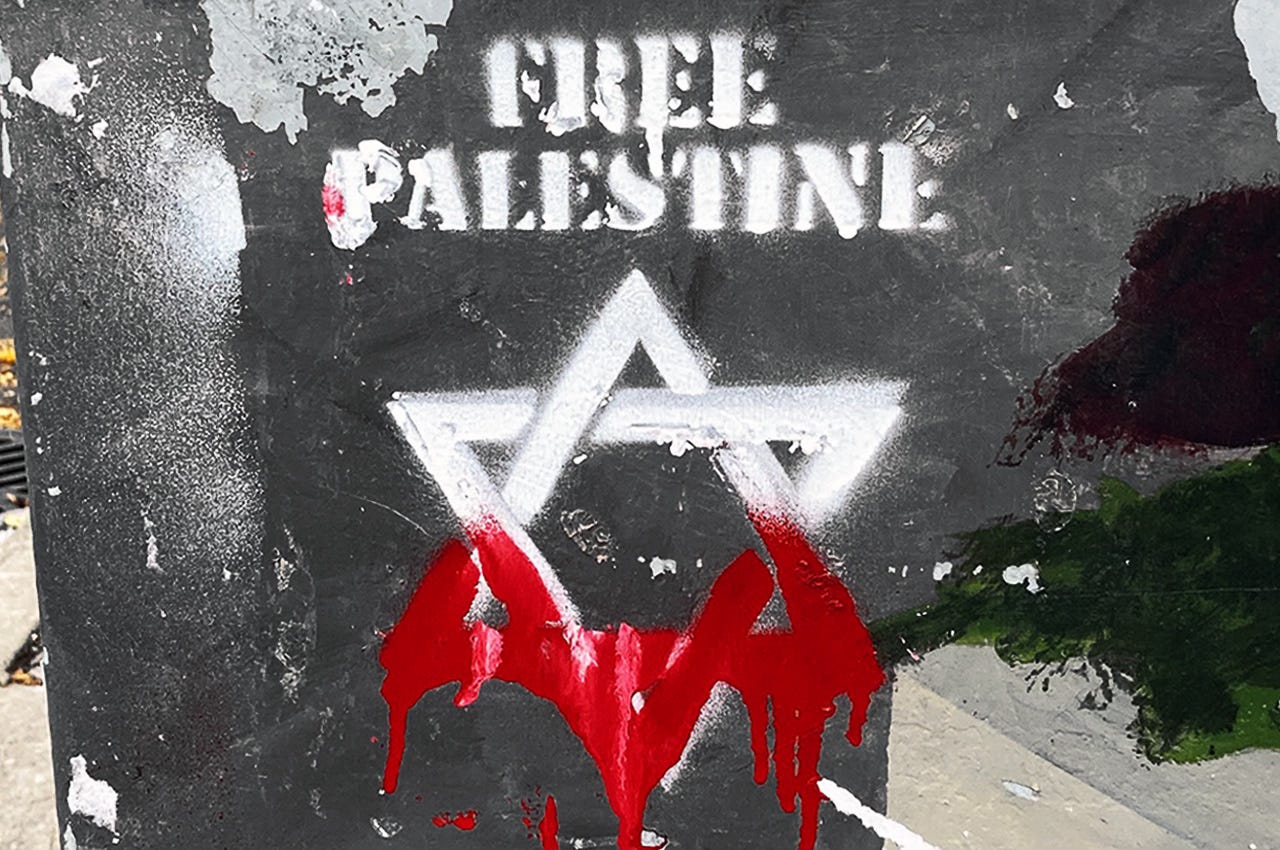
The “Free Palestine” movement and its fellow travelers seem to have issued a contemporary Western world smitten by “moral exhibitionism” a license to kill Jews.1 Indeed, when in the midst of a brutal war a claim gets made that one party, Israel, is committing a genocide of the Palestinian people—even as making such a determination and its converse are often tendentious, emotive in the fog of battle2—the result is nothing short of a death warrant that makes the murder of Jews morally licit, refurbishing (Nazi Germany-style) the kind of medieval blood libels that in the twentieth century brought about the Holocaust and the destruction of European Jewry.
“Why did the Holocaust take place?” asked rhetorically a Palestinian Fatah official on Egyptian television in February 2024.3 Exuding the kind of classic antisemitic prejudice so charming in its untaintedness, his answer was as predictable as it was simple: “Why? Because Jews and World Zionism were planning the takeover of Germany, and they had begun decaying [the place] economically . . . which instigated Hitler’s reaction.”4 So in this mindset, Hitler was an average guy simply reacting to an insidious Jewish cabal, and in that sense he was as justified in mass-murdering unarmed Jews as were Hamas’s “razzia pogromists”5 of October 7, 2023.

This article examines some of the cultural and intellectual bearings that lend legitimacy to this kind of thinking, and to the “Free Palestine” phenomenon in particular, which advances hoaxes and stereotypes that feed a modern, restituted, “righteous” form of antisemitism. Exploring these sorts of temperaments by examining historical and journalistic chronicles, political texts, and Palestinianist historiography and popular attitudes, this article also reflects on a Western world’s post-October 7 cultural, intellectual, and academic preoccupations—the “Global North’s” modern challenges, as it were, an area that has become the breeding ground of an acceptable, non-controversial antisemitism, in many quarters validating a righteous “right to kill Jews.” Using the phrase “Global North” in the meaning given it by Gilles Kepel, the West seems to have been assigned to a space painted as irremediably colonialist, racist, and slave-holding, a West that is an eternally guilty practitioner of apartheid and other ills of human history. It is a “Global North” that is summoned to self-recriminate, self-hate, and self-abnegate, and that must be replaced by a rising—once subjugated but now liberated—beatific “Global South” that ostensibly never colonized and never brutalized, and which is otherwise a carrier of noble human values and humanistic truths that the West ought to espouse.6
Moral Exhibitionism and the Right to Kill Jews
In a climate of intellectual nihilism and hemiplegic morality of this sort, which presumes that colonialism is an exclusively Western (Judeo-Christian) ill, holding Islam (the other colonialism) blameless, the “Free Palestine” current has germinated and emerged triumphant, coming to dominate prominent contemporary Western public, media, and intellectual spheres, particularly university campuses. “Our higher education system is severely battered,” wrote Gabriel Noah Brahm in his inaugural text introducing a new Telos series focused on higher education.7 In his telling, universities have become places where “[o]pen support for the violently anti-Jewish, misogynist, homophobic Hamas terrorist organization . . . is one sure sign that long-standing problems, rooted in both curriculum and administrative policy, have reached a turning point.”8 Incidentally, little significant campus agitation has been noted in the Middle East proper, or in the Muslim world, where one would have expected to see more virulent anti-Israel and pro-Palestinian sympathies on display. Thus, the “Free Palestine” movement seems to have remained at its core a Western “liberal” phenomenon that continues to gain followers, command influence, and captivate growing audiences who at times are all too willing to translate arguably justified support for a Palestinian cause into calls for the “destruction of the American empire,” the “eradica[tion of] America as we know it,” and “the total collapse of the university structure and American empire itself”9—all of this correlating with violent antisemitic attacks no less unbridled in their malignancy than the October 7 pogroms themselves.
In the United States alone, the Anti-Defamation League estimated that antisemitic acts increased by more than 350 percent barely three months after October 7, 2023.10 In the three months preceding this writing, the consequences of this unrestrained anti-Jewish rage have translated into criminal deeds no longer daunted by their criminality—indeed, proud of the crimes’ “Free Palestine” impulses. These incidents include the Passover 2025 arson of Pennsylvania governor Josh Shapiro’s residence, with “the people of Palestine” reportedly uppermost in the perpetrator’s mind; a June 2025 firebombing of Jewish demonstrators in Boulder, Colorado, with the attacker allegedly shouting “Free Palestine” as he threw incendiary devices at peaceful marchers; and finally, the May 2025 murder of two Israeli embassy staffers in Washington, DC, with the perpetrator, again, allegedly doing the deed “for Free Palestine.” Indeed, “Free Palestine” seems to have morphed into a fashionable “vigilante league,” affiliated with multifaceted “intersectional”11 Global South movements, ostensibly righteous benevolent beatific “Davids” facing cruel “colonialist, racist, Islamophobic” Global North “Goliaths,”12 seeking the liberation of the Palestinian people from Israeli occupation and the establishment of a Palestinian state, all by means of intimidating, harassing, terrorizing, and, when the opportunity affords itself, murdering Jews.
Yet, at its core, “Free Palestine” remains “Palestinianist”13 rather than “Palestinian” per se, international in its scope, anti-Jewish (not to say outright antisemitic) in its sentiments, and a throwback to Soviet-style “national liberation movements” aiming for destruction rather than building—in this case, the destruction of the world’s sole Jewish state on the debris of which a Palestinian democracy would emerge.14 Indeed, the former Soviet Union is believed to have molded what became “the ideological, diplomatic and military backbone” of the Palestine Liberation Organization of yore—for all intents and purposes, a precursor and lodestar of today’s “Free Palestine” movement. The ultimate aim, as articulated in the 1968 PLO Charter and revisited in a 1980 Fatah political platform, is
[t]he liberation of Palestine, a full and complete liberation; the annihilation of the Zionist entity in all of its economic, political, military and cultural manifestations . . . and the establishment of an independent democratic Palestine which would rule the entire land of Palestine.15
Following the 1993 Oslo Agreement, which had committed both Palestinians and Israelis to an “end of conflict” phase, paving the way to eventually putting in place a “two-state solution,” the Palestinian National Council voted in 1996 to nullify the PLO Charter’s clauses calling for the “dismantlement of the Zionist entity.” Yet it remains unclear whether the language in question was amended or removed, given that a two-thirds-majority vote was required to approve an amendment, and that based on the April 1996 voting results, it does not appear that this two-thirds threshold was reached.16 Nevertheless, the impulse of Palestinians and friends to do away with the State of Israel seems to have remained, and as October 7 and its aftermath indicate, the “Free Palestine” movement appears to be carrying the PLO’s old mantle. As Bret Stephens noted in an April 2024 New York Times opinion piece, the “Free Palestine” movement makes no bones about its
calls to get rid of the Jewish state in its entirety (“from the river to the sea . . . ”), its open celebration of the murder of [the Jewish state’s] people (“resistance is justified . . . ”) and its efforts to mock, minimize or deny the suffering of Israelis, which so quickly descend into the antisemitism on naked display.17
In other words, at play is an uninhibited unapologetic antisemitism that depicts Jews as colonizing usurpers of Arab lands, latter-day Nazis committing a genocide of the Palestinian people while feigning victimhood—“false victimhood” being a classic antisemitic trope of the devious Jew, who is otherwise always a manipulator, never a victim. This skilled semantic and factual perversion, turning the Jewish narrative on its head, morphing the liberated, redeemed, post-Shoah Jew into an executioner, was predicted in 1967 (the year is not accidental) by French Philosopher Vladimir Jankélévitch (1903–1985), who prophesied a coming “anti-Zionism” as a polite, righteous form of antisemitism—an unbelievable boon to the antisemites of yore. The antisemitism of the future will call itself anti-Zionism, wrote Jankélévitch in 1967:
it will grant us permission—indeed it will give us the right, nay the duty—to be antisemites, in the name of democracy. Simply put, anti-Zionism is antisemitism justified, democratized, made accessible, free for all. Anti-Zionism is a license to become democratically antisemitic. And should we, in the process, become able to paint the Jews themselves as Nazis, what a wonderful thing that would be!18
Thus, the “Free Palestine” slogans prevalent on Western university campuses and dominating the public arena and social media platforms appear to be in this spirit of Jankélévitch’s ominous 1960s prediction. Indeed, “Free Palestine” votaries and fellow travelers seem to be bequeathing a modern world smitten by what Céline Pina termed “moral exhibitionism,” a free license to “murder Jews.”19 Pina notes that when unencumbered by knowledge, when freed of the reckoning of history, when discharged of the responsibility and meaning that words carry, one can claim unrestrainedly that
Jews are committing a genocide, even as there are no genocides being perpetrated. In this way, one would in effect be issuing a license rendering the murder of Jews licit . . . especially in a world of ostentations, histrionics, and pretense, where “moral exhibitionism” replaces morality. When in the Middle Ages Jews were depicted as Christ-killers, when the uncouth of times bygone are convinced that Jews murder Christian children to collect the ritual blood required in the preparation of Passover matza, the killing of those Jewish child-killers becomes a virtue. It is precisely those blood libels of times past that got rehabilitated by Nazis, justifying their twentieth-century industrial-grade mass-murder of Jews.20
Thus, a new, troubling historical and semantic manipulation is being introduced into the political and cultural narratives dealing with Israel and the Jews, one that renders the Islamist aggressor as the victim, justifying his anti-Jewish hostility—in other words his antisemitism—with putative Jewish “crimes against humanity.”21 This in effect becomes a “mitigating diversion,” writes Jean Szlamowicz, one that spawns a new kind of morality rendering Jew-hatred and the vilification of the Jew not only acceptable but indeed righteous.22 Yet this is an ancient “scam” given a new lease on life, a scam that seeks to paint the Jew as a diabolical destructive beast, and in turn justify dispossessing him of his ancestral history and memory in the ancestral land of his birth. In this way Jews get tarnished,
banished from their lands; they get persecuted since Roman times; they get subsequently conquered and subjugated by Umayyad, Abbasid, Seljuk, Crusader, and Ottoman occupations; they get further harassed and attacked since 1948. . . . Yet it is they, the Jews, who are the accursed, accused of occupation, an accusation tantamount to a revisionist expropriation of Jewish history.23
That is how speaking about the Hamas–Israel war—indeed discussing the Arab–Israeli conflict as a whole and in any context—gets mired in what Georges Bensoussan termed “the emotional plague,” a fickle sentiment opening the floodgates of passion, disregarding logic, reason, and fact.24 Reading history through the prism of the “emotional plague,” notes Bensoussan, makes one indifferent to sober, evidence-based historical inquiry, privileging feelings over fact and prejudice over judiciousness.25 That is how 500,000 dead in Syria’s brutal war, the persecution of Muslim Uighurs in China, and the Muslim Rohingya in Burma fail to generate passions, riots, protests, and university campus unrest similar to those provoked by the Hamas–Israel war since October 2023.26
The deaths of Muslims and Arabs around the world seem to be of little to no interest unless Jews are involved. In other words, it matters little who the victim may be. It matters more that the victimizer—or perceived victimizer—be a Jew, or better yet, a perp (or perceived perp) assumed to be a member of the dominant white heterosexual colonial Christian patriarchal phallocentric order, of which the Jews, and Israel, are naturally prime representatives. As Brahm notes, a new righteousness is being deployed whereby the Jews are not only “‘white’ (a term used on campus to mean ‘structurally racist’) but ‘hyper-white’ (the whitest, therefore most racist of all).”27
In sum, “remove the Jew from this brew,” the moral exhibitionists seem to be suggesting, “and watch order return to world disorder.” Those are almost verbatim the words that Palestinian national poet Mahmoud Darwish (1941–2008) relayed to a Jewish interlocutor in a landmark 1997 interview. Speaking with Israeli poet Helit Yeshurun, Darwish famously asked her:
Do you know why us Palestinians are so widely known around the world? Because you [the Jews] are our adversaries. The interest in the Palestinian question is a function of the world’s interest in the Jewish question. Yes. The world’s main interest is you, not me! Had we been at war with Pakistan, no one would have ever heard of me.28
To this axiom is added the prevalent belief, an “emotional plague,” that Israel is an illegitimate Western colonial creation,29 that indigeneity in the Near and Middle East belongs exclusively to Arabs and Muslims, and that a putative Arab Muslim invasion, colonization, and occupation of a supposedly pre-Islamic Near and Middle East is somehow a manipulation of historical facts, a travesty of the reality that the Near and Middle East had always been Arab and Muslim.30
Lebanese-American essayist and statistician Nassim Nicholas Taleb, who since October 7, 2023, appears to have moved away from his earlier indictments of what he once termed “bigoteering,” seems to have put his finger on some of the earlier iterations of the “scam” that Pena, Szlamowicz, and Bensoussan have in turn likened to “moral exhibitionism” and “emotional plague.” In an online essay titled “Pedophrasty, Bigoteering, and Other Modern Scams,” Taleb defined “bigoteering” as the impulse to tar
someone (or someone’s opinions) as “racist,” “chauvinist” or somethinglikeit-ist in situations where these [accusations] are not warranted. This is a shoddy manipulation to exploit the stigmas accompanying such labels and force the opponent to spent [sic] time and energy explaining “why he/she is not a bigot.”31
In this same vein, Taleb defined “pedophrasty” as an
argument involving children to prop up a rationalization and make the opponent look like an asshole, as people are defenseless and suspend all skepticism in front of suffering children: nobody has the heart to question the authenticity or source of the reporting. Often done with the aid of pictures. . . . Pedophrasty has its most effects on actors, journalists and similar types who are intellectually insecure, deprived of critical judgment, and afraid of being classified as violators of some norm of political correctness.32
But as Taleb suggested in 2018, the damage has been done. Blood libels involving children are difficult to wash away. And although very easily debunked in a rational world, we seem to have long since exited that world. Indeed, writes French philosopher Michel Onfray, “we have officially entered the post-truth era,” an emotive irrational kind of learnedness “where there are no truths except the one that says ‘there are no truths.’”33 Conversely, we have inaugurated a universe where all that matters is staking claims, taking positions, digging in one’s heels, shouting down opponents, muzzling them, canceling them, “hating on them” (to use a Woke-chic turn of phrase), and assaulting them, because what matters in our post-reason universe is not facts that our opponents may be adducing but the fact that we don’t like the facts they are adducing.34 Therefore, claiming Israel is resurrecting medieval Jewish blood rituals (the kind of canard that led to the Holocaust and the destruction of European Jewry) seems like a “neat trick.” It is also an image not easily erased in a modern age consumed by “mood swings” and “social media clicks.” Bigoteering and pedophrasty thus become effective forms of “moral exhibitionism” possessed of a remarkable staying power, auguring frightening consequences.
Conclusion: Moral, Semantic, Factual Confusion
An adage attributed to seventeenth-century French prelate and statesman Cardinal de Richelieu (1585–1642) suggests that politics is the art of making the necessary, or rather the desirable, possible. In the case of the Hamas–Israel conflict, alea jacta est! The die is cast! The desire, in some quarters the necessity, of stigmatizing the Jew as a Christ-killer—and all else that issues from that stereotype, e.g., the Jew as murderer of Palestinian children, bloodthirsty genocidal colonizer, usurper of Arab lands, etc.—has been made possible. Never mind that the historical consensus recognizes Christ as a Jewish rabbi who lived among and preached to Jews in Roman Judea, not Palestine;35 in his modern (“Free Palestine”) incarnation, Jesus remains an ancestor and symbol of Palestinian Arabs, his self-sacrifice an iteration of the Palestinian struggle.
But this proceeds from an old, proud historical—or rather mythological—pedigree: a denialist Palestinianism sitting on Islamist foundations,36 aiming to expropriate, in order to deny, Jewish historicity. In 1983, addressing an adoring press corps at the UN in Geneva, Yasser Arafat proudly noted:
We [the Palestinians] were under Roman imperialism. We sent a Palestinian fisherman, called St. Peter, to Rome; he not only occupied Rome, but also won the hearts of the people. We know how to resist imperialism and occupation. Jesus Christ was the first Palestinian fedayeen who carried his sword along the path on which the Palestinians today carry their cross.37
Thus, in 1983 and since, not only would Jesus be dispossessed of his Jewishness, without so much as a whimpering pushback from those who otherwise ought to “know better,” but the “Free Palestine” movement in more recent times would follow suit—and then some. Some may recall the iconography of early iterations of campus unrest across American and European universities, namely, anti-Israel demonstrations coinciding with the 2023 Christmas season, brandishing placards depicting in turn a baby Jesus, alongside a crucified image of him with the grieving Madonna at his feet, both clad in some representation of Arafat’s trademark keffiyeh. This imagery would be further enhanced with not so subtle antisemitic and anti-Israel slogans, often written in Fraktur font reminiscent of Nazi iconography.38 Thus, the long—arguably three-millennia-long—history of antisemitism, with its impressive linguistic and semantic foundations, would find new fertile ground in the enlightened West, in the Western academy no less, mere days following October 7, 2023. In this long history, there have been ancient Egyptian, Babylonian, and Roman antisemitisms, followed by a Christian antisemitism and an antisemitism of the Age of Enlightenment, leading us to the antisemitism of the socialist—that of the Jew as greedy capitalist—all the way to the antisemitism of the nationalist—that of the Jew as a rootless cosmopolitan.39 Today, we have a resurgence of “scientific genetic” antisemitism, where crackpot (mainly Middle Eastern) “geneticists” seem ready to begin measuring bone density, skull shapes, skin tone, and eye color in order to deny Jewish history in the Middle East and assign “Jewish indigeneity” to the Palestinians.40 “We, the Arabs, are the real Semites, not the Jews,” proudly declared a Fatah official on Egyptian Television in February 2024.41
Those are essentially the historiographic bearings of the “Free Palestine” movement, which not only argues that Jews are usurpers of Palestinian lands, but that the Palestinians are in fact the “real Jews,” who are currently being ethnically cleansed by allogenic Israelis. These moral, semantic, and historical inversions ought not stand the test of honest historical scrutiny, but they still persist all the same. And so, while the Jews are denied their claimed authenticity as Jews, the classic anti-Jewish caricatures and the antisemitic cabal ascribed to them remain. With this is brought back into circulation the old antisemitic caricature of the Jew as deicide (killer of Jesus), as bloodthirsty predator, casting acceptability on a classic antisemitic canard, whipping the “moral exhibitionists” of our times into the hysteria of consenting to the righteousness (nay, the moral duty) of removing Israel from existence in order to wash away the depravity of its presence. Remove Israel, we are told by the “Free Palestine” crowd, and watch the reign of peace descend on the universe. Never mind that one would be hard pressed meeting a non-Jewish parallel in this kind of reasoning—say, removing Russia, Iran, or Myanmar from existence in order for peace on earth to prevail.42
Yet this is the dominant “morality” of our times: a modern totalitarianism under a different guise, an Orwellian extortionist system whereby those who dissent are tarred with bigotry, racism, chauvinism, Islamophobia, or “somethinglikeit-ist,” to use Taleb’s neologism.43 Indeed, being stigmatized in this way gets one affiliated with the white heterosexual Christian patriarchal phallocentric world order, one that dares assign sex at birth (the latter being a form of violence). Belonging in this group is tantamount to social and professional death, so it is better for one to comply than to die. Totalitarianism is indeed a collective reeducation camp, where domestication (or rather “breaking” in the equestrian sense of the term) is at play, abominating an “existing order as corrupt and immoral” and presenting society with an ostensibly better, more virtuous alternative.44
Acquiescing in this new extortionism, wrote French philosopher and public intellectual Renée Fregosi, is an illustration of the “self-hate” gripping Western societies, the outcome of a Western kind of “psychological despair” spawned by the West’s proclivity for self-criticism (not a vice), taking stock of its colonialist past, and self-castigating for its present economic, cultural, and technological supremacy. All this leads, in Fregosi’s estimation, to variations of self-flagellation, self-abnegation, and increasingly self-hate.45 This in turn yields the espousal of an alternate narrative: a “Global South” narrative deemed more “virtuous,” because “intersectional,” weaving Palestinianism and Islamism in its expansive folds.46
Thus, by way of skilled rhetorical inversions “indoctrinating a pre-determined, sacralized, unassailable official version of the common good,”47 the “Free Palestine” crowd rides on modern Western fetishes such as “gender fluidity . . . anti-racism . . . and anti-colonialism,”48 seeking out and recruiting non-Muslim allies, often progressives adrift in search of a new moral compass and in need of new “fashionable victims” to protect, advocate, and cry for. In this, the “new progressives”—in the main, social media fashionistas, supermodels, Hollywood heartthrobs, rock musicians, and Democratic lawmakers—become willing “voluntary dhimmis,” to use Fregosi’s coinage.49 It is in this climate that the “Free Palestine” movement, Islamist at its core, espouses anti-racist ostentations, ensconcing itself in Western liberal societies that it otherwise largely resents, denigrates, and decries, with an eye toward ultimately subverting and transforming them.50
Chief among the culprits in this sad state of affairs may be our universities and our elite disseminators of knowledge and information. Perhaps justifiably so, and with all the good intentions in the world, they depict Palestinianism and Islamism from a Christian bias, deeming Islam and “Muslim causes” an “Arabic form of Christianity” when in fact Islam itself is ill-fitted for such a comparison.51 Indeed, Islam is not only a religion; it is also a political, judicial, and social system, a civilization and a civilizational project that is self-assured, pugnacious even, militant, conquering, colonial, and, from a Muslim worldview, righteous, immutable, inexorable, and divinely sanctioned. Bernard Lewis noted that Islam came into the world not to coexist with other religions but indeed to supersede and rule over them. He wrote that, from its inception, Islam has been
a religion of power, and in the Muslim worldview it is right and proper that power should be wielded by Muslims and Muslims alone. Others may receive the tolerance, even the benevolence, of the Muslim state, provided that they clearly recognize Muslim supremacy. That Muslims should rule over non-Muslims is right and normal. That non-Muslims should rule over Muslims is an offence against the laws of God and nature, and this is true whether in Kashmir, Palestine, Lebanon, or Cyprus.52
That may also be true in Western secular societies where Muslim demography is on the rise. That is also why Israel is an anomaly from an Islamist and Islamic perspective; and before Israel, Lebanon was the anomaly, until that anomaly was corrected, stripping Lebanon of its sovereign Christian content.53 Confronting this, and the many related challenges facing Western liberal societies today, requires epistemic clarity, knowledge, understanding, a coherent civilizational project, and the dissemination of a counternarrative of fact as an alternative to emotions, diffidence, and self-abnegation. As Georges Bensoussan notes, the Arab–Israeli conflict in general and the recent Hamas–Israel sparring and settling of scores in particular are seldom about facts and often about perceptions and feelings, where waxing hysterical always trumps waxing historical, where propaganda always drowns fact, where mythology always defies pedagogy, where sentiment is always privileged over discernment, and where vilifications always flout reason.54
Perhaps turning down the media volume and turning up dispassionate readings of evidentiary facts—and doing so outside of platitudes and victimhoods—may help. Even if one detests Zionism (as the “Free Palestine” crowds do), and even if one is unmoved by the Palestinian narratives (as the other side does), all of us (this author included) may be better served taking a break from their respective mythologies and seeking knowledge away from the excesses of “intersectionality” that would rather vituperate than debate and that often sacrifice the cause of knowledge in favor of discourses of accusations and lachrymose lamentations.
Topics: Israel Initiative
Franck Salameh is a historian and multilingual translator, biographer, memoirist, and professor of Near Eastern Studies at Boston College. He is also Editor-in-Chief of The Journal of the Middle East and Africa. His academic and public work center primarily on Levantine minorities and the history of ideas and political thought in the Modern Middle East, with a special focus on Arabism, Zionism, Islamism, as well as Francophonie and the history of France and French missionaries in the East. He has published extensively in national and international academic journals as well as in public outlets. His most recent books include The Other Middle East (Yale Univ. Press, 2017) and Lebanon’s Jewish Community (Palgrave, 2019). His current book projects include a biography of Franco-Lebanese relations that traces a millennium-long story of emotional attachments and betrayals between the Maronite Church and France. His second book-in-progress is an anthology of Arab Nationalism, updating in a way Sylvia Haim’s 1964 classic. His third book-under-construction is an intellectual biography of Lebanese-Belgian Jesuit Henri Lammens (1862–1937), one of the spiritual forefathers of modern Lebanese nationalism, and an archnemesis of Edward Said and his modern epigones, Arabists and Islamists of yore, who may very well be folded under the fashionable woke umbrella of our times.
I will use “moral exhibitionism” in the definition given it by the Manhattan Institute, as the “hollow virtue of overreaction,” flaunting one’s self-assigned high morals and ethical behavior in an overwrought, ostentatious manner (often mannerisms), with the intention of being seen and earning praise. This is better known in social media circles as “virtue signaling.” See Theodore Dalrymple, “Moral Exhibitionism: The Hollow Virtue of Overreaction,” Manhattan Institute, December 2, 2024, https://manhattan.institute/article/moral-exhibitionism-the-hollow-virtue-of-overreaction.
See, for instance, Jeremy Bowen, “Israel Is Accused of the Gravest War Crimes—How Governments Respond Could Haunt Them for Years to Come,” BBC, June 8, 2025, https://www.bbc.com/news/articles/c0r1xl5wgnko; “‘It is Important to Call a Genocide a Genocide,’ Consider Suspending Israel’s Credential as UN Member State, Experts Tell Palestinian Rights Committee,” United Nations: Meetings Coverage and Press Releases, October 31, 2024, https://press.un.org/en/2024/gapal1473.doc.htm; and “5 Reasons Why the Events in Gaza Are Not ‘Genocide,’” American Jewish Committee, December 5, 2024, https://www.ajc.org/news/5-reasons-why-the-events-in-gaza-are-not-genocide.
Yasser Abu Sido, Sada al-Balad interview on Egyptian television; see MEMRI TV, February 23, 2024, https://www.memri.org/tv/fatah-official-yasser-abu-sido-no-fan-hitler-holocaust-reasons-jews-control-germany.
Ibid.
I use “pogromist razzia” in the way it was coined by Gilles Kepel, in his description of October 7, 2023. See Gilles Kepel, Le Boulversement du monde: L’après 7 Octobre (Paris: Éditions Plon, 2024), p. 7. Kepel was in fact the first Middle East scholar to have aptly recalled a Koranic term, “Ghazwa,” to describe the October 7 attacks on Israeli civilians. In his view, the attacks were nothing if not religiously motivated “raids” reminiscent of the brutality of some of the early stages of the Muslim conquests. In traditional Arabian intertribal conflicts, “razzias,” from the French cognate rendering of the Arabic word “ghazwa” (attack), this action, usually conducted with military and civilian attackers combined, involved unbridled orgies of plunder, destruction, abductions, and capture of slaves, intended to surprise, stun, and paralyze the enemy under attack. The purpose was precisely to be swift, brutal, and merciless, aiming to annihilate tribal rivals and extinguish any possibility of their survival and recovery. See, for instance, Gilles Kepel, Holocaustes: Israël et la guerre contre l’Occident (Paris: Éditions Plon, 2024), p. 26.
Kepel, Holocaustes, pp. 18–19.
Gabriel Noah Brahm, “From Palestine Avenue to Morningside Heights, the Crisis of the U.S. Academy after October 7: Announcing a New Series of Critical Takes on Higher Education and the Middle East Conflict,” TelosScope, April 23, 2024, https://www.telospress.com/from-palestine-avenue-to-morningside-heights/.
Ibid.
The Anti-Defamation League, “Students for Justice in Palestine (SJP),” August 9, 2024, https://www.adl.org/resources/backgrounder/students-justice-palestine-sjp.
See Anti-Defamation League, “U.S. Antisemitic Incidents Skyrocketed 360 Percent in Aftermath of Attack in Israel, according to Latest ADL Data,” January 17, 2024, https://www.adl.org/resources/press-release/us-antisemitic-incidents-skyrocketed-360-aftermath-attack-israel-according.
Intersectionality is, briefly, the claim that all oppressions intersect and therefore all are kindred causes (and souls) that must be addressed and solved collectively. Based on this rationale, the causes of feminists and the LGBTQ+ communities coalesce and ally with the causes of Islamists—never mind that Islamists are merciless misogynists and homophobes.
Kepel, Holocaustes, pp. 13–14.
The term “Palestinianism” is alleged to have been coined by Edward Said to connote an ideology of open-ended opposition to Zionism. See Adam Shatz, “Palestinianism,” London Review of Books, May 6, 2021, https://www.lrb.co.uk/the-paper/v43/n09/adam-shatz/palestinianism.
Raphael Israeli, PLO in Lebanon: Selected Documents (London: Weidenfeld and Nicolson, 1983), p. 33.
Ibid., p. 9.
Article 33 of the PLO Charter states that the charter “cannot be amended except by a two-thirds majority of all the members of the National Assembly in a special session called for this purpose.” In April 1996, 504 PNC members out of a total of 800 voted to amend the charter, falling short of the two-thirds majority required. Furthermore, voting in favor of amending the charter does not seem to have resulted in an actual amendment. See the Palestinian Charter, https://www.pac-usa.org/the_palestinian_charter.htm.
Bret Stephens, “The Appalling Tactics of the ‘Free Palestine’ Movement,” New York Times, April 2, 2024, https://www.nytimes.com/2024/04/02/opinion/the-appalling-tactics-of-the-free-palestine-movement.html.
Vladimir Jankélévitch, L’imprescriptible (Paris: Le Seuil, 1986), pp. 19–20; quoted in Emmanuelle Hénin, Xavier-Laurent Salvador, and Pierre Vermeren, Face à l’obscurantisme woke, Kindle ed. (Paris: Presses Universitaires de France, 2025), p. 351.
TANDEM TV, “On a recréé le droit de tuer des Juifs | Céline Pina” [The Right to Kill Jews Has Been Recreated | Céline Pina], YouTube video, May 27, 2025. See also Nassim Nicholas Taleb, “Pedophrasty, Bigoteering, and Other Modern Scams,” Incerto (Medium), June 20, 2018, https://medium.com/incerto/pedophrasty-bigoteering-and-other-modern-scams-c84bd70a29e8.
TANDEM TV, “On a recréé le droit de tuer des Juifs.”
Jean Szlamowicz, “La banalization du mal” [The Banalization of Evil], in 7 Octobre: Manifeste Contre L’Effacement d’un Crime [October 7: A Manifesto against the Erasure of a Crime], ed. Sara Fainberg and David Reinharc (Paris: Descartes & Cie, 2024), p. 123.
Ibid., p. 124.
Ibid.
Georges Bensoussan, “La peste émotionnelle” [The Emotional Plague], in Fainberg and Reinharc, 7 Octobre, p. 201.
Ibid.
Ibid.
Brahm, “From Palestine Avenue to Morningside Heights.”
Mahmoud Darwich, La Palestine comme métaphore (Arles: Actes Sud, 1997). The interview was conducted in February 1996 in Amman, Jordan, and was first published (in Hebrew) in the Spring 1996 issue of the Israeli cultural journal Hadarim. That same year the interview was translated into French by Simone Bitton and published in the Revue d’études palestiniennes, and then republished in a collection of Darwish’s interviews titled La Palestine comme métaphore (1998), all translated and edited by Elias Sanbar and Simone Bitton. The English version, translated by Amira el-Zein and Carolyn Forch under the title Palestine as Metaphor, was published in 2019. The snippet reproduced here is my own translation from the original French.
This was in effect the claim made by French president Emmanuel Macron in October 2024 that “Mr. Netanyahu ought to not forget that his country was created by a United Nations decision.” This is of course an inaccurate, ahistorical claim. The UN decision that Macron was referring to, UNGAR 181, which was adopted on November 29, 1947, called for the partition of British Mandate Palestine into an Arab State, a Jewish State, and Jerusalem as an international condominium. See “Tensions au Proche-Orient: pour Macron, Israël ‘a été créé par une décision de l’ONU,’ Netanyahou lui répond,” Le Figaro, October 18, 2024, https://www.lefigaro.fr/international/tensions-au-proche-orient-netanyahou-ne-doit-pas-oublier-que-son-pays-a-ete-cree-par-une-decision-de-l-onu-cingle-macron-20241015.
Bensoussan, “La peste émotionnelle,” p. 202.
Taleb, “Pedophrasty, Bigoteering, and Other Modern Scams.”
Ibid.
Michel Onfray, L’autre Collaboration: Les origines françaises de l’Islamo-gauchisme [The Other Collaboration: French Origins of the Islamo-Leftist Alliance] (Paris: Plon, 2024), p. 426.
Kepel, Le bouleversement du monde, pp. 37–39.
“Palestine” was a Roman (not an Arab) neologism, post-Second Temple, that the Roman ascribed to Judea in an attempt to erase the Jews from historical memory, completing their dispossession from the land. Using “Palestine” in the period in which Jesus lived, and branding him a “Palestinian” and a symbol of the “Palestinian struggle,” is anachronistic as well as historically mendacious.
Yassir Arafat cut his political teeth in the ranks of Egypt’s Muslim Brothers.
Bat Ye’or, The Dhimmi, Jews and Christians under Islam (Rutherford, NJ: Fairleigh Dickinson Univ. Press, 1985), p. 145.
A version of this text fragment appears in Franck Salameh, “Antisemitism Is about Semites Like Dolichocephaly Is about Language,” in October 7: The Wars Over Words and Deeds, ed. Asaf Romirowsky and Donna Robinson Divine (Waltham, MA: Brandeis Univ. Press, forthcoming in 2025).
Onfray, L’autre Collaboration, pp. 413–25.
Ibid., pp. 425–27.
See Yasser Abu Sido, Sada al-Balad interview.
Andrew Pessin, “The End of the Academy as We Knew It,” TelosScope, April 22, 2024, https://www.telospress.com/the-end-of-the-academy-as-we-knew-it/.
Taleb, “Pedophrasty, Bigoteering, and Other Modern Scams.”
Mostafa Rejai, Comparative Political Ideologies (New York : St. Martin’s Press, 1984), p. 41.
Renée Fregosi, “De la dhimmitude volontaire,” in Hénin, Salvador, and Vermeren, Face à l’obscurantisme woke, p. 346.
Ibid. Fregosi attributes this to a variant of “Stockholm syndrome,” a form of sympathy for “the other” generated by capitulation, nihilism, accommodation, and ultimately intellectual laziness and moral cowardice.
Matthieu Bock-Côté, Le Totalitarisme sans goulag (Paris: Presses de la Cité, 2023), p. 27.
Hénin, Salvador, and Vermeren, Face à l’obscurantisme woke, p. 8.
Fregosi, “De la dhimmitude volontaire,” p. 346.
The Anti-Defamation League, “Students for Justice in Palestine (SJP).”
Rémi Brague, “La Dhimma,” in Bat Ye’or, Le Dhimmis: Documents (Clamecy: Les Provinciales, 2025), pp. 7–8.
Bernard Lewis, “The Return of Islam,” Commentary, January 1976, https://www.commentary.org/articles/bernard-lewis/the-return-of-islam/.
Much ink has been spilled on the question of Islam’s tolerance of Christians and Jews. Bernard Lewis reminds us that “tolerance” in religious matters is a modern virtue, with its converse “intolerance” being a modern vice, and that the responsibility of a good monotheist is in fact to invite others into their belief system, not tolerate them in their error. And so, rather than speaking of a tolerant Islam, Thomas Asbridge suggests recognizing Islam as being “relatively tolerant [in its] approach to [the] subjugation” of non-Muslims in the lands Muslims conquered, and not tout court “tolerant” in the modern sense of the word, which is a very different concept from “tolerance.” Thomas Asbridge, The Crusades: The Authoritative History of the War for the Holy Land (New York: Harper Collins Publishers, 2010), pp. 22–23.
Bensoussan, “La peste émotionnelle,” pp. 201–3.