


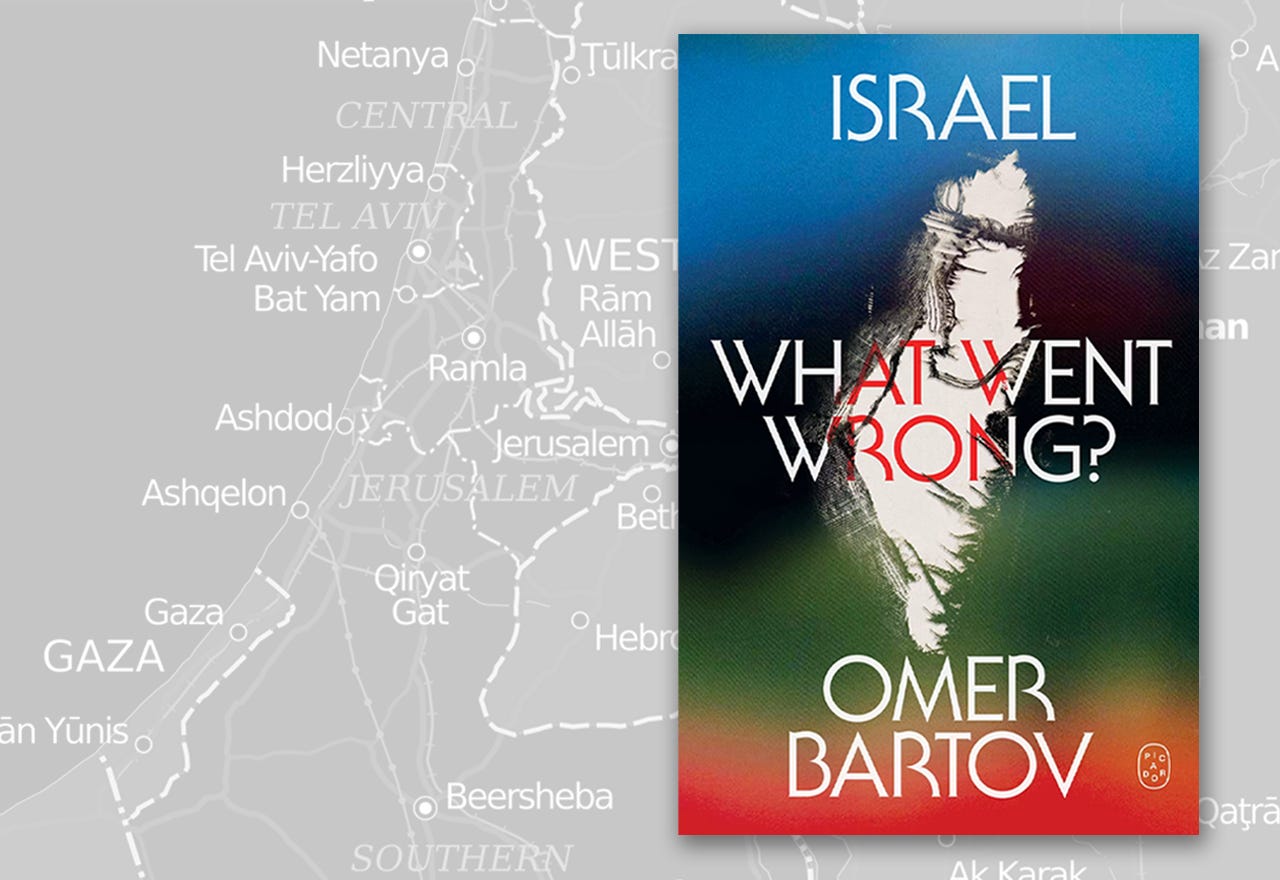
Omer Bartov, Israel: What Went Wrong? New York: Farrar, Straus and Giroux, 2026. Pp. 243.
Omer Bartov, distinguished historian and now public intellectual, does not like what Israel has become. In his view, Israel has become its own Greek tragedy. Originating as a response to the Holocaust, Israel committed, and continues to commit, its own genocide against the Palestinian people. Zionism, “a movement that sought to emancipate European Jewry from oppression and persecution” (3), has morphed into an ideology defined by the “oppression and persecution” of the Palestinians. Even worse, Israel responded to the Hamas invasion of 10/7 with a genocidal war against Gaza’s inhabitants that was “conducted with the wide support, laced with denial and indifference, of most its own Jewish citizens” (3). How Israel became such a monster is the question Bartov explores in this short, maddening book.
Before I get to the many problems, errors, and omissions in Bartov’s argument, let me give credit where credit is due: unlike other examples of what Matti Friedman terms “Gazology”—a new literary genre that blames everything on Israel and grants the Palestinians total immunity—Bartov does not let Hamas or the Palestinians off the hook. The Hamas attack on 10/7 “is a war crime and a crime against humanity” (20–21), “akin,” Bartov says later in the book, “to the attack on the United States on September 11, 2001” (120). Bartov even admits (in a qualified way) that maybe “the Arab and Palestinian rejection of the partition was a mistake” (137).

But these moments are few and far between. For the most part, everything is Israel’s fault, and Zionism is ultimately the reason why, Bartov repeats over and over and over again, Israel has committed genocide in Gaza.
Such an incendiary claim requires evidence, and here is where Bartov’s argument falls apart.
His evidence for Israel’s genocide is, to put mildly, shaky at best. Bartov asserts at the book’s start that “68,000 Palestinians were killed, about 80 percent of whom were civilians, the majority of them children” (5). Bartov does not specify his source, but the numbers likely come from Gaza’s Health Ministry, which is of course Hamas. But Hamas is hardly a reliable source. Bartov surely knows that Hamas doesn’t distinguish between combatants and non-combatants, and they have been caught inflating the number of deaths. In addition, Hamas counts anyone up to the age of 18 as a “child,” which includes combatants. But instead of qualifying his numbers and acknowledging that Hamas manipulates statistics for propaganda, Bartov accepts what Hamas says at face value and repeatedly states that Israel kills children.
Nor does Bartov take into account the type of combat Israel faced in Gaza—urban combat—and how that might have impacted civilian casualties. Hamas is not a conventional army with uniforms, nor did they fight Israel on a field well outside population centers. Instead, Hamas fighters hid among civilians, used protected facilities, hospitals in particular, for military purposes, and booby-trapped buildings.
That’s above ground. Below ground, there was even more. Bartov mentions the vast tunnel system Hamas constructed in Gaza only twice (36, 122), and even though Bartov is deeply concerned about civilian casualties, he ignores how Hamas refused to let civilians into the tunnels for protection. Mousa Abu Marzouk, a member of Hamas’s political bureau, admitted that “the tunnels are meant to protect us [Hamas fighters] from airplanes”; it’s someone else’s responsibility to take care of civilians. Which is not to say that innocent civilians didn’t die, but surely Hamas bears a significant amount of responsibility for those deaths by using the civilian population as human shields and refusing them shelter. Yet Bartov gives them a pass.
There was a mordant joke circulating after 10/7 that if Israel really wanted to commit genocide, the war would have been over on 10/8. Instead, the IDF took many steps—all ignored by Bartov—to protect, as far as possible, the civilian population. To quote noted military historian and expert on urban warfare John Spencer:
The IDF has telegraphed almost every move ahead of time so civilians can relocate, nearly always ceding the element of surprise. . . . Israel gave warning, in some cases for weeks, for civilians to evacuate the major urban areas of northern Gaza before it launched its ground campaign in the fall. The IDF reported dropping over 7 million flyers, but it also deployed technologies never used anywhere in the world, as I witnessed firsthand on a recent trip to Gaza and southern Israel. Israel has made over 70,000 direct phone calls, sent over 13 million text messages and left over 15 million pre-recorded voicemails to notify civilians that they should leave combat areas, where they should go, and what route they should take. They deployed drones with speakers and dropped giant speakers by parachute that began broadcasting for civilians to leave combat areas once they hit the ground. They announced and conducted daily pauses of all operations to allow any civilians left in combat areas to evacuate.
A responsible analysis of the Gaza war would take these warnings and precautions into account. But not this one.
Bartov inadvertently reveals how his bias against Israel shapes his reporting when he writes about his interactions with Israeli and American college students. In 2024, after his New York Times op-ed warning about genocide, Bartov gave a talk at Ben-Gurion University of the Negev. He was confronted by a group protesting his lecture and calling for it to be canceled. But instead of being silenced, Bartov (to his credit) invited the students in for a conversation. The students, Bartov noted, “had recently returned from reserve service, during which they had been deployed in the Gaza Strip” (38). They tried to rebut Bartov’s accusation that Israel was committing genocide. Instead, they blamed the destruction on Hamas “using civilians as human shields”; even more, “They showed me photos on their phones to prove that they had behaved admirably toward children, denied that there was any hunger in Gaza, insisted that the systemic destruction of schools, universities, hospitals, public buildings, residence, and infrastructure was necessary and justifiable” (39).
Even though these students had “lived experience” with Gaza, and provided photographic evidence, Bartov is having none of it. Instead, Bartov dismisses them as deluded because they had “internalized a particular view that had become commonplace in Israel” (39), namely, that Hamas are “human animals” (39). Given that more Jews were killed on 10/7 than at any time after the Holocaust, and given the barbarity of Hamas’s behavior, including rape, which Hamas live-streamed, hatred of the enemy should not be surprising. Instead, Bartov refuses to give any credence to people who are in a much better position than most to judge the IDF’s behavior. Instead, Bartov says, condescendingly, that he feels sorry for them because they “were unaware of how they had been manipulated” (43).
It’s deeply ironic that Bartov condemns Israel for its lack of empathy concerning Gaza because he seems to have zero empathy for Israel. He condemns the Israeli media, for example, for refusing to cover the joyous reception Palestinian prisoners got when they returned (126) while privileging the reception Israeli hostages received. But Bartov seems to excuse Hamas returning the body of a “young Palestinian woman” instead of the corpses of the Bibas children by calling it “an apparent mix-up” (126). Rather than condemning this macabre trick, Bartov focuses his outrage on the Israeli media for saying that murdering these two children demonstrated how Hamas’s cruelty “knows no bounds” (127). He doesn’t seem to care that they were murdered, not killed by an Israeli strike. Instead, Bartov is more concerned with blaming Israeli authorities for “[inflaming] public opinion” (125). It’s more than clear that Bartov has a lot more sympathy for Hamas—which, we should always remember, started this war—than for Israel.
A little later, Bartov talks about the protests at American universities, and he takes a very different approach. He grants that “in the early days following the Hamas attack, there were voices among protestors that justified or even glorified the massacre of Israeli civilians . . . or simply denied the atrocities” (60). But Bartov immediately tries to downplay them, claiming “these were minority voices among the protestors,” and a little further, “it must be stressed that the vast majority of the protestors in the United States have not condoned the crimes of Hamas” (60).
Yet Bartov does not provide any evidence to back up these assertions. How does he know that “the vast majority” didn’t condone Hamas? How does he know these were “minority voices”?
When Cornell history professor Russell Rickford exclaimed that not only was he “exhilarated” by 10/7 but that if you weren’t, you were “not human,” the crowd of students around him cheered. At an encampment protest at the University of California, Los Angeles, students wrote in chalk: “Oh Qassam [referencing the Izz ad-Din al-Qassam Brigades, Hamas’s military wing], oh beloved, we want to burn Tel Aviv.” You can find many more examples. So there is good reason to doubt that support for Hamas was a “minority” position. But the skepticism Bartov extends toward the Israeli students disappears when dealing with American anti-Israel protests.
Let me finish by unpacking a sentence that sums up everything wrong with this book: Israel’s establishment in 1948 “was followed by an invasion of Palestine by several Arab armies and the expansion of the intercommunal clashes into a full-scale war” (139).
First, “several armies”: “several” typically refers to two or three items, not many, and implies that the exact number is not very important. In fact, FIVE armies invaded: Egypt, Transjordan (now Jordan), Syria, Iraq, and Lebanon. Six if you want to include the soldiers that Saudi Arabia sent to fight with Egypt. Bartov’s use of “several” deliberately minimizes the forces arrayed against the new state, as if the threat they posed were not very great.
Next “intercommunal clashes” is a remarkably mild way of describing the bloody, anti-Jewish, and anti-Arab violence roiling pre-independence Israel.
Finally, the five armies did not invade “Palestine.” On November 29, 1947, the United Nations passed a resolution partitioning the British protectorate, Palestine, into an Arab and Jewish state. On May 14, 1948, David Ben-Gurion reads the Declaration of Independence, and 11 minutes later, President Harry Truman recognized the new state. One day later (May 15), the five armies invade, not Palestine, but Israel, for the express purpose of destroying the nascent Jewish state.
Why would Omer Bartov—a distinguished historian—make such a mistake? The answer is that Bartov thinks that Israel’s founding is a grievous, historical error, and he’s nostalgic for the Arab League’s plan for a “‘unitary state’ that would have an Arab majority and allow minority rights for the Jews” (138). Think about that. Bartov is okay with Jews as second-class citizens.
There are many more errors and omissions. Bartov repeatedly says that Gaza is “occupied,” but Israel left the Gaza Strip in 2005 (rockets were launched from Gaza a month later). Granted, Israel tries to control Gaza’s borders to try to prevent weapons smuggling (apparently, unsuccessfully), but so does Egypt, which Bartov neglects to mention, and Egypt built the mother of all walls to keep the Gazans out.
Bartov asserts that “the rise in anti-Jewish violence around the world . . . [is] associated first and foremost with extreme right, racist, and white supremacist elements” (102), which surely will come as a surprise to the victims of the Bondi Massacre and the Boulder attack. In fact, Bartov completely neglects radical Islam, even though there is a very long history of anti-Jewish sentiment in Islam and Hamas is an explicitly Islamist organization.
Bartov’s use of sources is also unreliable. He claims, for example, that a June 2025 op-ed in the Washington Post by Norman Goda and Jeffrey Herf presents “not only Hamas but all Palestinian resistance to Israeli oppression as Holocaust-like genocidal actions” (114). But a quick look at the article shows that’s not true. Instead, Goda and Herf argue that the genocide accusation against Israel is unfounded, and they show how anyone challenging the accusation will be subject to all manner of abuse, including being called a “Zionist rat.”
What makes this book so frustrating is that in detailing only some (there are a lot more, but space does not allow) of Bartov’s errors, it may seem that I fully endorse Benjamin Netanyahu and all his works. But that’s not true. Pointing out that it’s a mistake to call Gaza “occupied” does not mean that the West Bank is not occupied, just as stating that the IDF’s tactics in Gaza don’t amount to genocide does not excuse the settler violence against Palestinians in the West Bank. There is a great deal that Netanyahu has to answer for, not the least being bringing the most extreme, and racist, elements into the government. But instead of a rational, evidence-based discussion about where and how Israeli policy has erred, Bartov’s screed only supports those who want to deny Israel’s right to exist and ally themselves with Hamas and Hezbollah. Israel: What Went Wrong? is not antisemitic, but it gives intellectual cover for those who are antisemitic, and that’s unforgivable.
Peter C. Herman is emeritus professor of English literature at San Diego State University. He has published books on Shakespeare, Milton, and the literature of terrorism, and essays in Quillette, Newsweek, Jewish Journal of Los Angeles, Inside Higher Ed, and Times of San Diego. His latest book is Early Modern Others: Resisting Bias in Renaissance Literature (Routledge).