

The Stunted Racial Identity Development of Pro-Hamas White Women
by Mara Lee Grayson

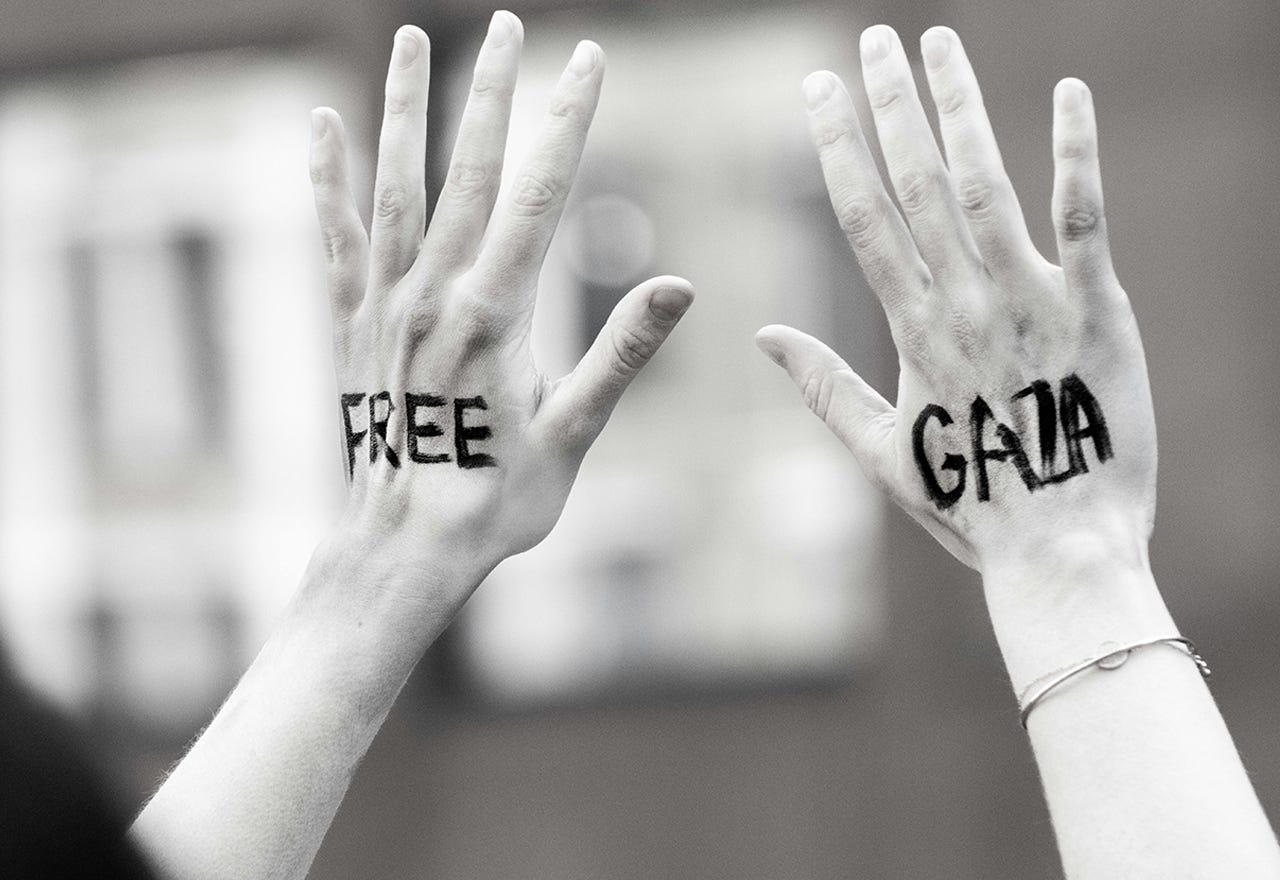
Preliminary research on the relationship between antisemitism and the campus encampment protests of spring 2024 found that anti-Israel beliefs were more prevalent among female students than male students. Given that Israeli women were sexually violated, mutilated, and murdered on camera by Hamas terrorists on October 7, these findings are notable, and might be surprising, were they not reflective of similar dynamics off-campus. For example, it took UN Women two months to issue, under pressure, a lukewarm acknowledgement of the brutal sexual violence against Israeli women, which was more than the National Women’s Studies Association did when they vaguely noted the “gendered and sexualized harms” that occur during war without even mentioning October 7—but condemned Israel’s “systemic violent campaigns” against Palestinians.
In their May 2025 article on Telos Insights, Russell A. Berman and Rebecca A. Kobrin posited eight potential reasons for the disproportionate representation of women within the encampments. Some possible explanations centered around statistical representation, such as that more women than men lean left politically or that women are likelier to be involved in humanities disciplines wherein support for protests was fostered. Others considered women’s allegiance with Palestinians they perceived to be victims in light of women’s experiences of gender oppression, a “preexisting grievance mentality,” or the media emphasis on Gazan women and children as casualties of war. Two theories dipped into more psychosocial waters, with Berman and Kobrin suggesting a possible “appeal of patriarchy” and a related “anti-intellectual pleasure” in romanticizing a violent male paradigm, represented by the Hamas rapist, that differs from the “degraded masculinity” of collegiate young men of the twenty-first century.

My sense is that all of these suppositions help to explain why so many women have aligned with a violent misogynistic movement like Hamas, but I’ll offer one more possibility, which relates not directly to gender but to racial identity development. Some research on campus attitudes related to the Israel–Hamas war found that white scholars were more likely than scholars of color to oppose Israel’s military response. Specifically, then, my supposition relates to the overrepresentation of white women in anti-Israel activism since October 7. To unpack this supposition, I’ll briefly examine the role of antiracism in the context of anti-Israel activism, followed by an overview of racial identity development theories, before I consider how this helps us understand the actions and attitudes of white women. Finally, I’ll tie these three elements together to explain how white women’s support of Hamas as a “resistance” movement reifies both racial and gender privilege.
Racial Framings of the Israeli–Palestinian Conflict
Contemporary narratives about the Israeli–Palestinian conflict, reinforced by the strategic infusion of anti-Israel and antisemitic propaganda into academic disciplines within the humanities, frequently frame Zionism as a colonial racism that must be eradicated and, subsequently, view Hamas terror as a justifiable form of resistance to ensure Palestinian liberation from racialized colonial injustice. Many young pro-Palestine activists thus see Palestinian nationalism not only as a social justice imperative but as a specifically antiracist movement. That so many of today’s antiracist activists shortsightedly assume that racism, privilege, and power operate the exact same ways transnationally enables them to apply Western frameworks of race and racism to the rest of the world, including Israel and Palestine, without engaging the critical reflexivity needed to recognize the ethnocentricity of such an approach. When mapped onto the Israeli–Palestinian conflict, a binary racial framework combines with existing antisemitic tropes about Jewish power and turns Israel and Jews into “hyper-whites” or “superwhites,” regardless of skin color.
In 2024, during the encampments, I spoke with a white woman professor in an elite, predominantly white institution who claimed she was “proud” of her students for engaging in protest because they “aren’t usually political.” (Apparently, the content of students’ political protest was less significant to this professor than the very fact of their politicization. Still, I imagine she would have exhibited less pride had her students protested against diversity and inclusion initiatives or in support of ICE raids, or if they had worn white robes and hoods instead of keffiyehs and balaclavas.) Notably, this professor remarked that her students “weren’t very active when George Floyd was killed” in the summer of 2020. Remember one of the classic functions of antisemitism: political displacement, or scapegoating. In a society where racial discourse has traditionally operated along a Black/white binary, and wherein Black men have been significant targets of police brutality, police officers are viewed by many in social justice circles as functionaries of systemic racial injustice. At a predominantly white institution, where white students benefit from the privileges of whiteness, white students protesting the murder of a Black man by police would require a critical examination of the privileges they have but which Floyd had not. In comparison, protesting the murder, thousands of miles away, of Palestinians, whom they conceptualize as nonwhite victims (regardless of Palestinians’ skin color, the actions of Hamas terrorists, or the agency of Palestinians in supporting Hamas to represent them) by the Israeli military, which they view as the arm of the white state (regardless of Israelis’ skin color or the needs and right of a state to defend itself against genocidal terrorism) is far easier.
In other words, by protesting against Israel, white students in the United States can believe they are challenging systemic injustice without any requirement to substantively engage with their own privilege or complicity. For white American student activists, the psychic benefits of displacing whiteness, racism, and systemic injustice onto Israel negate any potential impulse to question their own standing in the United States or their presumptions about the issues supposedly central to their activism. They need not wonder, for example, why the only Jewish country in the world is framed as an exclusionary, global, colonial superpower, despite being surrounded by countries from which Jews were exiled, how it is that so many supposedly white Israelis actually have dark skin, or why the Israeli military was in Gaza in the first place, despite not having had a presence there in nearly a decade leading up to the October 7 massacre of Israelis by the Palestinian-elected terrorist group Hamas.
Moreover, because whiteness has historical roots in European Christianity, and because Judaism has historically been Christianity’s immediate Other, those who frame Israeli Jews as white oppressors are actually reinforcing, not challenging, whiteness. Ill-informed anti-Israel activism thus cements both a Christian-inflected white worldview and a reductive antiracist stance that requires little education on the issues they claim to care about and even less self-examination.
Racial Identity Development
In the wake of 2020’s pseudo-racial reckoning—I say “pseudo” because it hasn’t actually eradicated anti-Black racism—students, especially young white students, have been increasingly, if self-consciously, cognizant of the privileges afforded to those with light skin in the United States. Many theories of racial identity development suggest that, as one learns about injustice, they can become consumed by the need to share their new knowledge with others, but that individuals ideally will move into a place of integration wherein racial identity is only part of a healthy self-concept. In Asian American identity development models, for example, this incorporation is preceded by an “awakening” marked by anti-establishment perspectives, often influenced by “campus politics.”1 Black identity development theories suggest that once individuals recognize the saliency of anti-Black racism, they may initially devote their energies less to developing a healthy Black self-image than to overtly challenging and rejecting everything they associate with whiteness.2 Notably, many identity development scholars label this stage “resistance.” It should not escape readers that this is the same term anti-Israel activists have used to praise Hamas’s October 7 massacre.
There are many horrific aspects of equating gang rape and mass murder to “resistance,” but an intriguing aspect to this equivalency is that, in racial identity development, resistance is not the goal but instead an ideally temporary phase marked by anger and rage rather than a healthy self-concept. One must move past this phase to integrate their new knowledge alongside all the other knowledges and characteristics of themselves, to develop a healthy identity as an individual in a socially structured world. For white people, this may entail a process of continued self-reflection and learning from other cultural groups, rather than denigrating or idealizing other people based on shared identity characteristics. Anti-white attitudes and activism at the resistance stage of white identity development demonstrate neither allyship nor enlightenment, in large part because these efforts are motivated not by the desire to build a more equitable world but instead, as identity development theorists Rita Hardiman and Molly Keehn have noted, by “negative feelings such as guilt and shame which lead people to want to distance themselves from their whiteness.”3
It seems that contemporary social justice theorists and activists have gotten stuck in early stages of racial identity development, and, rather than grapple with what they have learned about systems of racism and colonialism (or recognize that they have learned precious little, if anything at all, about Jewishness or antisemitism), they are driven not by collective cultural understandings or overlapping identities but instead by resistance to those outside of their designated community and a missionary impulse to spread the word.
White Women’s Transaction of Privilege
The pressure to disavow racial privilege may be stronger for white women, who are often seen as beneficiaries or even stewards of white privilege, a view exemplified in popular culture and discourse by the “Karen” figure. Indeed, as Tenisha L. Tevis, Naomi W. Nishi, and I have found, white women seem to be overrepresented in social justice work in educational spaces, a dynamic that may reflect white women’s efforts to avoid being seen as racist or to assuage guilt over their own privileges. “Paradoxically,” we point out in The Gendered Transaction of Whiteness: White Women in Educational Spaces, “the white woman who takes on antiracist work to signal that she is a good white woman who cares about antiracist work actually reifies the logics of whiteness through that very same virtue-signaling behavior.”
White women may be so used to gender subordination and so inculcated into the ways of whiteness that they accept and even transact gendered oppression for the privileges of being included, if in a subordinate role, in the white patriarchy. For the white woman who experiences gendered subordination but light skin privilege, efforts to distance from whiteness may lead to a fetishization of “resistance” that excuses the rape and murder of women if committed by peoples assumed to be nonwhite. What she may not consciously realize, however, is that this fetishization is intrinsically racializing and misogynistic. Because she accepts the subordination of gender to race, she ascribes the same hierarchical system of identity classification to others: thus, an Israeli woman is first Israeli and therefore not a victim, and a Muslim man is first a Muslim, not a rapist. Rather than integrate all aspects of her social identity—or consider anyone else’s—the white woman who proclaims herself an intersectional feminist paradoxically essentializes according to supposed racial categories those with whom she claims allyship.
Reifying Privilege through Allyship
It is not surprising that student activists are stuck in early stages of any sort of identity development, since they are likelier than not to be adolescents and young adults. After all, part of what characterizes most student activism is the youth of the protestors. It is more troubling that scholars and educators encourage students to embrace a rageful resistance rather than a healthy integration. Alas, one racial identity theory in particular may help us understand that dynamic and why it is so prevalent. Janet Helms’s white identity development theory is problematic for multiple reasons, including its presumption of Jewish whiteness and limited accounting for populations outside the Black/white binary, but it is foundational in social justice circles. This model suggests that the white person who abandons anti-Black racism will experience a “cognitive restructuring” and “a euphoria perhaps akin to a religious rebirth”; at this stage, the white person focuses on “the goal of changing White people.” That this impulse to proselytize, so to speak, is informed by Christian discourses, the same Christian discourses that inform whiteness, goes unacknowledged in Helms’s work.
Though a full examination of the reasons for the limited examination of Christianity in social justice frameworks is outside the scope of this essay, it is worth noting that Christianity, specifically through the significant involvement of Black churches, historically provided a foundational framework for civil rights activism in the United States. For some populations, then, while Christianity once determined the tangible and conceptual structures of oppression, it also provided the tools for liberation. Still, Christianity remains a largely unexamined dimension of whiteness and racism as well as antisemitism.
The supposed antiracists who acknowledge antisemitism only insofar as it is committed by right-wing pundits or Christian Nationalists should—but rarely do—consider how their own activism might be informed by similar, if less overtly expressed, belief systems. The white woman who performatively resists the whiteness into which she has been socialized but rationalizes the motivating ideologies and impacts of Islamist fundamentalist violence as “resistance” merely trades one patriarchy for another. That both Christianity’s and Islam’s intrinsic Other, by virtue of cultural history and religious origin, is Judaism means that any antisemitism the white woman has absorbed from Christian society she may have limited reason to question in the context of Islamism.
Today’s student activists may have learned the terminology of critical literacy, but they haven’t learned how to fully apply its cognitive dispositions, and they are so preoccupied with pointing out Israel’s white oppressor colonial racism that they aren’t stopping to consider that maybe they themselves are the racists.
Topics: Israel Initiative
Mara Lee Grayson’s books include Antisemitism and the White Supremacist Imaginary (Peter Lang, 2023) and Teaching Racial Literacy (Rowman & Littlefield, 2018). Previously a tenured associate professor of rhetoric and composition at California State University, Dominguez Hills, she now works as the director of education for the Campus Climate Initiative at Hillel International.
See Jean Kim, “Asian American Racial Identity Development Theory,” in New Perspectives on Racial Identity Development: Integrating Emerging Frameworks, 2nd ed., ed. Charmaine L. Wijeyesinghe and Bailey W. Jackson III (New York: NYU Press, 2012), pp. 138–60.
Bailey W. Jackson III, “Black Identity Development: Influences of Culture and Social Oppression,” in Wijeyesinghe and Jackson, New Perspectives on Racial Identity Development, pp. 33–50.
Rita Hardiman and Molly Keehn, “White Identity Development Revisited: Listening to White Students,” in Wijeyesinghe and Jackson, New Perspectives on Racial Identity Development, p. 123.