

The Politics of Spring: Nowruz and Cultural Continuity
by Mohadeseh Salari Sardari

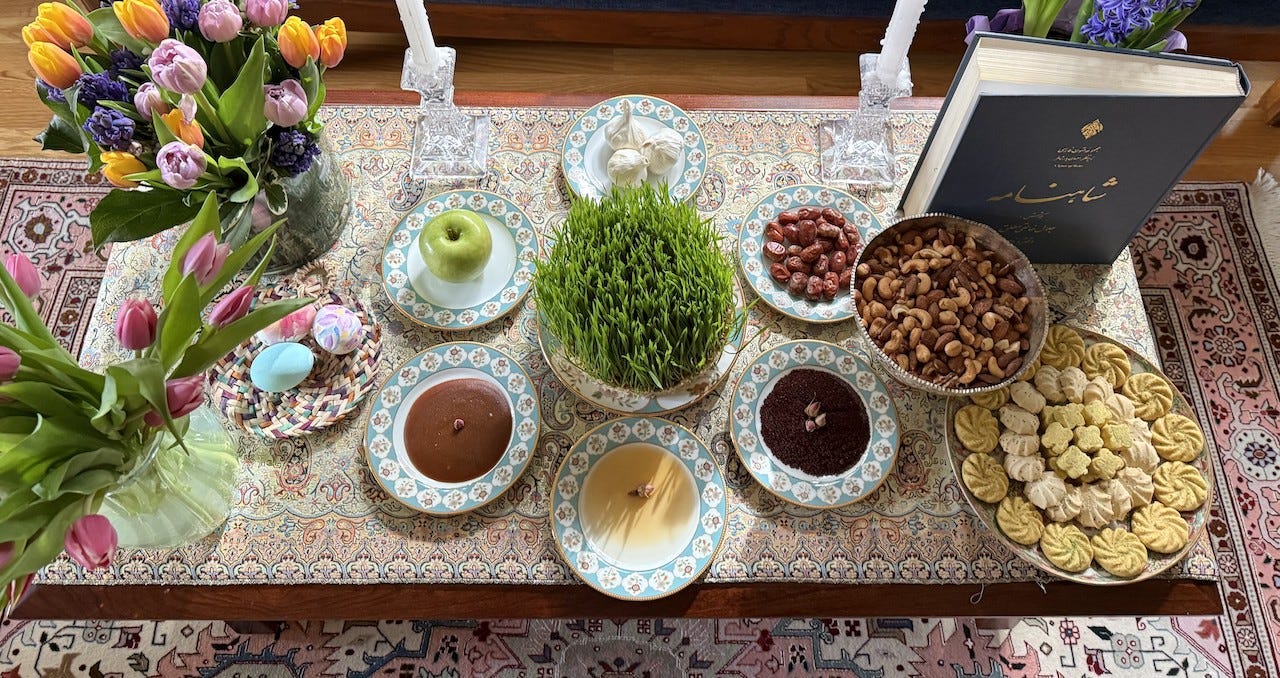
I vividly remember perhaps my earliest Nowruz. The exact moment of the new year, vernal equinox, changes every year. That year, it arrived at midnight. We were in our ancestral village, in my grandparents’ house. There was no electricity. Only the faint light of an oil lamp. Just before the new year, my grandfather returned from his orchard outside the village. A farmer, he spent most of his days there caring for the trees. In his hands, he carried a small block of earth. From it grew a Nowruz tulip, a local flower that blooms each year around the arrival of the new year. My grandfather had not cut the flower, he never cut flowers. Instead, he brought the tulip with its roots still in a clump of soil. After Nowruz, he would take it back and return it to the earth where it belonged.
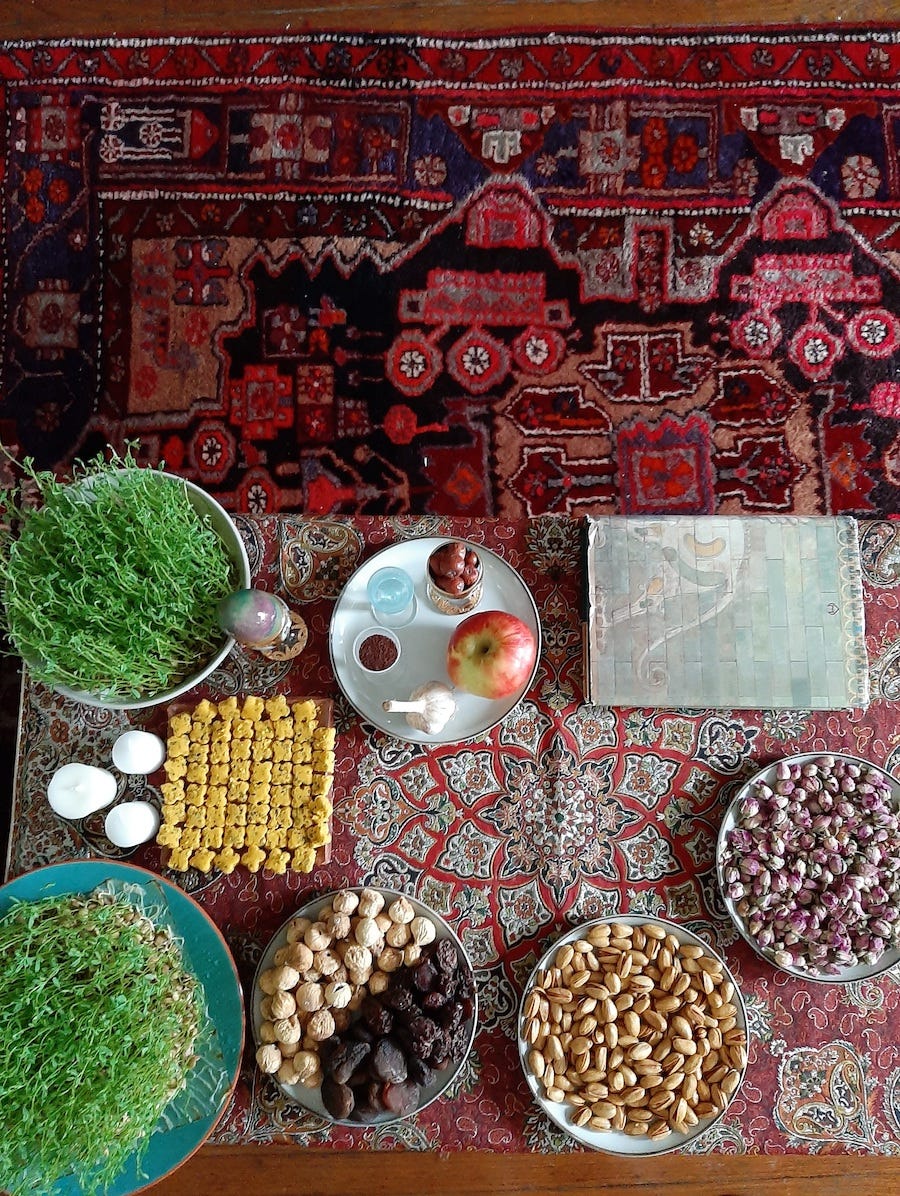
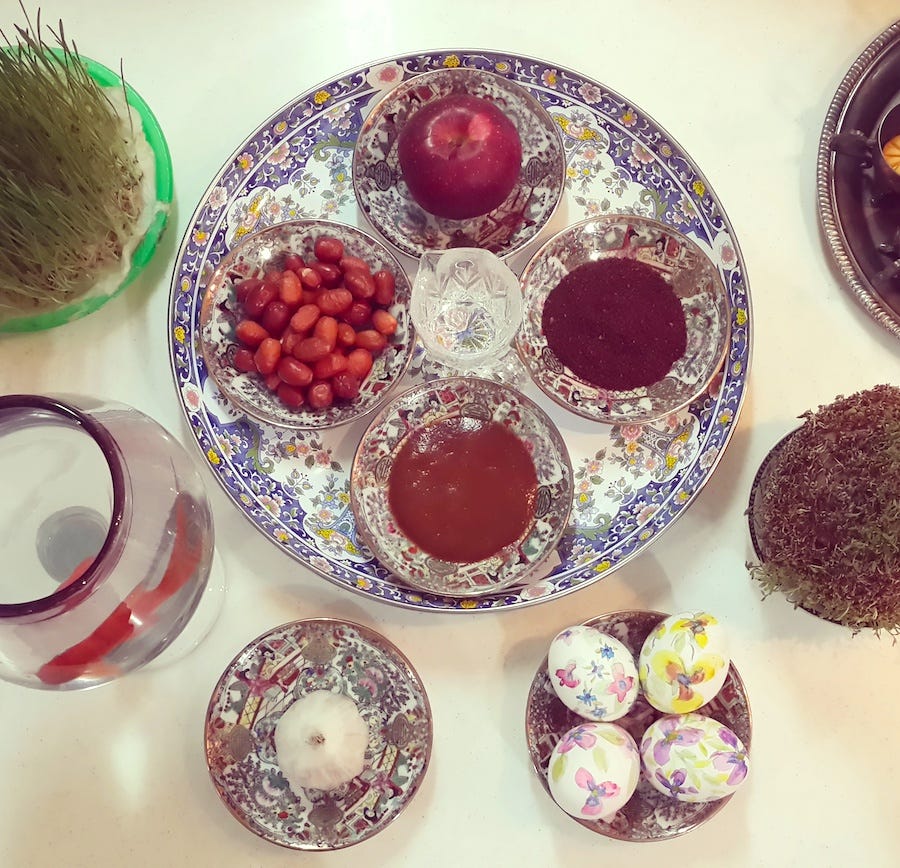
The Haft Sīn is the Nowruz spread that Iranians prepare to welcome the new year. It includes seven items whose names begin with the Persian letter s. Each one symbolizes a wish for the coming year. Flowers and fresh green sprouts are also placed on the spread. They welcome spring and symbolize hope for a good harvest. A small bowl with a goldfish and colored eggs are also part of the table. We caught a small fish from the river that ran through the valley below the mountain where our village rested. It swam in a bowl on the Haft Sīn table during the celebration, and the next morning we returned it to the river. For the eggs, my grandmother took me to the henhouse early in the morning. She showed me how to choose them, which ones to leave so they could become chicks, which ones to throw away, and which ones we could collect to eat after Nowruz.
When my grandfather arrived with the Nowruz tulip, we gathered around the Haft Sīn spread. He turned on his old radio. Together, we listened for the countdown to the new year. After the new year arrived, my grandfather entertained us with shadow plays. He made figures with his hands in the light of the lamp. Later, we fell asleep listening to my grandmother’s fairy tales, stories about a little girl who saved her hometown from a Div, a mythical monster. Except for the radio, we celebrated Nowruz almost the same way my ancestors must have done thousands of years ago. In the same village. In a simple house. Gathered around an oil lamp. Hoping for a prosperous new year. Ritual has a power in this way, it folds time. A single night can carry centuries within it. Many countries have been shaped by migration. Their earliest languages and rituals have often been lost. Iranians, however, show a rare continuity.
The memory has stayed with me. The smell of fresh bread. The wind against the wooden doors and windows. The flickering light on the walls of the mud-brick house. Spaces like these shape our inner worlds long before we understand them. Perhaps that is why I studied architecture. Nowruz has always been a celebration of life’s small gifts, nothing grand, nothing loud, just moments of hope. A few years later, I witnessed my first Islamic Qurban feast. It took place in my hometown, in Meydan. Hundreds of lambs stood crowded together, waiting for their throats to be cut, their blood offered in thanks to Allah, recalling Abraham’s willingness to sacrifice his son. It was not hard for me to know which traditions I felt close to, which celebrations I wanted to honor, and which rituals I wished to be part of.
But under a totalitarian regime, even the most intimate traditions become politicized. Nothing escapes government interference, especially Nowruz. These regimes want isolated individuals, stripped of their individuality and turned into obedient masses. Nowruz does the opposite. It brings people together and reconnects them with family, memory, and the shared rhythms of life. Power tries to control rituals, calendars, and bodies. The Islamic Republic attempted to discipline time itself by replacing Nowruz with Islamic events. But ritual survived power. At first, officials insisted that people should prioritize what they called proper Islamic celebrations: the birth of Mohammad or the day he received revelation. Yet society did not abandon Nowruz. It remained deeply rooted in everyday life and memory. Some influential clerics openly criticized it. Morteza Motahhari, a prominent religious thinker and a close disciple of Khomeini, called Nowruz rituals a superstition. To them, Nowruz was irrational folklore. Rituals like the Qurban sacrifice, however, appeared perfectly logical and legitimate. But again, people did not let go of Nowruz. After all, who can truly forget the first day of spring?
Eventually, the clergy attempted a different strategy: to Islamize the celebration rather than eliminate it. They introduced Arabic prayers that, they claimed, should be recited at the moment of the new year, as if the arrival of spring needed religious validation in order to be complete. Yet the unease with Nowruz remained visible. In his annual New Year speeches, Ali Khamenei never sat beside a Haft Sīn table or any of the traditional symbols of Nowruz. Instead, he appeared with only a Qur’an on the table beside him while addressing the nation.
In this way, something as gentle as Nowruz has been turned into a political battlefield. In Persian, Nowruz literally means “new day.” Yet the word ruz also carries a broader meaning: it signifies an era, an age, or a moment in history. This is why Nowruz has endured. It is not merely a date on a calendar. It is the human belief that the world can begin again. Hannah Arendt’s concept of natality, the human capacity to begin again, resonates deeply with the spirit of Nowruz. As a celebration of a new day and the renewal of spring, Nowruz reflects all beginnings.
This Nowruz, after Khamenei’s death, would be more than the turning of the year. It would mark the beginning of a new era for many Iranians. We would grow green sprouts in the names of those killed in the protests and uprisings of the past forty-seven years. And when we looked at the Nowruz tulips, we would not wish for a better future anymore. We would look at them knowing that a new and prosperous era for Iran has begun.
Topics: Reflections & Dialogues
Mohadeseh Salari Sardari grew up in Bandar Abbas in southern Iran and trained as an architect in Iran before pursuing her PhD in the United States. She is completing her PhD dissertation, Literary Selves and Architectural Space, in the Department of History of Art and Architecture at Brown University. Her research explores the intersections of architecture, literature, gender, and spatial politics in modern Iran. She is currently a lecturer in Stanford University’s Department of Comparative Literature and has worked with museum collections and exhibitions at institutions including the Museum of Fine Arts, Boston, and the RISD Museum. Her work on Iranian literature, art, and culture has been published in both Persian and English.
