


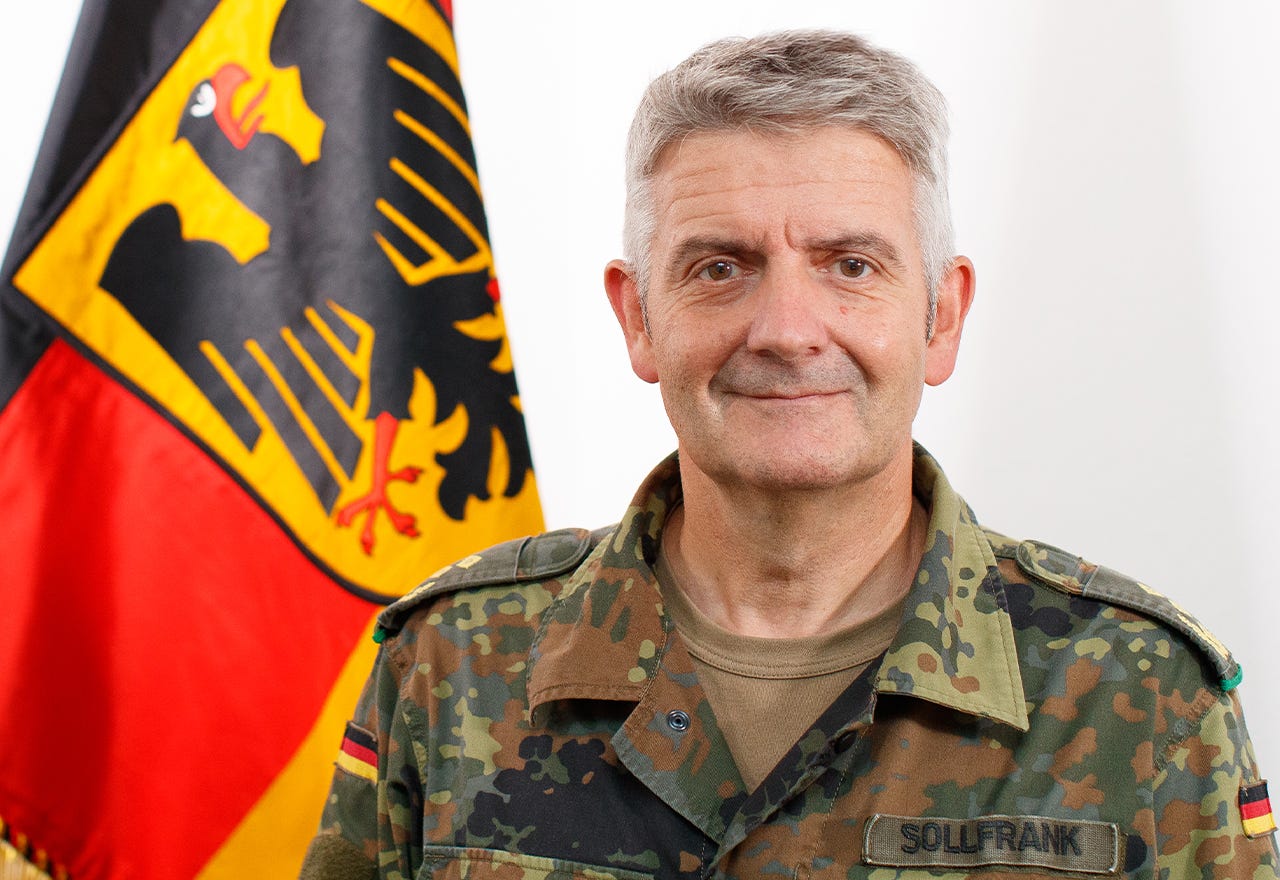
Alexander Sollfrank is Commander of Germany’s Joint Operational Command and former Commander of NATO’s Joint Support and Enabling Command. He has previously emphasized the importance for the Bundeswehr and NATO to prepare for a Russian assault. In a recent interview in the German newspaper Die Welt, he underscored how, despite considerable losses in the Ukraine War, Russia is simultaneously rebuilding in a way that could facilitate its opening an additional front on Europe’s eastern flank and a potential targeting of Germany. The assault might well begin—indeed, perhaps it has already begun—in hybrid dimensions including disinformation, sabotage of critical infrastructure, and cyberattacks, as preparation for a full-scale conventional invasion.
Rather than treating the wars in Ukraine, Gaza, and Iran as distinct conflicts, one can deduce from Sollfrank’s warning that they are preliminary theaters within a single great power competition that can spill over into the European heartland and challenge NATO to live up to its responsibilities. There is no inevitability in this potential escalation, but neither should one overlook how the distinct wars—here Ukraine, there Gaza—may not only foreshadow an expansion into Europe, but are already merging into a single war, with increasing interaction between the several zones: Russia aiding Iran with upgraded drones and intelligence to counter the United States, while Ukraine enters into defense pacts with Gulf states as a response to Iran’s drone warfare against Saudi Arabia, the Emirates, Bahrain, and even Qatar. In the interview that follows, Sollfrank discusses how the fighting in Europe might begin.
General Sollfrank, Russia is currently suffering massive losses—in both personnel and materiel—in its war against Ukraine. Does Russia still pose a genuine threat to Western Europe?
Alexander Sollfrank: Our analyses proceed from the premise, first, that we here in the West—in Germany, in Europe—remain clearly in Russia’s crosshairs. That we are potentially vulnerable to attack. That Russia is currently doing everything in its power to replenish its stockpiles, to strengthen its troops, and to grow its military to a size of 1.5 million soldiers. The question is: When will Russia attack? When will the situation arise in which Russia launches an attack on Europe—including Germany? Of course, a smaller, regional-scale attack is possible at any time. NATO speaks of a “Fight Tonight”—a scenario for which we must be prepared. And that, too, is firmly within our focus. At present, our planning is based on the assumption that Russia will be ready to launch a large-scale attack against us by 2029. However, we are also making preparations for the possibility that an attack—albeit on a smaller scale—could occur sooner. And that is precisely what we are preparing and gearing up for.
The nature of warfare is no longer evolving in annual increments, but rather in terms of months and weeks. What does this imply for potential attack scenarios? Should we anticipate, above all, a massive drone war?
Sollfrank: I think that when we discuss scenarios regarding how Russia might potentially threaten us in a conflict, we can generally assume that such a move would naturally be preceded by corresponding hybrid attacks—that is, anything falling outside the scope of a conventional assault. We are already witnessing elements of this today: sabotage, disinformation, and, for instance, massive cyberattacks. Should an actual attack materialize, a conventional military strike would, of course, constitute an integral part of that offensive. Moreover, such an attack would be waged across all domains—on land, in the air, and at sea. Such a scenario would also be accompanied by nuclear threats as well as by long-range strikes deep into enemy territory, specifically targeting areas toward France and Germany, in order to hit key strategic nodes within those regions. In short, we must be prepared to face precisely the kind of warfare we are currently witnessing in the conflict involving Iran.
Do you have sleepless nights given the fact that time may be running out? We see the rearmament efforts—in Germany as well as among our NATO partners—but are we really moving fast enough?
Sollfrank: Well, as the Commander of the Joint Operations Command, I serve as the operational commander of the German Armed Forces—the Bundeswehr—and in that capacity, things can never move fast enough for me. We cannot afford for weapons and ammunition to arrive too late. We cannot afford lengthy debates before a decision is finally reached. So, from that perspective, I must admit that I am constantly restless.
On the other hand, I remain confident: I see a great sense of unity here in Germany—and indeed across all 32 NATO nations—regarding our resolve to counter any potential attack. Take “Eastern Sentry,” for example: this is an air-based deterrence operation in which Bundeswehr Eurofighters fly daily patrols along the eastern flank, ready to repel attacks should the need arise. We have ground forces stationed in Lithuania. Other nations have forces deployed in Estonia, Latvia, Poland, Romania, and so on. Along the entire eastern flank, we have forces in place—specifically to be ready to “fight tonight.”
Even without the United States?
Sollfrank: Well, the United States is, of course, absolutely central to NATO—particularly in ensuring that the alliance, as a nuclear power, maintains the necessary credibility in its deterrence posture. However, my daily interactions with American generals and soldiers leave absolutely no room for doubt that the Americans are fully committed and standing right alongside us.
Has it truly sunk in among the German public that this threat posed by Russia is not some distant, abstract issue, but rather a matter of immediate and pressing relevance?
Sollfrank: I certainly sense that this awareness—this consciousness—exists: that the days of being free from threat are over, and that there is someone here who could potentially attack us with weapons to enforce his interests. And not merely as an abstract construct, but possibly very soon—and then in a very, very concrete way.
You are preparing for a day that everyone hopes will never come. Should that day arrive nonetheless, can NATO—can Germany—win such a war against Russia?
Sollfrank: I am firmly convinced that we can. Of course, there are still shortfalls here—deficiencies that we identify and address on a daily basis. We are working hard to resolve them. However, if I were not convinced right now that such an operation—such a war—could be successfully prosecuted, then deterrence itself would be a complete failure. And I am convinced: Our plans are sound, our forces are prepared, and we have an excellent fighting force. We will counter any act of aggression with everything we have. We work hard every single day on our preparations. If we were to waver, if we were to falter, or if we failed to use this time—for instance, to stockpile the necessary armaments, ammunition, and so forth—then things would indeed become difficult. But let me reiterate: 32 nations are currently putting their shoulders to the wheel. And things are moving in absolutely the right direction.
I would like to return to the subject of the deficits. When you look at Ukraine, you no longer see an infantry war, but rather a drone war. Russia is currently striving to produce up to 1,000 drones a day. Does NATO—does Germany—even have the capacity to hold its own in such a drone war?
Sollfrank: Yes, well, we are monitoring this very closely. Incidentally, Russia has just fired 1,000 drones at Ukraine within a 24-hour period. Nor does Russia show any signs of ceasing its attacks. Moscow is not backing down, despite suffering massive losses. And, naturally, we are not yet prepared for a conflict on this scale. That must be stated quite clearly. However, we are well on our way—on a very, very good path—to developing this capability. And we already have truly excellent capabilities to demonstrate. But once again: time is critical, and we must not let up now.
This interview originally appeared in German in Die Welt and is presented here by permission. Translated by Russell A. Berman.
Topics: Reflections & Dialogues
Russell A. Berman is Walter A. Haas Professor in the Humanities at Stanford, a Senior Fellow at the Hoover Institution, and former editor of Telos. He is now President of the Telos-Paul Piccone Institute.
