

The One Nation Conundrum: The Strange Case of Australian Populism
by Mark G. E. Kelly

The sudden spectacular rise of a right-wing populist party in Australia might seem entirely unsurprising given that something similar seems to be happening in many Western countries. Australia’s One Nation (technically Pauline Hanson’s One Nation party, often referred to by the acronym PHON) can thus be easily understood as a local correlate to Reform UK or the Alternative für Deutschland (AfD).
Living in Australia, and specifically in the rural hinterland where PHON’s rise has been most pronounced, I have however been puzzled by this as perhaps by no other political phenomenon I have encountered in my life. The most puzzling—indeed uncanny—aspect of this is the way I see absolutely nothing anywhere either online or in real life that reflects this phenomenon. I have heard or seen no one signal any support for this party. It has come up in conversation only with the very politically interested in the context of discussions of the polling, and even then this does not seem to be much discussed.

Moreover, not only are there no outward signs of this psephological phenomenon but nothing seems to have changed either that might have caused it. Yes, we are beset by several crises that have been occurring in much the same way in many other countries with the same results, but none of these have particularly coincided with the rise of One Nation. One Nation has existed for almost thirty years, far longer than the aforementioned populist right-wing formations in other countries. We have endemic cost-of-living crises and the highest rates of immigration anywhere in the world, but these are respectively a slow-burning issue and a long-standing one: this is very different from the UK, where record high immigration suddenly occurred in a discrete event a few years ago, increasingly and accurately referred to as the “Boriswave,” which might directly be linked to anti-immigrant sentiment. One might say that Australia is, as so often, rather late to the party, but this doesn’t explain why it has decided to arrive at this point. One might point to the appearance of prominent new backers of ON, to billionaire mining magnate Gina Reinhart and former Nationals leader Barnaby Joyce, but in both cases we can see this as much of an effect of the party’s trajectory as a cause: certainly it began well before they climbed on board.
I have reached the conclusion that the cause is quite simple, amounting to the recent playing out of what has been referred to as the Great Realignment. In Australia as elsewhere in the West, social liberalism increasingly aligns with higher income and educational attainment and thus traditional center-left and center-right parties that draw their key personnel and support from the university-educated have found themselves increasingly detached from a working class with quite different values. This has tended to make conventional center-right political formations, such as the mainstream U.S. GOP, the Conservatives in Britain, or Christian Democrats in Germany, which depended on an unspoken alignment of the wealthy with the lower orders around social conservatism, increasingly unviable as a political proposition, and hence is one of the main causes of the growth of Reform and the AfD, as well as, of course, MAGA in the United States.
In Australia specifically, the rise of One Nation is therefore a symptom of the collapse of a quite peculiar conventional center-right formation, called the Coalition or LNP (Liberal-National Party—although technically this appellation refers only to its Queensland branch). The Coalition is a permanent coalition of two political parties: the National Party, which represented rural interests, and the Liberal Party, which can best be thought of as itself a broad church of urban and suburban opponents of the Labor Party, including some social liberals (so-called “wets”) but typically dominated by economically and socially conservative views. The Coalition has thus operated for decades on the basis of economic neoliberalism (with a partial protectionist carve-out for agriculture to please the Nationals) and social conservatism that appealed to sections of the wealthy, working class, and rural voters.
The Coalition model collapsed in essence because relatively wealthy electorates have become overwhelmingly socially progressive. Wealthy parts of Sydney and Melbourne were the absolute core of the historic Liberal Party, but many dramatically flipped in 2022 to so-called “teal” challengers (so called after their campaign color-coding), women candidates who were economically conservative but in particular rejected Coalition hesitancy on climate action. This altered the electoral dynamics so as to make Coalition government in many states and at a federal level suddenly seem impossible.
In light of this, the Liberal Party chose a new leader (ex officio also then the leader of the Coalition), Sussan Ley. In effect, Ley, a moderate, attempted to tail the teals and move the Coalition back towards the center. It was this that proximally caused One Nation’s rise. One Nation itself did nothing in particular to catalyze it; rather, the Coalition began unsuccessfully chasing its own lost core and in so doing thoroughly alienated its outer suburban and rural voters.
One Nation’s new rise terminated in a plateau when the Liberals ditched Ley and replaced her with outer-suburban right winger Angus Taylor, who immediately began moving the party back toward the right. While this stemmed the hemorrhaging of support to One Nation, it has done little to win any voters back, and offers no particular prospect of winning back the lost urbanite core, where indeed the teals are beginning to coalesce into a formal political party.
It might be added that the Nationals had their own considerable woes stretching back a decade, emanating principally from rural perceptions they were too compromised and insufficiently representing “the bush.” Consequently, they had already been partially displaced by an alternative rural party, the Shooters, Fishers and Farmers Party, before they declined in turn, clearing the ground for One Nation apparently to become the new countryside default.
The Labor Party’s response to the rise of One Nation has been muted. While promising to cut immigration numbers and alleviate cost-of-living pressures, there is little evidence of the government delivering either thing, and the electorate certainly doesn’t seem convinced. By far their most voluble response so far has been the May 2026 budget, in which Labor quite deliberately broke a campaign promise and restricted so-called “negative gearing” on investment property. A long-standing third rail of Australian politics, negative gearing allows owners to deduct costs of maintenance from their taxable income, which has long been seen as a subsidy to older, wealthier real estate investors, and hence a force for house price growth in the context of ever-cratering housing affordability. Far from seeing off One Nation, this is clearly oriented toward the youth vote and thus seems if anything directed to head off the threat to Labor from the left, specifically the Australian Greens who, like the Green Party in England, have made significant gains from Labor among left-wing and Muslim voters due to widespread outrage over Israeli actions in Gaza. This makes tactical sense for the Australian Labor Party, for which the rise of One Nation might be seen as nonthreatening due to its effect of dividing the right to Labor’s advantage. Nonetheless, the budget was generally panned, and, while it did swiftly reverse creeping Green gains against Labor, its main effect seems to have been to restart One Nation’s previously stalled rise at the expense of both Liberals and Labor, leading to a novel situation in which One Nation has now become the front-running party in some polls.
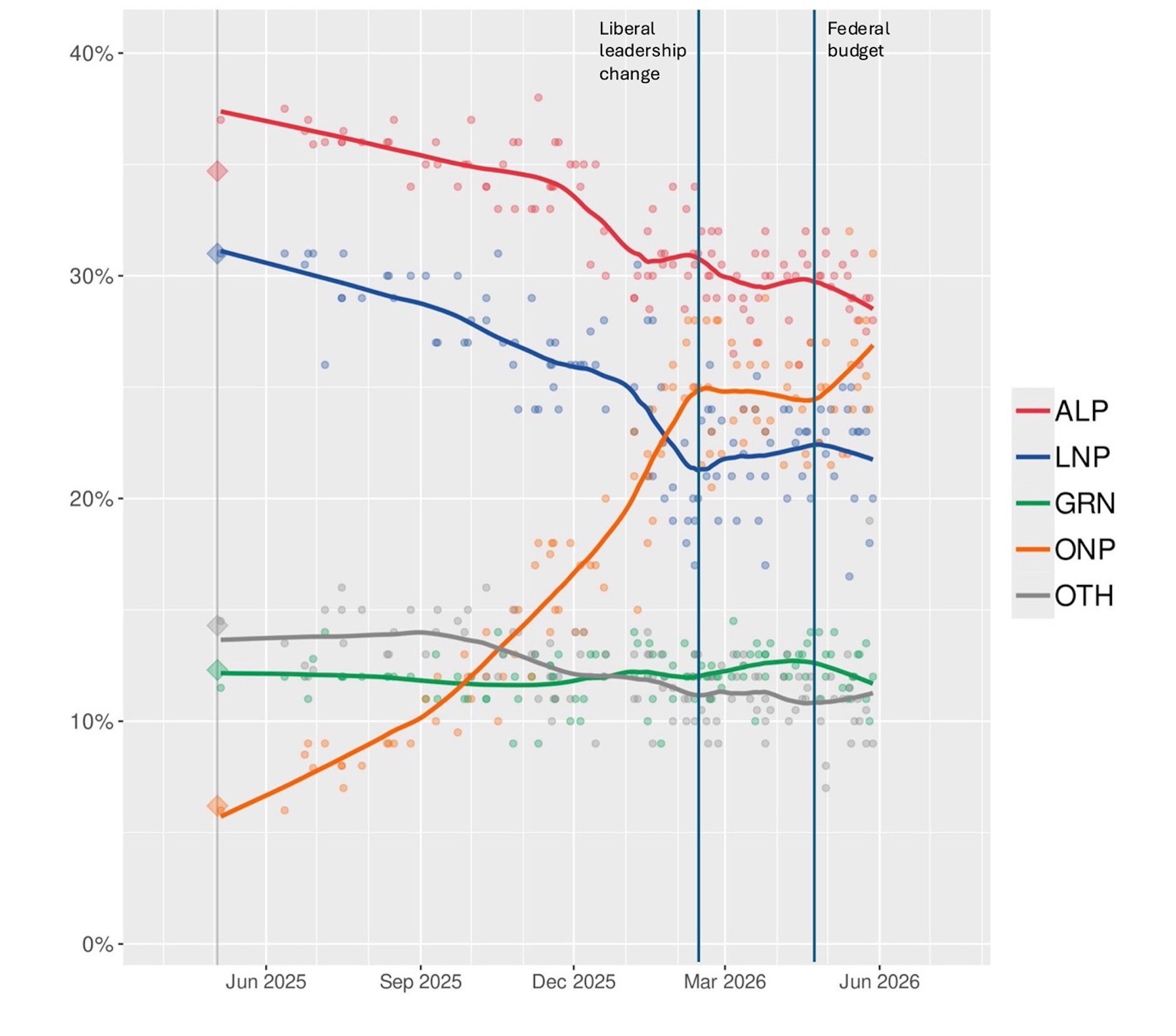
The below graph shows One Nation’s meteoric rise in orange, beginning steadily from the last Australian federal election in 2025—Ley became Liberal leader effectively immediately at the election as her relatively right-wing predecessor lost his seat. The apparently exponential growth in PHON support terminates abruptly exactly when Angus Taylor becomes Liberal leader in February 2026, and it instead begins to slowly decline until Labor present their May budget, when it begins to grow again rapidly—May also saw the by-election triggered by the resignation of Sussan Ley upon her leadership ouster, which was won by One Nation. Notably, when PHON polling waxes, both Coalition and Labor wane, whereas the Liberal-National rebound under Taylor corresponded to both Labor and PHON decline.

One Nation is itself a very strange beast. It has always been centered on—though has not always been led by or even included—the figure of Pauline Hanson, an unprepossessing regional shopkeeper turned politician who was dumped by the Liberal Party as a candidate on the eve of the 1996 general election over her views but won anyway. She formed a new party, which within two years took 23 percent of the vote in the state election in her native Queensland. However, it failed to replicate this success at the national poll later the same year: Hanson herself lost her seat, and the party descended into infighting, culminating in it losing so many members that it not only could not maintain its registration but was also found to have registered itself illegally, for which Hanson and a key ally were briefly imprisoned. The party then spent more than two decades vacillating in the electoral wilderness: it has continued to exist, sometimes under slightly different names, sometimes without its eponymous founder, and occasionally one or two members have been elected, often then to leave the party or lose their seats in due course.
Reputationally, the party has long been perceived by many, particularly on the left, in the way parties of the far right typically are: as fascists, beyond the pale of polite consideration. Again typically, this is rather hyperbolic. One Nation’s distinction had always been opposition to immigration, but a culturalist one: the name referred to the ideal of a singular Australian nation that welcomed immigrants who assimilated to Australian norms and conversely demanded that Australians Aborigines also assimilate to this singular culture. In the context of Australia’s extraordinarily high per capita migration intake, this meant a position on immigration that would retain substantial if much reduced levels. Of course, critics, particularly on the left, have seen all this as a barely veiled racism. In our hyperpoliticized times, there is no shortage of critics on the online right who, contrariwise, see One Nation as weak beer and not racist enough. Importantly, though, there is no significant political force to the right of them. Until recently, the largest political force in Australia to the right of Hanson was the explicitly Nazi National Socialist Network (NSN), which has since disbanded and been banned.
PHON support is anti-immigrant, anti-elite, relatively conservative, a complaint about cost-of-living pressure, etc. But I do not believe the rise in One Nation’s support betokens any particularly shift in public views on these questions, so much as a conclusion that neither the Coalition nor Labor will address them, after years or decades of signaling that they would and then not delivering. In this regard, the shift is very similar to that seen in the UK contemporarily.
One Nation is growing then effectively as a repository for sentiments that have no other vehicle. The party has little to commend it. It is organizationally fragile such that it is hard to believe it would cohere in the event it won any significant representation. It is ideologically inconsistent such that it does not represent any clear proposition. Scarcely a week passes without a prominent figure in the party contradicting previously announced policy positions. Its platform is a hodgepodge and, for example, involves no foreign policy position. One Nation is not so much isolationist as simply uninterested in the outside world, engaging with it largely through trying to outflank the major parties to the right in opposing China and supporting Israel. Generally PHON has deliberately aligned itself with Trump’s America, but just last week a senior member of the party shocked almost everyone by describing the United States as “the world’s greatest terrorist organisation.”
Of course, similar things might be said about other right-wing populist parties abroad, but in their cases this is more a matter of them being new and unproven organizations. One Nation might be unique in the longevity of its track record of dysfunction and cognitive vacuousness. In such a situation, one might reasonably expect some new, more coherent force to emerge. The Liberal Party actually does have, in its not insubstantial hard right, the resources to become a more competent vehicle of this type.
It is worth mentioning in this regard that Australia’s electoral system is dramatically different from those of most other countries in at least two relevant respects. One is that voting is compulsory, meaning that there is no significant reservoir of nonvoters that might be mobilized by a movement that speaks to an unrepresented constituency. Mandatory preferential voting in Australia means that, in the crucial federal lower house at least, all voters must direct their votes in preferential order such that every single valid ballot will ultimately be cast for one of the two front-running parties. This means that all left- and right-wing votes tend to fall behind the leading left and right candidates, which would mean the determining question of which party will dominate will depend on whether One Nation or Coalition can lead in first preferences. That said, many Coalition preferences may in fact flow instead to Labor as moderate voters of the right prefer the center-left to the hard right, constituting an effective cordon sanitaire against One Nation. This implies that One Nation besting the Coalition in first preferences across the country might redound to the electoral benefit of the currently governing Labor Party in the House of Representatives. The prognosis for Australian politics from here remains necessarily unclear. The remaining question, much as with Reform UK, is whether PHON can attract enough Labor voters for it to break through, not just by displacing the Tories but also by leveraging alienation of relatively socially conservative suburban Laborites.
The silence I hear at backyard barbecues around One Nation’s rise may thus be attributed to the quietness of the politics it displaces: no one was loudly declaring their intention to vote for the Coalition previously either. Voting in Australia’s compulsory, preferential system, away from the heated invectives of university campuses and inner-city protests, lends itself to a quiet, resigned lesser-evilism. Our Saturday elections revolve for many more around getting a “democracy sausage” at the polling place than around the numbers they put on the ballot. Of course, this banality of process does not rule out that dramatic results might yet emanate from it.
Mark G. E. Kelly is Executive Director of the Telos–Paul Piccone Institute. He is Associate Professor and Program Lead in Philosophy at Western Sydney University. He is the author of six books, most recently Normal Now: Individualism as Conformity (Polity, 2022).