


Modern nationalist movements are torn between identity as a subjective narrative and identity as an institutional construction. This tension is perhaps most visible when we look at the Palestinian nationalist movement through the lens of poststructuralist theory, and specifically the works of Judith Butler. There is an instructive parallel between the tenets of postmodern gender theory and a specific form of nationalism that has fetishized the symbolic performance of nationalism instead of seeing it consummated in the social construction of the state. By prioritizing symbolic accidents over functional essence, Palestinian nationalism has created a condition of teleological suspension that indefinitely defers the consummation of Palestinian statehood, while enabling apocalyptic gestures such as the would-be genocidal invasion Hamas launched on October 7, 2023.
Judith Butler’s concept of performativity offers the clearest lens for this dysfunction. The term “performative” is often dismissed with the added adverb “merely,” as if “performative” were merely an academic euphemism for “fake” or “insincere.” That forgets the folk wisdom of “fake it ’til you make it.” Performativity, for Butler, refers to a repetitive practice that produces the effect of an identity. Butler draws from the theory of speech acts to argue that realities are often constructed through the continuous repetition of symbols, rituals, and language. In her seminal books, Gender Trouble and Bodies That Matter, Butler argues that we do not “have” a gender; rather, we “do” gender, and through that doing, we create the illusion that there is an internal, preexisting essence behind the performance.

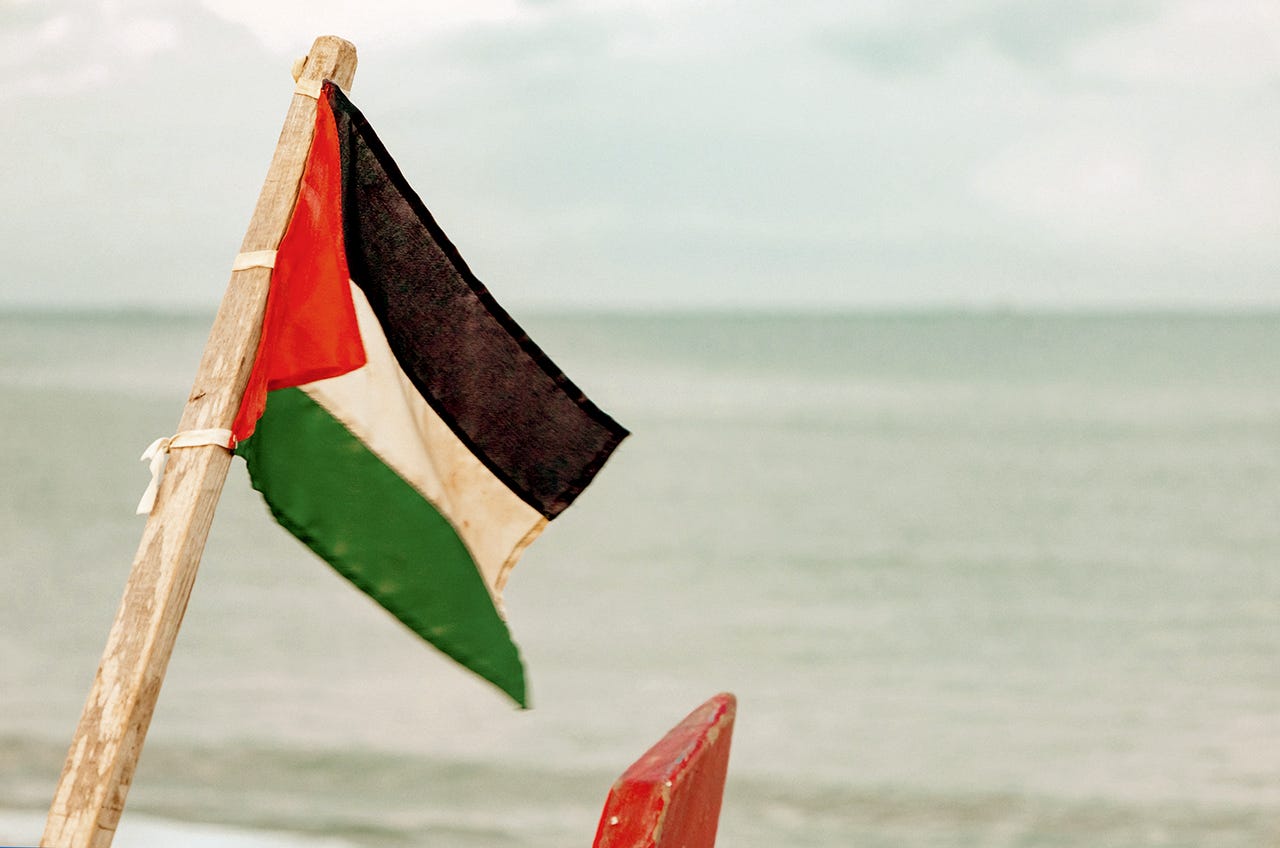
When this logic is applied to the political sphere, specifically to the Palestinian national movement, a structural similarity to gender theory emerges. The Palestinian national movement has not been a precursor to a Palestinian state, but a performance affirmed through symbols (the flag, the key), historical narratives, violent resistance, and international advocacy. The nation exists within the repetitive acts of resistance and declaration rather than in the concrete structures of governing, such as taxation, law enforcement, and infrastructure maintenance.
Palestinian performative nationalism has become a permanent revolutionary praxis rather than a pre-state project. The 1993 dictum of today’s Palestinian Authority president, Mahmoud Abbas, that “the mind of the revolution is very different from the mind of the state” is a trenchant comment on the movement from within, but it has remained a merely verbal critique. For previous national movements up to Zionism, performative nationalism was part of the actual social construction of a nation-state. Performative nationalism was in part the glorification of constructing water and sewage systems, managing economies, and securing borders. With Palestinian nationalism, as with transgender performance, the work ends with the production of the identity.
In the context of nationalism, performative movements treat the trappings of nationhood—flags, anthems, resistance aesthetics, even, as we shall see, performative violence and international recognition—as if they were the essence of a nation-state. While these features are associated with nations, they do not constitute the whole of a state’s functional reality, which includes the enforcement of law, the collection of taxes, and the capacity for maintaining and protecting the population and defending the borders.
This fetishism mimics some outward performances of a state without constructing the machinery. In gender theory, this gap is ontological: because changing biological sex is impossible, the performance must be the fetishistic substitute for the reality. In the Palestinian case too, the anticipatory performance substitutes for its intrinsic goal. For the Palestinian movement, the performance does not act as a substitute for an impossible reality, but as a diversion from a possible one.
The current state of Palestinian nationalism is the result of a historical lineage of “mimetic nationalism.” In the early twentieth century, nationalist movements were iterative: the Zionists studied and copied the Irish struggle, and the Palestinians subsequently modeled their movement on the Zionists. The Irish national movement, however, eventually pivoted to the mundane work of statecraft, establishing the Free State, an army, a police force, and all the other apparatus of modern statehood. Éamon de Valera, who preferred irredentist resistance to the obligations of statehood, was crushed by the Treaty supporters of the Irish Free State in the Irish Civil War.
Zionists explicitly studied Irish guerrilla tactics but were obsessed with constructing bureaucracy and its material instantiations. They focused on building power plants, ports, and healthcare systems—effectively constructing a “state within a state” under the British Mandate. The performances of nationalism—the anthems, the flags, the diplomatic representations—were always understood as costuming for the material and bodily construction that is state-building.
In contrast, the Palestinian movement has fetishized external and superficial aspects of the performance of statehood. Gender theory says that the clothes make the woman, and, correspondingly, Palestinian nationalism performs as if some of the trappings of nationalism could make the state. The Palestinian national movement mimics the Jews’ armed struggle against the British and the Arabs from 1945 to 1948 rather than the proto-state Zionism that made that moment of resistance a stage of state-building.
Building a functioning Palestinian economy and fiscal system independent of Israel is omitted in part because the “refugee” identity—the core of the performance—requires a state of dependence on international aid, such as UNRWA. To become self-sufficient would be to stop performing the role of the victim. Consequently, the state does not arrive because neither Palestinians nor foreign powers engage in the essential work of building it.
A fundamental misunderstanding of political ontology contributes to the failure of state-building in the Palestinian context. As Eugen Weber argues in Peasants into Frenchmen, state-building is an act of colonialism, in some places largely externally imposed, in others like post‑1815 France internally driven. Weber demonstrates that national unity in France was not natural but was manufactured by a colonizing center in Paris that aggressively erased local cultures, imposed a standardized language, and utilized compulsory schooling and military conscription to turn disparate groups into a single nation.
Zionism succeeded because it both pursued this colonial praxis and collaborated in the British colonization of Palestine. The pre-state Jewish community (the Yishuv) imposed Hebrew over Yiddish, created a militia and an offensive strike force, and established centralized institutions. Like the French, the Italians, and the Chinese, the Jews colonized themselves to create their modern state. Like other peoples within the modern British Empire, they also allowed the British to colonize them as long as that colonization served the mandated end of building a Jewish national home.
The Palestinian movement, identifying purely as “postcolonial,” is structurally incapable of this process. If national identity is constructed entirely around resisting power and resisting imposition, the leadership cannot build a state, because, as Eugen Weber explained, a modern state is always and everywhere an imposition. To master the machinery of sovereignty, the Palestinian leadership (whether Fatah or Hamas) would have to superadd policing their own people and extracting revenue from them to the performance of resistance.
Palestinians and their foreign supporters blame their failures of modernization on “the occupation.” There are certainly cases where imperial or colonial powers have prevented the acquisition of state capacity by those despotically ruled. The United States has always carefully managed its Native American “subject nations” to prevent them from empowering themselves by conducting their own relations with European powers, or by accepting immigrants and assimilating them.
Palestine under British and Jewish rule is, however, not one of those cases. By refusing the status of subjects under the British Mandate or under Israeli occupation, Palestinians failed to acquire the institutional levers necessary to become citizens of their own state. The refusal to participate in the colonial work of state-building is illustrated by the Palestinian response to the British Mandate. In the 1920s, specifically with the 1922 Legislative Council proposal, the British offered a representative body to the Arab majority. The Arabs rejected it because participation would have implied recognition of the Balfour Declaration and acceptance of the legitimacy of the terms of the Mandate.
Under the Mandate the Palestinians even refused superficial performative aspects of nationalism. In 1926, Lord Plumer, the second High Commissioner, was invited by the Jews to a major athletic competition. At a ceremony in Tel Aviv, Plumer stood for the Zionist anthem, Hatikvah, prompting outrage from Arab delegations who accused him of bias. Plumer responded by asking the delegation if they had a national anthem for him to stand for. When they admitted they did not, he advised them to “get one as soon as possible.” It took the Palestinian movement over 60 years to heed this advice.
In the nearly eight decades since the British left, the Palestinians have mastered some of the performative aspects, but to a substantial degree neglected or refused the work of state construction. Beginning with the First Intifada they ceased to collaborate strategically with Israel, thus preventing the Jews from building the state apparatus for them eventually to take over.
Contrary to the postcolonial narrative that views all imperial presence as purely destructive, the history of successful state-building often involves a phase of indirect rule, where institutions are built for an emerging nation under the security umbrella of a hegemonic power. The Zionist movement understood this pragmatically. They utilized the British Mandate as a “cocoon,” allowing the British to handle the heavy lifting of external defense and external security. This freed the Yishuv to focus their energy entirely on the mundane internal construction of a state: collecting taxes, building power plants, and managing healthcare.
The tragedy of the Palestinian national movement is the repeated refusal to utilize the space of indirect rule for governance. The Oslo Accords were, structurally, an offer of indirect rule—an opportunity for the PLO to build a civil state while Israel bore the cost of external defense. However, Yasser Arafat, and later Hamas, rejected the logic of governance. For Arafat, the autonomy granted by Oslo was not a platform for building a state but a sanctuary for preparing violence. By prioritizing the capacity to kill Jews over the capacity to govern Palestinians, the movement remained trapped in a performative loop: forever staging the revolution, never constructing the state.
When the British left in 1948, the Zionists did not need to build a state from nothing; they merely needed to rename the one they had partly built and partly co-opted. Israel has repeatedly allowed Palestinians to conduct their own diplomacy and raise resources from European and Arab countries. The Palestinians have chosen to invest those resources in infiltration tunnels, improvised and purchased weapons, and payment to families of martyrs, rather than more permanent forms of state construction.
The ultimate trap of performative nationalism is found in acts of spectacular violence that attempt to summon a new reality through blood sacrifice. The Hamas attack on October 7, 2023, can be analyzed as “apocalyptic performativity”—an attempt to force the embodied world to align with a performative fantasy through sheer magnitude of rape and killing.
This substitution of spectacular violence for institution-building echoes other historical cases, most chillingly the Hutu Power movement in Rwanda up to the genocide of 1994. Both the Rwandan genocide and October 7th involve a group trying to solve a deficit of state-building by wholesale murder. Like the Palestinians relying upon UNRWA instead of building a tax system and a parastate to provide actual public services, the Hutu-dominated government of Rwanda outsourced public services to foreign aid agencies and NGOs. Lacking the capacity to defeat the RPF rebels on the battlefield, the Hutu government turned to the systematic slaughter of defenseless civilians to perform the purification of the nation. In both Gaza and Rwanda, performative violence did not achieve by itself what can only be done through socially constructed state power (if, sometimes, genocidal state power); rather, this violence invited its destruction by a more institutionalized military force of a state or, in the case of the RPF, of a state in waiting. Genocide for both Hamas and the militant Hutus was not a political-military strategy but a performative substitute for one. For that fetishistic substitution, Butler’s poststructuralist gender theory serves as apologist and cheerleader.
The political-philosophical problem can be summarized viscerally as “all wedding, no consummation.” The “wedding” is the ceremony of statehood: the flags, embassies, UN resolutions, and cultural cachet—an anticipatory display. Consummation would require producing state institutions on the ground. This would require enforcing law and order and building an economy and a bureaucracy that would enable the Palestinian nation-state to operate entirely or principally from Palestinian ways and means.
The Palestinian movement acts as if the ceremony is the marriage. They act as if the ceremony is loud enough, and if enough important guests attend, then a Palestinian state will spontaneously appear without the need for all the foundations of state construction. Herzl’s novel Altneuland was the performance of a vision and a promise, yes, but the modern Zionist movement Herzl created treated his novel as an inspiration for political and economic instantiation.
The Palestinian national movement has won over the audience (international opinion) and perfected the symbols of nationhood, yet it lacks the constructed reality of a state because the Palestinian national movement has refused to undertake the colonial labor of state-building and has successfully resisted or refused to allow it to be done sufficiently for the Palestinians by others, such as the British or the Israelis. The tragedy is that the partial performance has succeeded too well; the Palestinian national movement is waiting for the state to appear without internal or external colonization because they have perfected some of the performative aspects.
The Palestinian national movement has refused much of the praxis of state-building, but unlike the Kurds or the Zapatistas it is not content with becoming a nonstate autonomous community. Until the movement transitions from the ceremonies to the infrastructure of sovereignty, it remains a performance of nationalism that avoids the state-building that is supposed to consummate it.
Poststructuralist theorists view the instantiation of gender in the biological family or the instantiation of embodied power in the nation-state as oppressive structures that should be deconstructed. As Corinne Blackmer has pointed out, this leads the organized trans community to reject the successfully embodied performance that is the Jewish state. Conversely, the Palestinian movement they admire seems trapped in a fetishistic display where the performance of resistance becomes the highest possible achievement.
Topics: Israel Initiative
Michael S. Kochin is Associate Professor in the School of Political Science, Government, and International Relations at Tel Aviv University, and Visiting Scholar in the School of Philosophy at The Catholic University of America and the Van Andel Graduate School of Government at Hillsdale College in Washington, DC.