


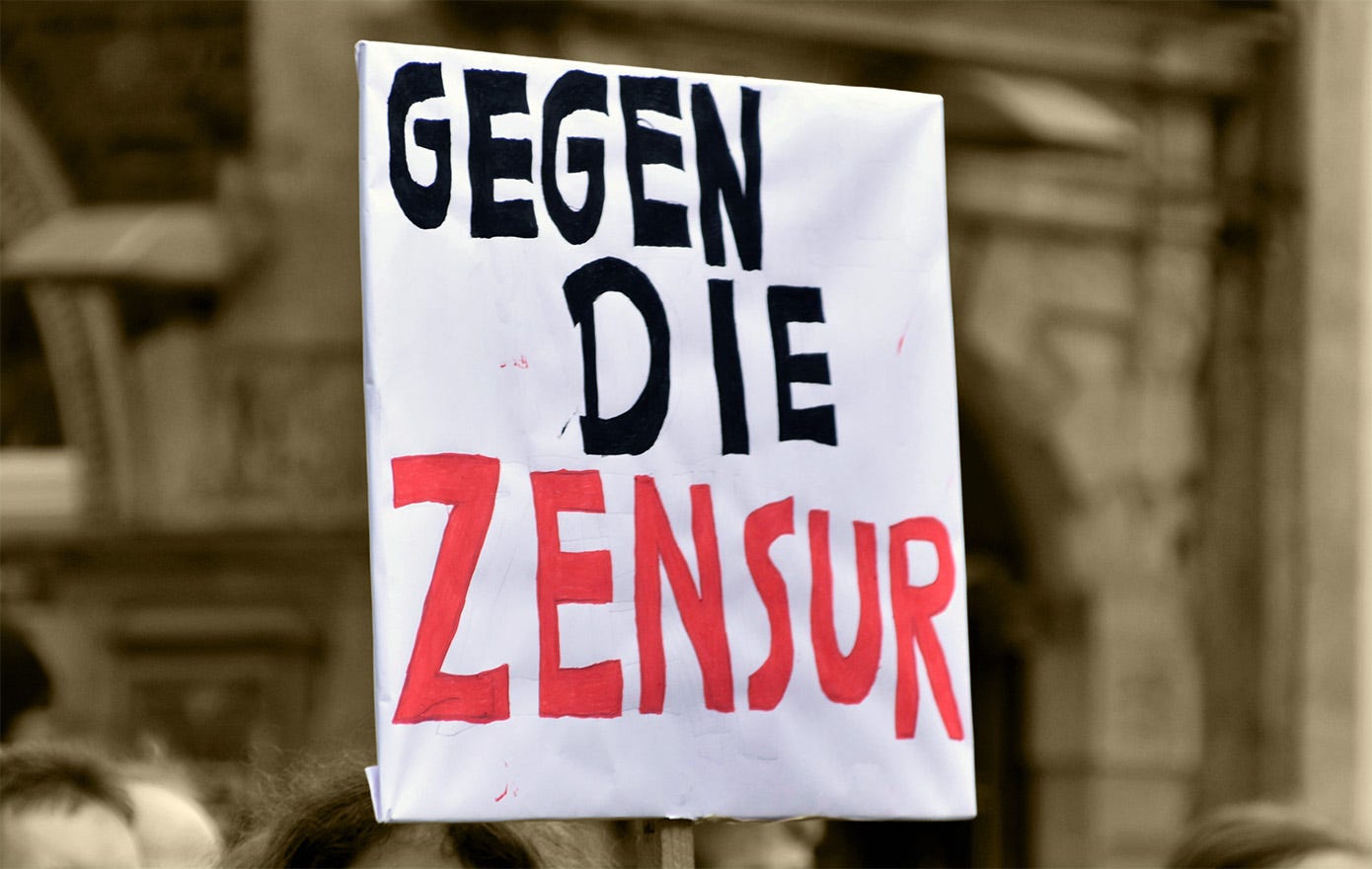
Article 5(1) of the German Basic Law (Grundgesetz) declares: “Everyone shall have the right to freely express and disseminate his opinions. There shall be no censorship.” As a foundational constitutional guarantee, the provision appears unambiguous.
That commitment to free speech has been hollowed out through a set of overlapping criminal statutes, government-backed enforcement networks, and targeted prosecutions—particularly since 2015. As a result, the space for political speech has narrowed, with concrete and measurable consequences: thousands of criminal prosecutions per year, police raids on private homes over social media posts, and a documented chilling effect on public discourse. Polling by the Allensbach Institute, Germany’s foremost survey organization, indicates that a majority of German citizens feel unable to express their political views freely.
The phenomenon has attracted comments from international observers, including the Economist and a segment on the CBS program 60 Minutes. This program drew wider Anglophone attention to the issue and featured prosecutors who described, with obvious schadenfreude, how painful it is for people when their mobile phones are taken away.

Section 188 and the Criminalization of Political Insult
This situation has been brought about by a series of new laws, such as Section 188 of Germany’s criminal code (Strafgesetzbuch), enacted in 2021 during the final year of Angela Merkel’s chancellorship, which creates a specific criminal offense for insult, malicious gossip, and defamation directed at persons in political life. Its immediate legislative pretext was the assassination in 2019 of Walter Lübcke, a regional politician murdered by a far-right extremist with a documented history of violent activity stretching back to his adolescence—largely predating the era of social media. The invocation of Lübcke’s killing as justification for a law regulating online expression was, from the outset, strained: incitement to violence and acts of violence were already criminalized under existing provisions of German law, and the perpetrator’s radicalization bore no evident causal relationship to unmoderated social media commentary.
The law’s actual scope is much broader and does not restrict itself to far-right speech, threats, or incitement. It applies to any expression deemed sufficiently insulting or defamatory toward a public figure in political life—a category whose boundaries are determined through prosecution and judicial interpretation rather than statutory precision. The result has been a wave of criminal proceedings against private citizens for comments that, in most comparable liberal democracies, would fall within the ordinary protections afforded to political speech.
Enforcement has been facilitated by a network of organizations whose business model it is to monitor digital platforms for potential violations. Among the most prominent of these are So Done or HateAid, NGOs that provide legal assistance to complainants and which work in close cooperation with politicians who bring charges. The institutional architecture thus combines state prosecutorial power with quasi-private surveillance infrastructure.
Documented cases illustrate the range of conduct now subject to criminal sanction. In one recent and widely reported instance, police initiated an investigation against a retired citizen who had shared a Facebook graphic depicting CDU leader Friedrich Merz as Pinocchio; the case, which caused some public amusement, was ultimately dropped, but only after the formal machinery of criminal investigation had been set in motion. More consequentially, Stefan Niehof—also a pensioner—had his home searched and his computer seized following a social media post characterizing Robert Habeck, then Federal Minister for Economic Affairs, as a moron. The circulation of a photograph showing Niehof accompanied by his daughter, who has Down syndrome, also generated substantial public attention and briefly brought the disproportionality of such enforcement into sharp relief.
The case of a construction engineer from Dortmund is perhaps the most instructive for the purposes of assessing the law’s scope. In April 2022, the man sent a letter to Manuela Schwesig, Minister-President of Mecklenburg-Western Pomerania, expressing sharp criticism of her role in promoting the Nord Stream 2 pipeline with Russia—a project subsequently discredited in the wake of Russia’s full-scale invasion of Ukraine. The letter was intemperate in tone (he invited her to join his colleagues in construction, rather than selling the public lies) but contained no threat. The public prosecutor nonetheless sought a monetary fine of €3,000. When the defendant declined to pay, the matter proceeded to a custodial sentence. In August 2023, he was arrested at his workplace and imprisoned for thirty days.
Defensive Democracy and Its Transformation
The intellectual and constitutional foundations of Germany’s restrictive approach to political speech lie in the concept of streitbare Demokratie—variously translated as “militant,” “fortified,” or “defensive” democracy. Developed in the postwar Federal Republic, the doctrine holds that a democratic order need not remain neutral in the face of movements that seek to exploit its freedoms in order to destroy it. The concept finds expression in several constitutional provisions, including Article 18 (forfeiture of basic rights for anti-constitutional purposes) and Article 21(2) (the prohibition of political parties whose aims threaten the free democratic basic order).
The concept was accompanied by a promise not to repeat the mistakes of the Weimar Republic. From the outset, however, it was also linked to a fear of the electorate, whom many within the elites held responsible for the rise of fascism. The architects of the Basic Law sought to build a constitutional order that would de facto protect democracy from the electorate.
Originally, the concept was designed to address existential threats to constitutional order—the prospect of organized movements dismantling democratic institutions from within. Yet the logic of defensive democracy has proved very flexible. As the concept’s boundaries have been extended, and as the designation of “threats to democracy” has been applied to an increasingly broad range of political positions and speech acts, the doctrine has been transformed from a safeguard against authoritarianism into a mechanism for entrenching political incumbency, especially with the rise of new populism.
The 2015 refugee crisis was a structural catalyst for this transformation. The scale and speed of irregular migration into Germany exposed deep divisions within the electorate, accelerating the growth of the right-wing populist party Alternative für Deutschland (AfD). The party’s electoral success confounded the expectations of the established parties. Unable to win back the trust of large sections of voters, mainstream politicians and their media supporters attempted to delegitimize their critics. The expansion of speech restrictions was central to this strategy. Critics of migration policy were characterized as xenophobes, their speech was labeled hateful or far-right adjacent, and legal mechanisms were used to penalize its expression.
The Broader Legislative Framework
Section 188 operates within a wider statutory architecture that compounds its restrictive effects. Section 130 of the Criminal Code—the Volksverhetzung provision, or incitement to hatred—has a longer history, originating in postwar efforts to suppress neo-Nazi agitation. It criminalizes the disturbance of public peace through incitement to hatred, violence, or arbitrariness against national, racial, religious, or ethnic groups, or against individuals on the basis of group membership. The provision has been subject to repeated legislative amendment, and its scope too has expanded considerably in the past years.
The application of Section 130 to critics of Islam is particularly revealing. In May 2024, Michael Stürzenberger, an activist associated with the anti-Islam organization Pax Europa, and a victim of an Islamist-motivated attack, was fined €3,600 under the provision for statements made at a rally in October 2020. This was an extension of an earlier conviction in a lower court, where Stürzenberger had received a six-month prison sentence without probation—a sentence that he successfully appealed. However, before the appeal case began, Stürzenberger was seriously injured in a terrorist attack in which a policeman was killed (the attacker had pledged allegiance to ISIS). The irony could not be starker: while terrorism attempted to silence him through violence, the state has attempted to do so through its anti-free speech laws.
Further provisions include Section 166 (defamation of religious beliefs), Section 86 (dissemination of material from unconstitutional or terrorist organizations) and Section 86a (use of symbols of such organizations). The application of Section 86a to far-right AfD politician Björn Höcke in May 2024—resulting in a fine of €13,000 for using the phrase “Alles für Deutschland” (“Everything for Germany”), a slogan associated with the SA during the Third Reich—illustrates the operation of these provisions. The charge was initiated by a member of the Green Party. That Höcke’s party subsequently won 32.8 percent of the vote in the September 2024 Thuringian state election—the largest share of any party—suggests that legal stigmatization has not achieved its intended deterrent effect on the electorate.
Consequences: Alienation, Chilling Effects, and Political Failure
The scale of enforcement under these provisions is substantial. The cumulative total of individuals affected by speech-related criminal proceedings over the preceding several years runs to tens of thousands. Police crime statistics recorded over 4,500 breaches of Section 188 in 2025 alone, and in 2024 the Federal Ministry of Justice recorded approximately 26,000 prosecutions for various “propaganda offences.”
The chilling effect of speech restrictions is not merely theoretical but can be observed empirically in patterns of self-censorship, as shown in the Allensbach surveys. This effect is particularly pronounced in debates around highly contested issues such as migration, climate change, and measures to combat the coronavirus pandemic.
But citizens who feel that legitimate avenues of expression have been foreclosed do not moderate their views; they redirect their political energy and anger. The electoral growth of the AfD is, at least in part, a structural consequence of a strategy that attempted to contain populist sentiment through legal coercion rather than political engagement.
In Defense of Classical Liberal Protections
Hans-Georg Maassen, the former President of the Bundesamt für Verfassungsschutz (Federal Office for the Protection of the Constitution), has characterized Section 188 as cementing “a two-tier society” and has questioned why elected politicians—who possess greater institutional resources than private citizens to rebut criticism—should receive elevated legal protection from public insult. Indeed, in a truly free and liberal society, the arrow of constitutional protection should run from citizen to state, not the reverse. Public figures who seek and exercise power accept heightened scrutiny, including scrutiny that is immoderate in tone, as a condition of democratic accountability.
The German case raises a question of broader comparative relevance: at what point does a democracy’s institutional self-defense become indistinguishable from the authoritarianism it purports to resist? The doctrine of streitbare Demokratie was conceived as a safeguard against totalitarian subversion. Its contemporary application—the prosecution of pensioners for satirical Facebook posts, the imprisonment of citizens for critical correspondence with politicians, the fining of opposition politicians for the use of historically resonant phrases—has departed so far from that original purpose as to constitute a qualitative transformation rather than a mere extension.
The case for robust free expression rests not on the intrinsic value of any particular utterance but on the systemic properties of open discourse: its capacity to surface legitimate grievances, to subject power to scrutiny, to allow bad ideas to be challenged and refuted rather than suppressed and preserved. Germany’s legislative trajectory over the past decade suggests a governing class that has lost confidence in these systemic properties—that has concluded, in effect, that political competition can be managed more reliably through legal constraint than through the persuasive resources of democratic argument. This is both empirically mistaken and normatively dangerous.
Sabine Beppler-Spahl studied economics at Hamburg University. She is chair of the German liberal think tank Freiblickinstitut and the Germany correspondent for Spiked. She also writes regularly for the European Conservative.