

The Castle in Chicago: The Obama Presidential Center and the Architecture of Power
by Mohadeseh Salari Sardari

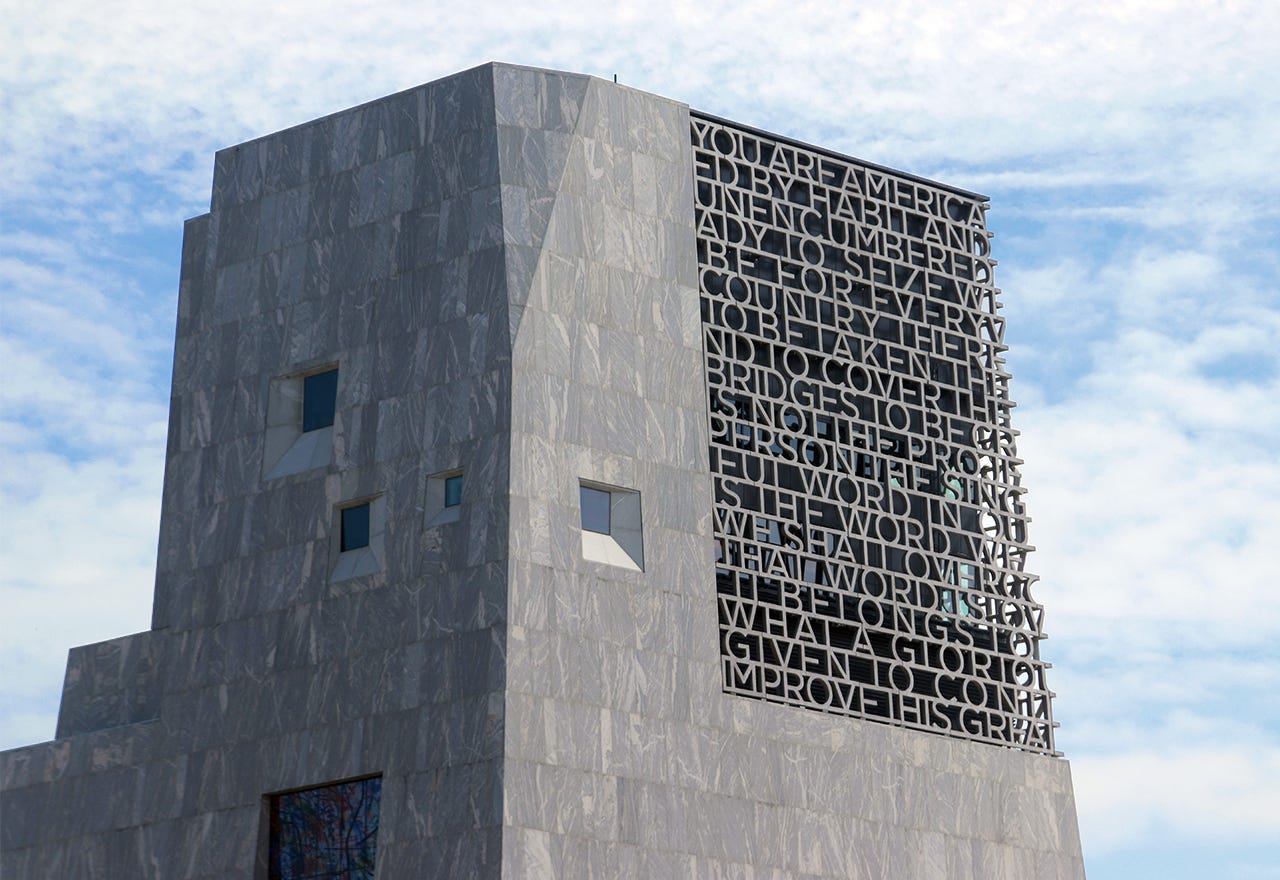
K. saw only a single tower, and could not make out whether it was a dwelling or belonged to a church. Flocks of crows were circling around it. His eyes fixed on the castle, K. went on, paying no attention to anything else. But as he came closer he thought the castle disappointing . . .1
Kafka’s description of the castle in The Castle resonates strangely when standing before the Obama Presidential Center in Chicago. K. approaches what should be a meaningful structure, only to find it “disappointing”—a word that lands with quiet devastation. The castle fails not through ugliness but through a kind of deliberate withholding: it will not give itself to you. The Obama Presidential Center invites comparison with Kafka’s castle in its remoteness and opacity.

Tod Williams Billie Tsien Architects has cited the work of Constantin Brâncuși as a formal inspiration for the tower’s monolithic presence. As architect Billie Tsien told the Guardian, “He talked a lot about his love of Brâncuși,” describing how Obama’s own enthusiasm for the sculptor shaped the building’s form.2 But formal inspiration borrowed from sculpture does not transfer cleanly to architecture. Brâncuși’s power lies precisely in the self-contained wholeness of objects that ask nothing of the body except to look. A building cannot make that demand. It must be entered, navigated, and lived in, and on those terms the Brâncuși analogy collapses. This comparison reveals a fundamental confusion between two different arts. Sculpture is an object you read from the outside; its meaning is surface and silhouette. Nobody enters a sculpture. Architecture, by contrast, is an art you inhabit—its obligation is not just to be seen, but to receive the human body, and to negotiate between outside and inside.
More critically, this sculptural ambition runs against the very grain of what modern architecture historically stood for. From Mies van der Rohe’s glass curtain walls to Le Corbusier’s pilotis and the democratic ideals of the Bauhaus, modernism was founded on the principles of transparency, accessibility, and human scale. It sought an architecture for everyone, rejecting monumentality, opacity, and aristocratic grandeur. The Obama Center presents a formal language more readily associated with monumentality and enclosure than with architectural transparency or civic accessibility. Like Kafka’s castle, it is visible but unreachable in spirit—a monument that humbles the visitor rather than welcoming them.
Chicago is one of the most architecturally consequential cities in the world, where American architecture found its own voice. Louis Sullivan developed his ornamental organicism there, rejecting European historicism in favor of an architecture rooted in the American experience.3 Frank Lloyd Wright extended this impulse, developing an architecture that spread across the land and treated topography and nature as generative forces rather than obstacles. What defined both men, beyond formal language, was a deep commitment to the human being as the measure of architecture. Wright’s buildings, though monumental in ambition, remain approachable. Their understated entrances draw visitors in through curiosity rather than grandeur.4 This contrasts with churches or castles, where scale and verticality emphasize hierarchy and the individual’s smallness before authority.
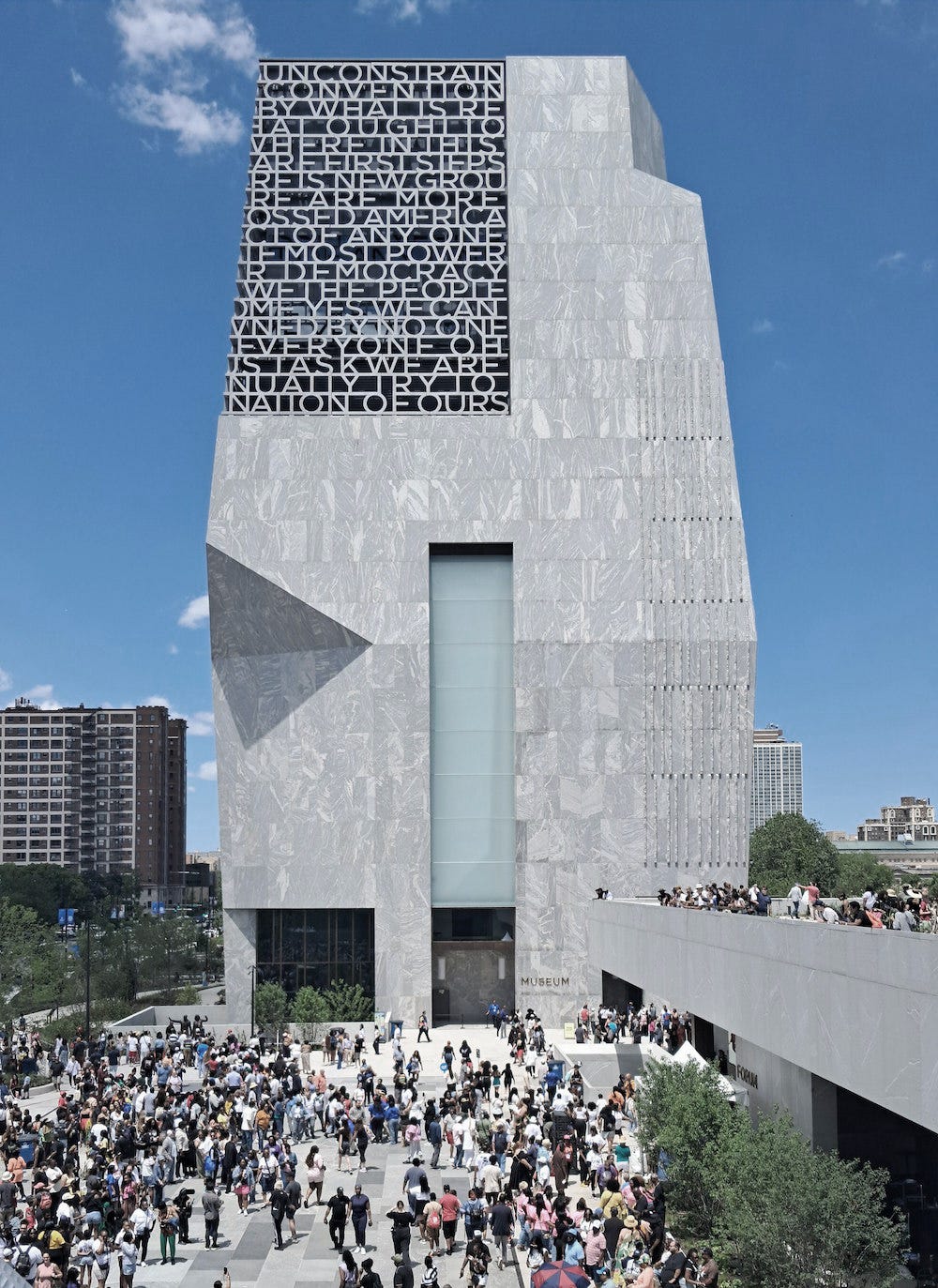
The Obama Center departs from the modernist emphasis on transparency and civic openness, as well as from the Chicago tradition of human-scaled democratic architecture. Instead, it borrows the language of sculpture and monument, achieving presence at the cost of belonging. The result is a contradiction between architectural language and democratic ideals.
If Chicago offers one local standard against which to measure this failure, a global one confirms it. More broadly, community centers succeed when they are grounded, literal, and responsive to the communities they serve. They work with local materials, engage local builders, and subordinate architectural ambition to human need. Renzo Piano’s work in Nouméa, the Tjibaou Cultural Center, and Alvar Aalto’s civic buildings such as the Säynätsalo Town Hall in Finland operate on this principle.
Piano studied local building traditions, translating the form of traditional Kanak buildings into a structure built from iroko wood and steel, designed to breathe with the Pacific wind rather than resist it. It does not announce itself from a distance. It reveals itself slowly, at walking pace, at human scale.5 Alvar Aalto’s Säynätsalo Town Hall follows the same principle: built for a small industrial community in local red brick, with an intimate council chamber and a courtyard that invites rather than commands. For a civic building, its modesty is almost radical. It tells the people it serves that they are not subjects of authority but participants in it.6 However refined their architecture, they remain fundamentally down to earth, oriented toward the people who will use them daily rather than toward the skyline or the history books.
The Obama Center does not belong to this tradition. It belongs instead to a much older and more troubling one: the architecture of power that uses scale and monumentality to assert authority rather than invite participation. The great medieval universities, the cathedrals, the fortified institutions of learning were deliberately forbidding, their gates a threshold that filtered the worthy from the unworthy. Modern architecture was born precisely as a rejection of this logic. It emerged from an urgent social need, housing for factory workers, schools, functional and dignified spaces for ordinary people who had been excluded from beauty and comfort as a matter of course.
There was, in fact, a closer and more fitting architectural lineage available to this project than either modernism or the Chicago school. Given Obama’s own Kenyan heritage, the building’s silence on Kenyan architectural traditions is a missed opportunity rather than a neutral omission. As architectural historian Itohan Osayimwese argues in African Buildings, Kenyan architectural traditions were once marked by considerable formal and spatial complexity before being disrupted, dismantled, and displaced through colonial extraction, looting, and collecting practices.7 This history offers another architectural lineage that the Obama Presidential Center might have engaged more directly. Such a lineage would not have answered the modernist critique by itself, since transparency and human scale are formal commitments that any tradition can honor or ignore, but it would have grounded the building in a history more specifically its own.
To erect a sculptural monument in the name of community, in the name of a presidency that presented itself as belonging to everyday people, is a symbolic contradiction that cannot be designed away. The architecture of self-aggrandizing monumentality, of power made stone, was precisely what dictators favored, all of whom despised modernism and suppressed it, replacing it with their own inflated classicism. That is not the lineage a democratic legacy should claim. The ultimate test of any building is not how it photographs from above but how it feels to stand before it, to enter it, to inhabit it. Architecture is experienced from the ground, at human speed, by human bodies. When a building only resolves itself from a distance or from the air, when its logic is compositional rather than inhabitable, it has answered the wrong question entirely.
Measured against the modernist tradition from which it departs, the Chicago architectural legacy it ignores, and the civic community it seeks to serve, the Obama Presidential Center remains most legible from a bird’s eye view. That is precisely the problem. A presidential legacy that defined itself through proximity to ordinary people deserved an architecture that works at eye level, at the scale of the street, the entrance, the hand on the door. Instead, it received a monument. And monuments, as Kafka understood about castles, can be seen by everyone and reached by no one.
Mohadeseh Salari Sardari grew up in Bandar Abbas in southern Iran and trained as an architect in Iran before pursuing her PhD in the United States. She is completing her PhD dissertation, Literary Selves and Architectural Space, in the Department of History of Art and Architecture at Brown University. Her research explores the intersections of architecture, literature, gender, and spatial politics in modern Iran. She is currently a lecturer in Stanford University’s Department of Comparative Literature and has worked with museum collections and exhibitions at institutions including the Museum of Fine Arts, Boston, and the RISD Museum. Her work on Iranian literature, art, and culture has been published in both Persian and English.
Franz Kafka, The Castle, trans. Anthea Bell (Oxford: Oxford Univ. Press, 2009), p. 11.
Oliver Wainwright, “‘Like a Klingon Prison’: Inside Barack Obama’s Audacious, Near-Windowless, $850m Presidential Library,” The Guardian, June 2, 2026, https://www.theguardian.com/artanddesign/2026/jun/02/klingon-prison-barack-obamas-presidential-library-chicago.
“Louis Sullivan Buildings Extant in Chicago,” The Art Institute of Chicago, https://www.artic.edu/archival-collections/digital-publications/louis-sullivan-collection/louis-sullivan-buildings-extant-in-chicago.
“The Buildings of Wright’s Chicago Years,” Frank Lloyd Wright Trust, https://flwright.org/explore/buildings-wrights-chicago-years.
“Jean-Marie Tjibaou Cultural Center,” Renzo Piano Building Workshop, https://www.rpbw.com/project/jean-marie-tjibaou-cultural-center.
“Säynätsalo Town Hall,” Alvar Aalto Foundation, https://www.alvaraalto.fi/en/architecture/saynatsalo-town-hall/.
Itohan Osayimwese, Africa’s Buildings: Architecture and the Displacement of Cultural Heritage (Princeton, NJ: Princeton Univ. Press, 2026).