

Subjects, Not Citizens: The Qajar Roots of the Islamic Republic
by Mohadeseh Salari Sardari

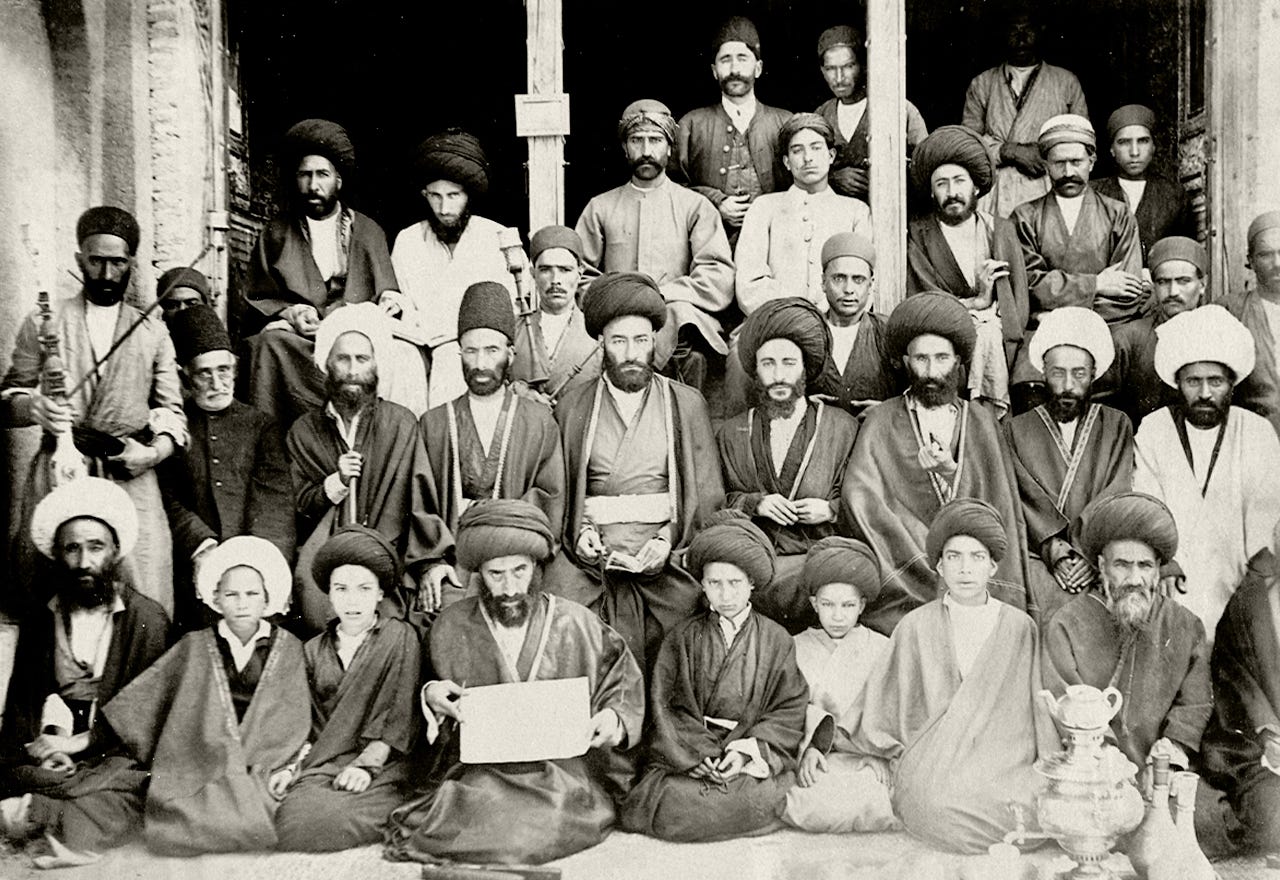
The Islamic Republic presents itself as something new, a revolution, a rupture, a divine mandate with no precedent in Iranian history. The historical record suggests otherwise. What looks like novelty is better understood as memory, a set of instincts about power, knowledge, women, and the West that the clerical establishment did not invent in 1979 but inherited from a much older arrangement. To understand where those instincts come from is to understand why the regime and the society it governs have never made peace.
The Pahlavi era is usually read as the great turning point in modern Iranian history, the moment the country broke from the Qajar dynasty (1786–1925)1—its despotism and clerical rule—toward secular modernization. They built modern schools, curtailed clerical authority over law, and pursued industrialization the Qajars never attempted. More than that, they built citizens: a growing professional class, women in universities and the workforce, a public increasingly literate, mobile, and accustomed to a state that had to at least perform responsiveness. By 1979, two different Irans existed in the same country: a society that had moved decisively toward citizenship, and a clerical apparatus that had never stopped thinking in the Qajar register of subjects to be governed. The revolution was not the clergy completing a process the Pahlavis began. It was the clergy capturing a revolution that belonged, at the outset, to the citizens the Pahlavis had created, and then using state power to force that society backward into the relationship the Qajars would have recognized. The Islamic Republic is not the fruit of Pahlavi Iran. It is the Qajar relationship reasserting itself against a Pahlavi society, which is exactly why the two have been at war for over four decades. Had the Pahlavi dynasty never come to power, it would be reasonable to argue that the Islamic Republic, not constitutional monarchy or secular nationalism, was the more “logical” successor to the Qajars. The Qajar kings rarely acted without the clergy’s consent, and in exchange the clergy was granted free rein over law, education, and the public. The clergy controlled the public sphere, while the shahs were left free to do as they pleased in private.

Nasser al-Din Shah (1831–1896), the fourth and longest-reigning ruler of the Qajar dynasty, is the clearest example of this arrangement.2 He lived a lifestyle forbidden to ordinary Muslims, protected by the simple fact that his transgressions stayed behind palace walls. He famously married two sisters simultaneously, a union prohibited even under Islam’s own rules of polygamy. He drank wine freely, but only within the confines of his harem, where it could not offend the clergy. The same logic governed his relationship to art and spectacle. Having encountered European theaters firsthand, Nasser al-Din Shah wanted one built in Tehran, but commissioning a public theater would have invited immediate charges of immorality. The solution was taxonomic: relabel the building as a venue for taziyeh, the ritual passion play commemorating the martyrdom of Imam Hossein. The result was the Tekyeh Dowlat, a structure that was a theater in every architectural sense and a religious space in name only.
What emerges is a system built on a simple compromise: the clergy governed the public face of Iranian life, while the monarchy was permitted private exemption from the rules it nominally enforced. This is precisely the structure the Islamic Republic would later inherit and formalize, except without the harem walls to contain it. This hypocrisy is not an invention of the Islamic Republic. Its roots lie in the Qajar state, which institutionalized the rigid split between private indulgence and public piety that earlier Iranian dynasties were not similarly bound by.
The Qajars were fascinated by Western progress yet did almost nothing to bring its substance—its technology, institutions, or knowledge—into Iran. The monarchy’s response to modernity was not reform but suppression. Iranians were barred from traveling abroad, travelogues and foreign magazines were restricted, and modern schools were banned. The target in each case was the same: any channel through which new ideas about governance, rights, or the organization of society might reach the population. The parallel between Qajar and Islamic Republic approaches to knowledge runs deeper than selective adoption of technology. It is structural. In both cases, the state pursued Western science and technology not to improve the conditions of the population but to strengthen its hold over them. Nasser al-Din Shah wanted new sources of tax revenue and a surveillance apparatus capable of suppressing popular uprisings.3 The Islamic Republic wants precisely the same things. The technology is newer; the logic is identical.
The car offers the sharpest illustration. Iran had no roads. Travel between cities was possible only on horseback or by mule, and even carriages were largely unusable. When Qajar kings acquired automobiles, the vehicles had to be shipped across the Caspian Sea and then carried on horseback to Tehran, where they were driven inside the walled enclosure of the harem.4 The country had no infrastructure that could accommodate them. That was not the point. The continuity into the present is difficult to ignore. The Islamic Republic’s ruling families drive luxury foreign cars in Tehran while imports of the same vehicles remain banned for the general public. The logic is identical to the Qajar court: modern technology is permitted, even embraced, as a tool of private pleasure and elite comfort, while any form of it that might empower or connect the broader population is kept out of reach. Modernity, across both dynasties, was not rejected but privatized.
When Christian missionaries sought to open schools in Iran, they were permitted to do so only in a few cities of the country, and only for Assyrian and Armenian Christians. Muslims were barred from attending.5 In Tehran’s first census, literacy and education statistics placed Zoroastrians, Jews, and Armenians at the top, and Muslims at the bottom.6 Persecution of religious minorities was nonetheless real and often brutal. Under the Qajar dynasty, Jews faced systematic legal discrimination alongside recurring communal violence. Mobs attacked Jewish neighborhoods in Shiraz, Tehran, and other cities, looting and burning homes. The situation in Mashhad was more extreme still. There, clergies forced the entire Jewish community to convert to Islam and forbade them from leaving the city—a condition that remained in place until the Pahlavi dynasty took power.7 Yet these same communities maintained robust internal traditions of literacy and learning—institutions that Muslim Iranians, excluded from any comparable secular education, were structurally prevented from developing. It was this preserved intellectual infrastructure that positioned the Jewish community as primary custodians of the Iranian musical tradition, keeping alive a body of knowledge that the state’s own policies had ensured no one else was equipped to hold.
The logic behind Muslim exclusion was spelled out in the texts of the period. Muslims had no need for secular education. They had the seminary. The clergy’s position was unambiguous. Modern schools spread heresy. This opposition extended to Iranian-run institutions as much as foreign ones. Iranian-owned schools were attacked and in multiple cases burned by mobs acting under clerical direction. The target was content, not origin. Any curriculum placing empirical inquiry or civic knowledge alongside religious instruction was treated as an assault on the clerical order. What emerged was a workaround. Elite families hired private tutors for their sons. Daughters received nothing. The reasoning was that female literacy was not merely unnecessary but dangerous. A woman who could write could compose letters to strange men, conduct secret correspondence, and find lovers. Writing was treated not as a cognitive skill but as a vector of sexual transgression, and suppressed on those grounds.8
The Islamic Republic inherited this logic and built it into the architecture of the state. By labeling the entire education system “Islamic,” it ensured that theology is not a separate subject but a constant undercurrent—present from a child’s first day of school through to a doctorate, regardless of whether the field is biology, architecture, or engineering. Students are taught the Quranic account of creation alongside the scientific one, embedding a direct contradiction at the center of the curriculum. Science is permitted where it serves the state and contained where it threatens the order on which the state depends.
The same principle governs universities. Shortly after the 1979 revolution, the regime shut down all higher education for three years under the banner of a “Cultural Revolution,” purging faculty deemed insufficiently loyal. When institutions reopened, hiring was governed not by academic merit but by gozinesh-e aqidati—a formal screening process testing candidates on Islamic doctrine and political allegiance. Admissions follow the same principle: Basij members and IRGC families receive priority placement, women compete for whatever remains, and certain fields are closed to them entirely as “unsuitable.”9 The system is designed less to cultivate knowledge than to reproduce political loyalty.
The treatment of women and children follows an equally direct line. During the Qajar era, girls were often married as young as eight or nine. Men could take multiple wives and as many sigheh—temporary wives—as they wished, while women had no rights in matters of divorce or consent.10 It is no coincidence that one of the first acts of the Islamic Republic after the revolution was to dismantle the Pahlavi-era Family Protection Law. The law had set the minimum marriage age for girls at eighteen and placed significant restrictions on polygamy.11 Both were abolished. The state goes further, actively promoting polygamy. State television runs segments featuring polygamous families, presenting the arrangement as the normatively correct form of household organization. The format is instructive, featuring young wives, multiple children, a shared domestic space, and no visible exit. The message is that this is what a properly ordered Muslim family looks like, and that the desire for anything else is a deviation to be corrected rather than a right to be protected.
The case of Aliakbar Sanati is illustrative. When Sanati attempted to establish an orphanage in Kerman during the Qajar era, the clergy mobilized against him. Documented accounts from the period describe children as young as four being put to work, by both Iranian and foreign companies, producing the fine carpets and textiles for which Kerman was famous.12 Sanati spent two years fighting for permission to open the orphanage, and even then was allowed to take in only boys; girls, the clergy maintained, were better off married as young as possible. The same logic governs the Islamic Republic’s promotion of early marriage today. Girls are not viewed as children with a claim to education, autonomy, or protection, but as reproductive resources. The state’s interest in early marriage is demographic and military: more births, younger, producing a larger pool of men available for conscription and ideological formation.
The Qajar kings maintained vast harems and hundreds of wives, and their sons were dispatched as governors across Iran from a young age, making kinship the backbone of imperial administration. The Islamic Republic operates on a similar principle. Since the revolution, a tight circle of clerical families, bound together by marriage, has held Iran in its grip, parceling out power among themselves.13 What Pahlavi modernization accomplished was cracking this circle open. Education and state-building carved real pathways upward for people born into rural poverty or urban obscurity, letting them rise into professional and even ministerial ranks.
The clergy’s objection to Pahlavi was never to dynastic or authoritarian rule in principle. They had supported the Qajars until their final days. What they opposed was the idea that ordinary people have the right to govern themselves. The doctrine of Velayat-e Faqih, the ideological foundation of the Islamic Republic, holds that only qualified religious jurists are fit to rule. In this framework, democracy is not simply impractical but sinful. A state that allowed anyone, regardless of background, to rise and govern was not an alternative model but a violation of divine order. The Guardian Council is where this theology becomes policy. Every candidate for elected office must pass clerical vetting before reaching the ballot, ensuring that the range of political choice is decided in advance by a small group of jurists. Elections happen, but the question of who may participate is settled before any vote is cast. This logic of controlled access extended well beyond politics. In culture, architecture, and the details of everyday life, the same impulse asserted itself: the clergy’s role was not only to determine who could govern but to decide what people may see, build, wear, and become. That ambition, total and ancient, is the thread running through everything this essay has traced, from the harem walls of the Qajar court to the ballot-vetting of the Guardian Council, a single unbroken insistence that the people governed are not the people who decide.
The war between the Islamic Republic and Iranian society is, at its core, a war between two different ideas of what a human being is. The Pahlavis, whatever their failures, built a society of citizens, people who understood themselves as having rights, futures, and a claim on the institutions that governed them. The Islamic Republic has spent many years trying to unmake that understanding, to reduce a citizenry back into subjects: governable, reproducible, conscriptable, and silent. That project has deep roots, older than the revolution and older than the Pahlavis. But the Qajar inheritance is not only a story about power and its abuses. It is also a story about the limits of that power, and about what happens when a state built on the logic of subjects encounters a population that has already decided it is something else entirely.
Mohadeseh Salari Sardari grew up in Bandar Abbas in southern Iran and trained as an architect in Iran before pursuing her PhD in the United States. She is completing her PhD dissertation, Literary Selves and Architectural Space, in the Department of History of Art and Architecture at Brown University. Her research explores the intersections of architecture, literature, gender, and spatial politics in modern Iran. She is currently a lecturer in Stanford University’s Department of Comparative Literature and has worked with museum collections and exhibitions at institutions including the Museum of Fine Arts, Boston, and the RISD Museum. Her work on Iranian literature, art, and culture has been published in both Persian and English.
Ann K. S. Lambton, Qajar Persia: Eleven Studies (London: I.B. Tauris, 1987).
Abbas Amanat, Pivot of the Universe: Nasir al-Din Shah Qajar and the Iranian Monarchy, 1831–1896 (Berkeley: Univ. of California Press, 1997).
Abbas Milani, “Nasir al-Din Shah in Farang,” in Lost Wisdom: Rethinking Modernity in Iran (Washington, DC: Mage Publishers, 2004).
Willem Floor, Transportation & Technology in Iran, 1800–1940: Chapar, Carts, Carriages, Automobiles, Bicycles, Motor Cycles, Lodgings, Sewing Machines, Typewriters & Pianos (Washington, DC: Mage Publishers, 2023).
Presbyterian Church in the U.S.A., A Century of Mission Work in Iran (Persia), 1834–1934 (Beirut: American Press, 1936).
Sirus Saʿdvandiyān and Manṣūra Ittiḥādiyya, Āmār-i Dār al-Khilāfa-yi Tihrān: Asnādī az Tārīkh-i Ijtimāʿī-yi Tihrān dar ʿAṣr-i Qājār [Statistics of the Capital Tehran: Documents from the Social History of Tehran in the Qajar Era] (Tehran: Nashr-i Tārīkh-i Īrān, 1368/1989).
“Tasavir: Mashhad History,” 7 Dorim, https://www.7dorim.com/tasavir/sh_mashhad_history/.
Mansoureh Ettehadieh, Shiva Rezayie, and Alireza Niknejad, Nime-ye Penhan: Zanān-e Irān dar Āstāne-ye Qarn-e Bistom [The Hidden Half: Iranian Women on the Threshold of the Twentieth Century] (Tehran: Nashr-e Tarikh-e Iran, 2020).
Mohadeseh Salari Sardari, “Women Who Cross Iran’s Invisible Borders,” The Freedom Frequency, March 27, 2026, https://www.thefreedomfrequency.org/p/women-who-cross-irans-invisible-borders.
Mansoureh Ettehadieh, “Zan dar Jameʿeh-ye Qajar” [Women in Qajar Society], Kelk, no. 55–56 (October–November 1995): 27–50.
Mahnaz Afkhami, Ḥuqūq-i Zan dar Īrān, 1346–1357: Barrasīhā-yi Ḥuqūqī va Taṭbīqī va Mutūn-i Qavānīn, bā Muqaddamaʾī dar Bāraʾi Sāzmān-i Zanān-i Īrān [Women’s Rights in Iran, 1967–1978: Legal and Comparative Studies and Legislative Texts, with an Introduction on the Women’s Organization of Iran] (Tehran: Markaz-i Zanān, Bunyād-i Muṭālaʿāt-i Īrān, 1994).
Sirus Parham, Farsh va farshbāfi dar Irān [Carpet and Carpet Weaving in Iran] (Tehran: Markaz-i Dāyirat al-Maʿārif-i Buzurg-i Islāmī, 1399/2020).
Mehrzad Boroujerdi and Kourosh Rahimkhani, Postrevolutionary Iran: A Political Handbook (Syracuse, NY: Syracuse Univ. Press, 2018).