


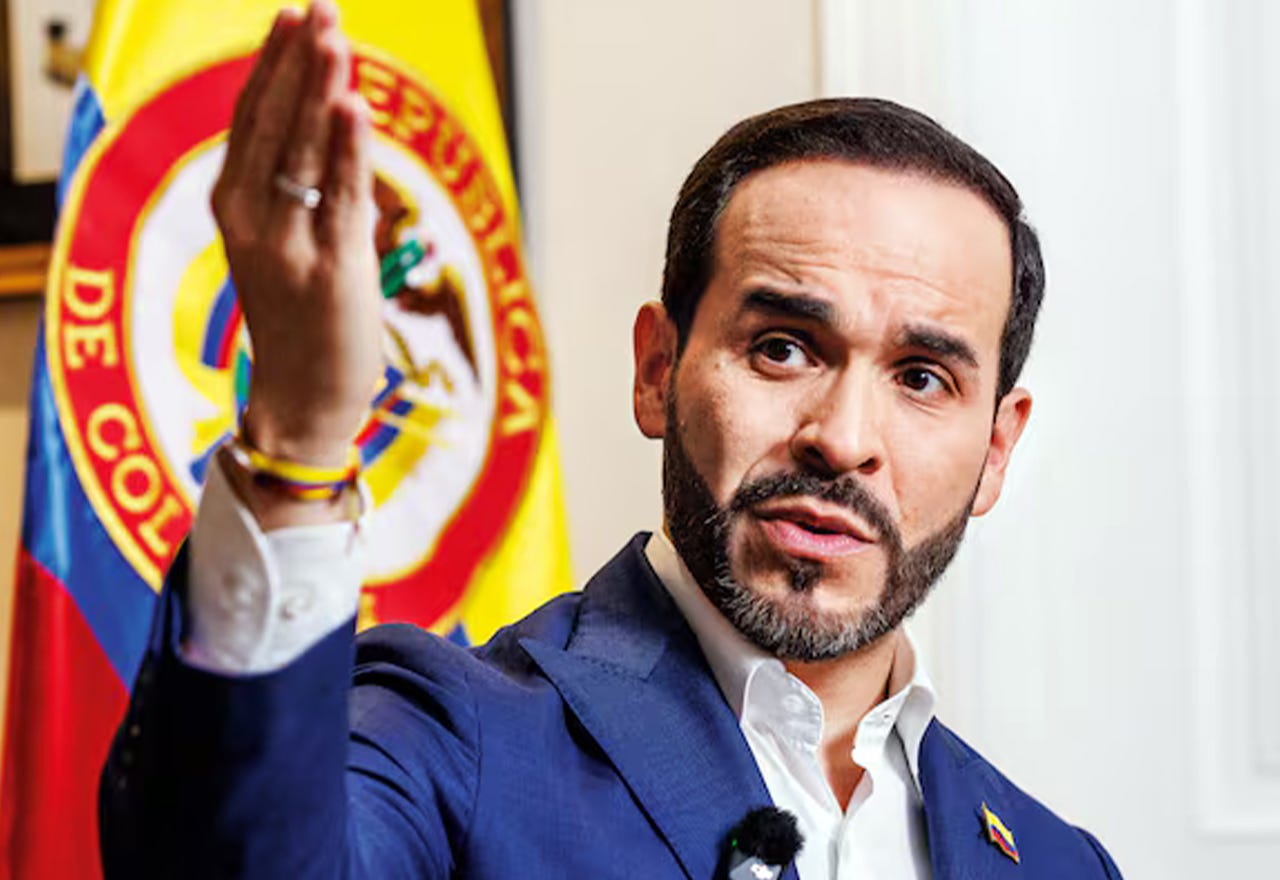
Colombia has just had its own political earthquake. The metaphor of a tectonic shift, which Adrian Pabst recently used in these pages to frame the outcome of May’s local elections in the UK, is just as apt here, perhaps more so, given the results of Colombia’s presidential election. Thanks to a razor-thin margin, but with more of the electorate voting than ever before, Abelardo de la Espriella, a political unknown less than a year ago, a defense attorney to the indefensible, a candidate pledging support to (and seeking support from) America and Israel, a proud Catholic (married with four young children), and an unapologetic nationalist, will become president on August 7. On that day, too, diplomatic relations with Israel, broken by the present government in response to Israel’s military response to October 7, will be restored.

Some context: While Colombia is the Americas’ second oldest continuous democracy, it has nonetheless suffered almost constantly from internal instability, as elites (and their local followers) with differing convictions, liberal and conservative, have battled each other via all means, including open violence, to establish control not so much over the national territory but over the regions deemed worth fighting over. An authoritative history of the country by David Bushnell is called Colombia: A Nation in Spite of Itself. The title, however, like many headlines, is betrayed by the content of the story. A more honest one might have emphasized that Colombia is, rather, a nation like any other, meaning that it struggles (perhaps more intensely, perhaps less successfully, so far) to actually be a nation (just like Spain and France, the United States and the United Kingdom do). And certainly, no one doubts that the last six decades or so have been marked by intensified internal conflict, which, though dressed up as political, is fundamentally driven by rent-seeking criminal groups that extract massive utilities via narcotrafficking and other illegal activities from the territories and populations they control. Perhaps the most compelling evidence supporting this claim is that since a peace agreement was signed now ten years ago, supposedly to end the internal conflict, cocaine production has only increased along with the criminality necessary to make it so.
A first real response to Colombia’s modern internal problems rooted in the criminal control of vast swathes of the national territory was attempted during the two presidential periods of Álvaro Uribe (2002–2006, 2006–2010). Uribe employed the country’s armed forces in an attempt to assert sovereignty against well-armed, well-organized, and well-financed enemies. His initiative weakened them such that, during the second Juan Manuel Santos period (2010–2014, 2014–2018), the biggest criminal group sat at the negotiating table and a peace agreement was signed. It is of note that though Santos was Uribe’s minister of defense and designated successor, ratified by the vote, he broke with Uribe in pursuing an impetuous peace with actors who still held some cards at the negotiating table, whereas Uribe was pursuing their total defeat. Colombians themselves voted against the peace accords in a national plebiscite. This in 2016, the year of Brexit and Trump. But politics in Colombia is such that the accords were signed despite popular rejection; this act of popular sovereignty was annulled when Santos ushered the accords through the Congress, which, as is said, represents the people, though it is perhaps more pliable than they are.
Critics of the accords had argued that they gave too much to rebels and secured too little basis for peace and prosperity in Colombia, and Ivan Duque (2018–2022) seemed to win his election by promising to modify them to favor sovereignty and state legitimacy. Doomed perhaps by the Covid pandemic in 2020, Duque produced no heir for the elections of 2022, and former guerrillero Gustavo Petro, who has held various political posts since demobilizing in 1990, and boosted by the socialist ethos that seemed necessary to many during lockdowns, finally became Colombia’s president. Heading what is known as the Pacto Histórico, which represents itself as the broadest movement ever of Colombia’s diverse subaltern populations, Petro promised Paz Total (Total Peace) and committed the state to what he called a “politics of life.”
What this meant was that the state would implement a one-sided ceasefire policy toward criminal organizations, making a farce of Colombian sovereignty, and invite them to the negotiating table. Petro’s avowedly progressive government would set an example by refusing violence outright, by meeting its antagonists as equals, treating them with dignity and respect, so as to hash out a way forward that would break Colombia’s cycles of violence once and for all.
Though the good intentions didn’t produce the hoped-for results, the Petro government has simply ignored this reality. As anyone approaching the situation disinterestedly would have expected, criminal groups have used the government’s ceasefire-first policy to further organize and control more territory even as they sit at negotiation tables. The result of the government’s pacifism is that murder and extortion are up and coca production is reaching record highs. Nonetheless, the realities of clientelism seemed to convince observers that Petro’s chosen heir, Iván Cepeda, who pledged continuity with the failed Petro policies, would likely win the presidential elections in the first round. Even as the state’s armed forces came under attack from emboldened criminal organizations in the run-up to these elections, Cepeda reiterated his unmitigated commitment to the politics of life and Total Peace. He was so sure of victory that he barely even campaigned, expecting to receive more than fifty percent of the vote and thus win the presidency in the first round.
Meanwhile many Colombians, approaching fifty percent as it turns out, judged the present government’s policies more harshly. The numbers coming in on the night of May 31, the first round of voting, revealed a country polarized, despite the presence of multiple candidates on the ballot representing a range of political options. Though he led in the pre-election polls, though he enjoyed all the advantages of incumbency (since Petro actively supported him), Iván Cepeda took only 40.90 percent of the vote. It was enough for second place. Taking a distant third place, and thus evidencing the collapse of uribista conservatism, was Paloma Valencia, senator of the Centro Democrático. After acknowledging her loss, both she and Uribe himself threw their weight behind the night’s winner, Abelardo de la Espriella, the outsider, who invoked the nation, the pueblo, the patria, with every other breath, who called Colombia’s rebel criminal organizations bandidos and promised to treat them as such. Indeed, it is most likely for this last reason that he won the night, showing the polls once more to be little better than guesses, with 43.74 percent of the vote. He and Cepeda went head-to-head in the June 21 runoff.
The polls got it wrong again leading up to the runoff, showing a comfortable win for de la Espriella. In the event, the margins were close. He eked out victory by only a 250,000-vote margin. Of course, a one-vote margin is enough. The loser demanded a recount, but this is normal and amounted to nothing. De la Espriella will become president.
What is an observer to make of all this? Where is the interest for readers of Telos? What seems to be contested here are two different understandings of sovereignty. The conception of sovereignty espoused by the left-wing government of Petro (and by his successor manqué) is entirely performative. It consists in denouncing imperialism in one form or another, peaking with calls to U.S. servicemen by Petro in New York encouraging them to disobey orders and with the breaking of relations with Israel. Such a move reeks of a lack of self-awareness, since one could easily make the case against Colombia that is made against Israel, of being some kind of illegitimate entity. But sovereignty so conceived is entirely inconsequential at home, where it counts. It sees armed, criminal groups as equals to the state. Though the post-Uribe governments of Santos and Duque ceded real sovereignty to the criminal groups, it was Petro’s Pacto Histórico that made the practice of state pacifism normative, that made abdication of sovereignty a point of principle and doctrine (unless it amounted to denouncing sovereign acts by other governments).
Here is the problem that a so-called “politics of life” cannot face in any adequate way, but which at least one half of the Colombian electorate seems to understand. The criminal, armed organizations of Colombia are not committed to peace or life, or even to Colombia. Their comparative advantage and their core competency, the thing that lets them establish their own de facto republics, taxing and conscripting and indeed governing where the Republic of Colombia does not (cannot), is precisely their willingness to kill. They operate in terms Charles Tilly would recognize, enriching themselves by engaging in war-making and (para)state-making while the state itself looks on, or looks away. And there is nothing that would incentivize them to wind things down. That off-ramp, the peace accords of 2016, has shown itself already to be the beginning of a road to nowhere. To sit across a table from such organizations and offer them the dignity of recognition is surrender. You treat them like equals. They treat you like a mug. Colombia’s political earthquake is rattling the status quo because while the supposedly viable politicians of the right and left offered the population more negotiations, the largest segment of the Colombian electorate appears to have rejected that strategy, to have understood that negotiation with people who will kill for cash cedes too much. It cedes the thing a state cannot cede and remain a state: the monopoly on legitimate violence.
De la Espriella, like all leaders since at least Biblical times, is a flawed vessel. But in giving him the presidency, voters seem to recognize that he is the only candidate who says out loud what ails Colombia: you do not negotiate with enemies who do not share your ideals and goals, your axioms. You simply give them a choice: surrender, or we will defeat you. Everyone wants to end the violence that plagues Colombia, but while Cepeda’s program of continued recognition would have led to only more futile dialogue, the electorate appears to have opted for something more effective.
This is why the result of presidential voting in Colombia should not be read as merely a swing of the political pendulum, following a trend seen in other countries of the region. This is not really about a more or less expected oscillation between left and right. Nor is it what some have described as a salto al vacío, a leap into the void (New York Times) or de la Espriella’s shortcomings in matters of taste or style (The Guardian). Such characterizations simply avoid reality. What we’re seeing most acutely in Colombia is that the liberal-procedural settlement (the “end of history,” as a wit once described it), based on the conviction that every conflict yields to inclusion, that the circle of legitimate interlocutors can be extended indefinitely, that recognition dissolves antagonism, has foundered. That supposedly irresistible historical force has collided with an immovable social object, with the one actor it cannot absorb: the criminal anti-liberal, the criminal egoist. The left reacts to the victory of de la Espriella fearing that he will repeat the real mistakes made by Uribe. This is possible, of course, but there is no reason to assume it probable, especially given the rotund condemnation of Uribe’s mistakes. The left seems quite unconcerned, however, when it comes to the reality of all the freedoms curtailed, all the lives cut short, all the children recruited, all the sexual abuse and forced abortions, which is the empirical consequence of allowing criminal control of territories and populations heretofore abandoned or ignored by the state. In short, the left seems quite unperturbed about the continued viability, via endless and fruitless negotiations, of the organized criminal who makes civilized life impossible. De la Espriella’s presidency, properly understood, promises not a rejection of rights or of democracy, but the recovery of their precondition. It insists on Hobbes before Locke. There is, obviously, no rule of law where the criminal rules.
By empowering him, the Colombian electorate, albeit by only the slightest plurality, shows that it has concluded that there is no need for more recognition. There is a need for the state to be sovereign. First, then, the monopoly on violence, then the land registries and rural courts, the local credit and primary schools and health posts and enforceable property rights that the country needs. These needs cannot be met when the territory is governed by criminals. The armed groups will not permit the second. And the first will never be settled by treating them as allies in the cause of life.
It is not all so simple, of course. Cepeda won the vote by large margins in some regions. Still, some of his strongest results came from territories where criminal organizations expanded significantly during the Petro administration, where the state’s Paz Total strategy ceded sovereignty to groups it was supposedly seeking to demobilize. In Roberto Payán, Nariño, for instance, Cepeda took nearly 95 percent of the vote. Whether such results reflect differing incentives, differing priorities for voters, or coercion of them by armed actors is difficult to determine. On the one hand, communities living amid chronic violence may rationally prefer an imperfect status quo to a possibly catastrophic military confrontation. On the other, government by criminal groups suggests the possibility of political intimidation. As the local “joke” has it, citizens in these areas had to vote for la política de la vida . . . or face the mortal consequences. Cepeda’s success in these regions therefore cannot by itself settle the debate over security policy. Indeed, if life in large parts of the country is increasingly dominated by criminal organizations, that may itself be perhaps the clearest evidence of the need for a properly military solution to the problem.
That said, even though the voters have given him the presidency, there is no guarantee that de la Espriella and his team will be successful in their attempt to do what needs to be done. The state is riven with egoists driven by petty and sectoral interests of their own, for starters. And then again, the criminal organizations, in one guise or another, have confronted many seeking to bring them to heel, whether with carrots or sticks, and they’ve outlasted them all. But de la Espriella, at least, has spelled out the solution, in practical, non-utopian terms—in what are, in fact, human terms. For you cannot build a country on territory you do not control, by negotiating with those who control it in your place, whose state-making does not aspire to anything like nationness, but is content and indeed motivated to remain at the level of organized, criminal rent-seeking. In a better world, the world of Macondo perhaps, negotiation would be enough. But this is Colombia, and the reality is that life here, for far too many, is far from magical. Though many still seem to be able to vote as if yet more words were enough to change that reality, de la Espriella, by making sovereignty the fundamental issue, has forged a plurality that believes otherwise.
Gregory J. Lobo is a philosophical anthropologist at the Universidad de los Andes, Bogotá, Colombia. His most recent book is Nationism. In Defence of Open Societies (Alibri, 2024).