


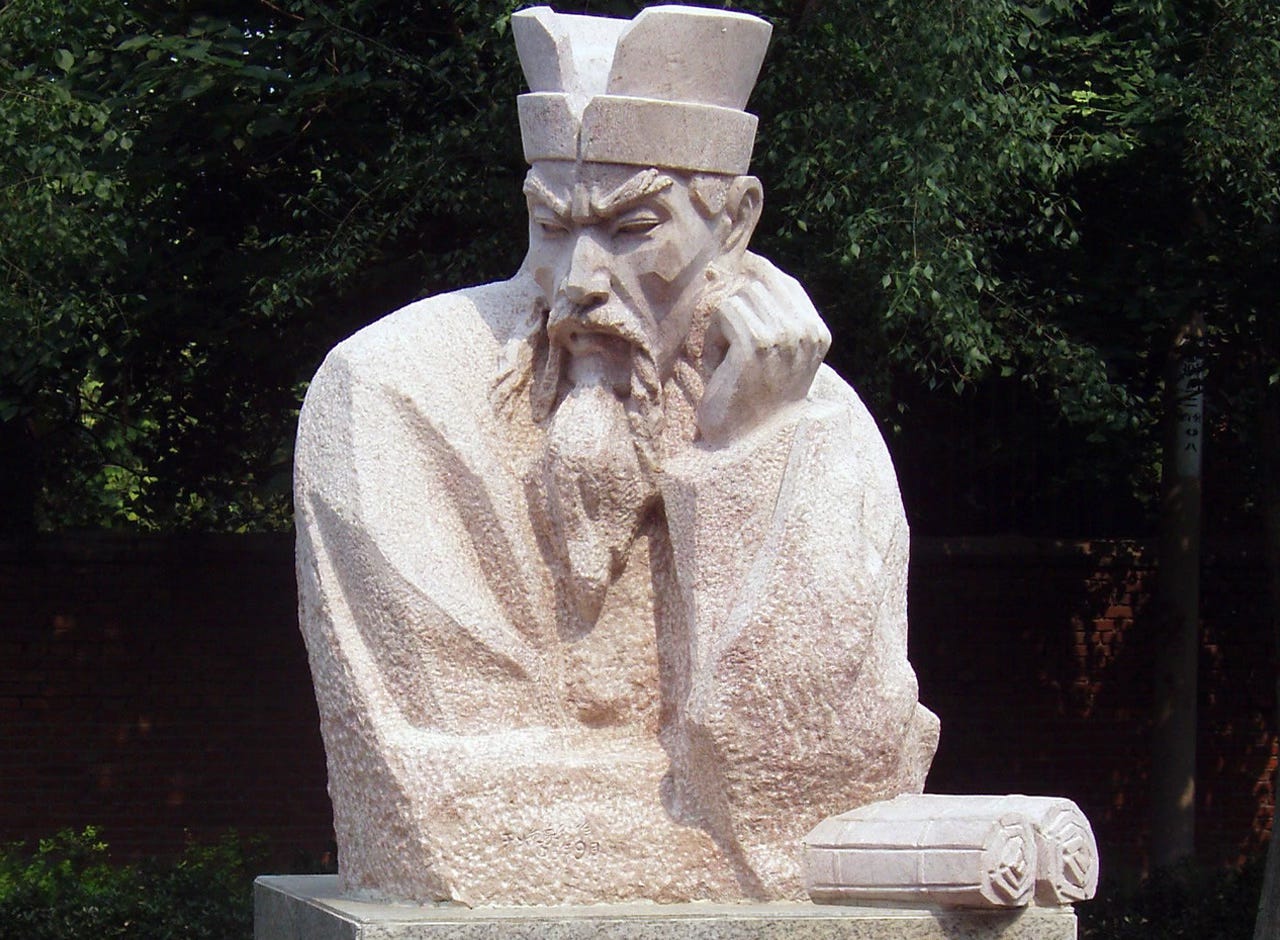
Among the ideological and institutional constraints that China faces in transitioning from a traditional to a modern democratic society—that is, in advancing what Jürgen Habermas has called the “incomplete project” of modernization—one of the most important is its legal culture. At the core of this culture are two traditions of Chinese legal thought.
These two traditions have been balanced in different ways over time, yet today they have achieved powerful integration in what is known as Orthodox Legal Thought, which provides the ultimate balance for authoritarian governance between hierarchical social differentiation and formal uniformity of punishment-oriented application.
The two traditions are Confucianism and Legalism, and the tension between them is ancient. The tension reaches back even prior to the establishment of China’s first unified state under the Qin dynasty (221–206 BC), to the Pre-Qin period (Confucius lived from 551 to 479 BC). Their integration as Orthodox Legal Thought in China is similarly old, tracing to the Western Han dynasty (202 BC–8 AD), especially during the reign of Emperor Wu of Han (141–87 BC).
The opposition between Confucianism and Legalism lies in their different views on the ideal social order and the methods to achieve the ideal. The difference is between two different types of “rule,” or Zhi, whose Chinese character is 治.
Whereas Confucianism advocates “rule by Li” (礼治 Li Zhi)—that is, rule by “propriety”—Legalism advocates “rule by law” (‘法治’ fa zhi).
A great deal hangs on the difference, including for society and politics today.
The Difference
For Confucianism, society is characterized by natural, hierarchical distinctions. In turn, moral education is central to maintaining these distinctions and the harmonious world that they enable. As Qu Tongzu explains simply in Chinese Law and Chinese Society, “Confucianism believes that the differences in kinship, hierarchy, seniority within families, and social status are . . . essential for maintaining social order. Li is the tool used to maintain these social differences.”
Significantly, the rule of propriety prescribes duties for individuals that differ based on their social position. Although every person should be governed by propriety, what is expected under that rule differs based on rank.
Confucianism does not deny the important role of law in society—it believes in punishment, with which law is strongly equated—but it asserts that law can only serve as an auxiliary to Li Zhi. Therefore, as the basic paradigm of governance it advocates the principle known as “morality as the mainstay and punishment as the auxiliary” (德主刑辅 dezhu xingfu). Most notably, Confucianism asserts that moral education, rather than punishment, is central to preventing crime.

By contrast, Legalism is a matter of the carrots and sticks, and it believes, especially, that the deterrent effect of severe punishment is central to maintaining social order. Importantly, while Legalism stresses the need for the strict application of law to everyone, it is not concerned with social equality. It maintains a spirit of formal equality in the face of social differences—thereby preserving them.
As Qu Tongzu explains, “Legalism does not deny or oppose the distinction and existence of high and low status, superiority and inferiority, seniority and immaturity, or closeness and distance.” Yet in asserting that that governing a country is a matter of “rewards and punishments, one to persuade goodness and the other to stop treachery,” it maintains that “what kind of behavior should be rewarded and what kind of behavior should be punished should not vary from person to person, and there must be the same published law.”
On the surface, the two schools of thought are at odds with each other. Confucianism advocates rule by Li based on social difference, while Legalism advocates rule by law that seeks formal uniformity. But they also share deep commonalities, in at least four respects.
First, whether it is the Confucian advocacy of rule by Li or the Legalist advocacy of rule by law, both traditions rely on the “rule of sages,” and their essence is autocratic. Both ideologies treat the people as the objects of governance; their common goal is to establish an orderly society where the people abide by rules, but they refuse to recognize people’s autonomy to determine their own lives, let alone the power to oversee their rulers. For similar reasons, the norms of criminal law are seen to cover nearly all social relationships.
Second, both Confucianism and Legalism emphasize the uniqueness of ruling ideology, advocate for the suppression of contrary opinions and thoughts, and regard the elimination of disputes or punishment as the ultimate goal of social governance, norms known as “no litigation” (无讼 wusong) and “no punishment” (无刑 wuxing).
Third, as noted, although Confucianism envisions a social hierarchy of superiority and inferiority of rank, Legalism by no means rejects hierarchical social relationships. Likewise, Confucianism does not deny the effectiveness of the rule by law but rather believes that it should merely play an auxiliary role in social governance.
Finally, the Confucian and Legalist ideas that emerged in the early Spring and Autumn period (770–476 BC) and the Warring States period (476–221 BC) possess a variety of mutual, interpenetrating intellectual influences. Not only did most of their representative figures come from the aristocratic class, but also a considerable number of Legalist representatives studied under Confucian masters. The thoughts of Guan Zhong, the pioneer of Legalism have a strong Confucian color, for instance, and Zi Chan, an early Confucian politician, published laws to make the people understand the basis and standards of punishment.
During the Warring States period, indeed, the basic views of Confucianism and Legalism on law grew relatively close, as Confucian scholars’ views about human nature shifted from the “theory of good nature” to the “theory of evil nature” under the pressure of social and political chaos. In turn, some Confucian scholars maintained the importance of imposing severe punishments on common people who could not be sufficiently educated.
The history of Chinese legal thought involves the shifting fortunes of these two schools of thought, and their eventual harmonization. This history and its underlying concepts will be unfamiliar to many traditional members of the Telos circle. Yet understanding them and making bridges between these ideas and those of Western social and legal thought is essential for the future of relations between China and the West.
The Integration of Traditions
The rapid collapse in 207 BC of the Qin dynasty, which had established a centralized and unified empire with the help of Legalist thought, revealed the danger of relying solely on Legalism to govern China. The Legalist doctrine of pure reward and punishment as power put the king in opposition to the interests of his closest subjects, and even to those of his sons. It was a regime without the ethical support of Li.
By contrast, the rulers of the early Han dynasty—which began in 202 BC and, with a brief interruption, came to an end in 220 AD‚ provided an opportunity for Confucianism’s reemergence in state governance. Beginning early in this period, Confucian scholars began to assert their role as “imperial teachers” and professional managers, seeking to obtain the “procurement” of rulers for its political propositions and services.
Lu Jia (陆贾 240–170 BC), for instance, asserted the principle of “not governing the world on horseback” to Emperor Gaozu of Han (汉高祖 256–195 BC). Shusun Tong (叔孙通 ?–?) formulated rules of court etiquette. In his “Public Security Strategy” (治安策 zhian ce), Jia Yi (贾谊 200–168 BC) argued for the importance of granting special legal treatment to the literati class, as rulers and literati formed a historical alliance of political interest. Dong Zhongshu (董仲舒 179–104 BC) received official favor with his theory of the Three Obedience and Five Constants (三纲五常 sangang wuchang), which justified the supreme nature of the monarch.
Although law under the Han dyansty followed the tradition of Qin law as formulated by the Legalists, Confucianism took the ideological field and became a kind of law de facto. Chen Chong of the Eastern Han dynasty characteristically asserted that “disobedience of Li will lead to punishment.” Li and law became substantially unified.
Yet there was an important difference from early Confucianism.
Beginning with the teachings of Dong Zhongshu (179–104 BC), Confucianism transformed the relationship between “kinship” and “respect” as articulated in the pre-Qin teachings of Confucius and Mencius. Specifically, it came to see loyalty to the monarch as being more important than filial piety to parents. Unconditional obedience to the monarch became the way of Heaven (天道 tian dao).
At the same time, the centralized system of supreme power of the monarch—and a governing philosophy relying on bureaucrats to manage social affairs—was maintained. Likewise, the fundamental ideas of Legalism about punishment were preserved.
One might say that centralized bureaucratic rule by law had become a consensus among both monarchs and Confucian literati. The process of its formation is called the “legalization of Confucianism” (儒家思想法律化 rujia sixiang falvhua).
What emerged, then, was the political ideology of Orthodox Legal Thought in China, which has been mainstream for two thousand years. It consists of: (1) Confucianism, based on unequal treatment of superior and inferior; (2) the tradition of the Legalists, which at its core emphasizes the supreme power of the monarch and loyalty to the monarch personally; and (3) the continuation of Legalism’s centralized power and bureaucratic system.
In time, after the collapse of the Han dynasty, Confucian officials during the Wei, Jin, Song, Qi, Liang, and Sui dynasties gradually codified this tradition. The unified code implemented under the Tang dynasty (618–907 AD) was a summary of the institutional experience of combining Confucianism and Legalism in previous periods, integrating Confucianism and Legalism into a single alloyed paradigm—Orthodox Legal Thought—which lasted until the late Qing dynasty (1644–1912).
Orthodox Legal Thought Today
Orthodox Legal Thought was formally abandoned under the Republic of China (1912–1949), but the continuity of legal culture determined that this paradigm would not disappear. Through its various carriers—customs, language, ways of thinking, institutional settings—legal culture, and its core, legal thought, still influences the legal thought and practice of future generations. Today, the fusion of Confucianism and Legalism is present in important ways:
1. Restrictions on Freedom
The ideological concept “one position as the highest authority” (定于一尊 dingyu yizun) in contemporary party discipline, which emerged in political discourse beginning around 2017, upturning its traditionally negative connotations, follows in the tradition of Confucianist-Legalist fusion. The tradition of censorship that follows in turn from this centralized vision has left a shadow over intellectual freedom, including in legal research, and it has hindered the democratic transformation of the country and society.
2. Legacy of Legalist Thought
The proposition that “the Party leads everything” reflects the Legalist view of comprehensive, centralized control, and the party’s emphasis on “seizing leading cadres as key minorities” (抓住领导干部这个关键少数 zhuazhu lingdaoganbu zhege guanjian shaoshu) reflects the Legalist emphasis on the importance of state power. In social governance, the emphasis on the core significance of government leaders, the goal of “maintaining stability” through legislation, and “instrumentalizing the functions of law and judicial organs” are all extensions of traditional orthodox thinking.
3. Legacy of Confucianism
Contemporary ideology emphasizes the role of moral governance, harmony, the exemplary role of party organizations and members, and the combination of “governing the country by law” and “governing the country by virtue”—all echoes of traditional Confucian thought.
In an officially released authoritative interpretation of Xi Jinping Thought, allusions related to traditional legal thought are cited far more frequently than Marxism-Leninism, Mao Zedong Thought, and Deng Xiaoping Theory. This is no accident.
The transition from mutual opposition to mutual integration of Confucian and Legalist legal thought reflects the ultimate balance between the “differentializing” and “uniformizing” paths of governance in authoritarian societies. The continuation of Orthodox Legal Thought and its corresponding institutionalized governance system for two thousand years reflects the stability and profound historical significance of the social order structure brought about by this balance.
When the supporting forces behind this balance are washed away by the historical tide, this combination will not disappear.
Topics: China Initiative
Peter William Wang is an independent legal scholar.