


Beginnings: Habermas and the Early Telos Milieu
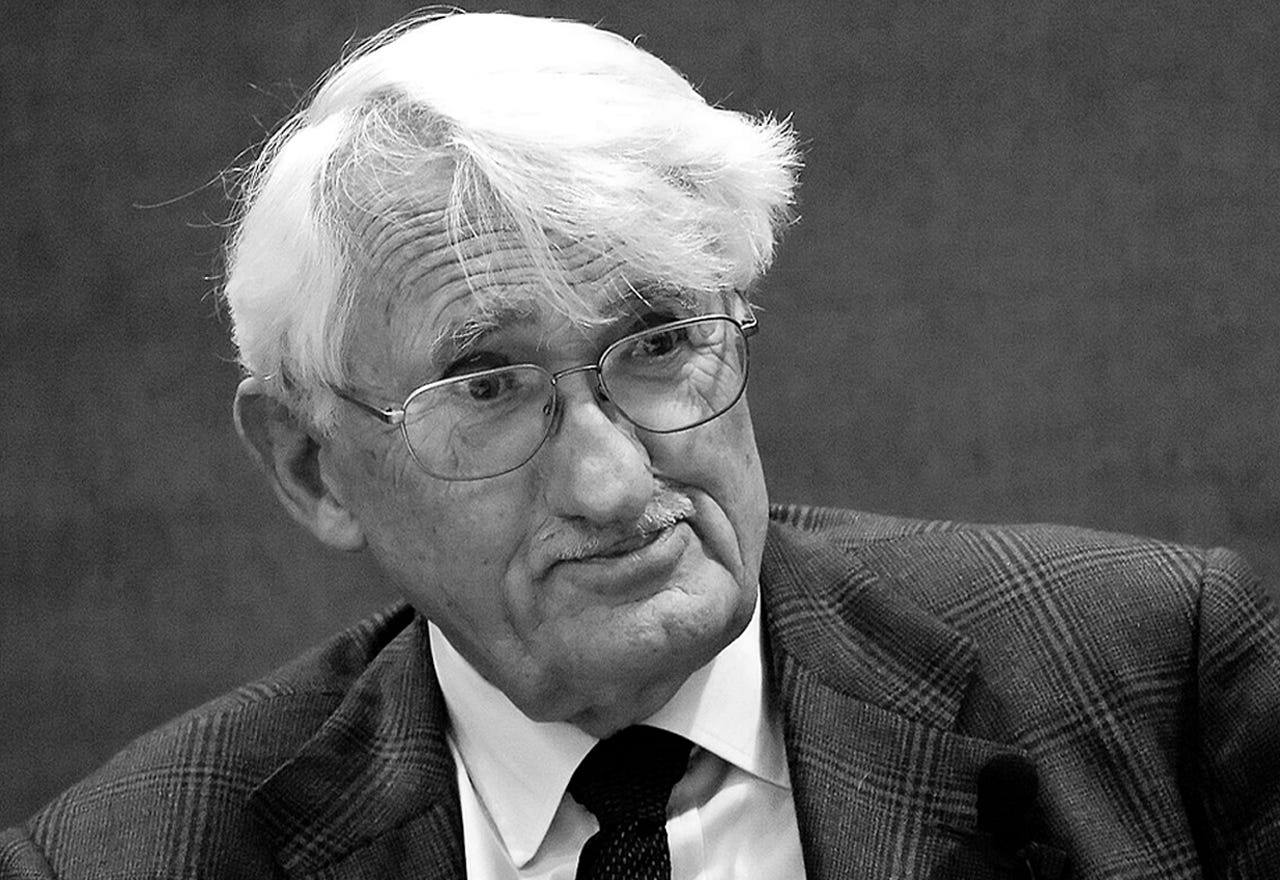
Jürgen Habermas passed away on March 14 at the age of 96. By far the most prominent German philosopher of his generation, he became a leading intellectual in the Federal Republic and gained extensive international renown. Telos had a long engagement with his work, with references to Habermas stretching back to the early 1970s, that is, to the very first years of the journal, which was founded in 1968. The Telos discussion of Habermas would continue for decades. A detailed analysis of that engagement—as part of the larger American reception of Habermas—would surely be a worthwhile project. Here are some of the key parameters.
One might frame that reception history in terms of the history of Critical Theory, with two lineages initially close to each other, then diverging, and, half a century later, displaying a surprising similarity. Habermas’s intellectual career was, of course, intimately connected to the Critical Theory of the Institute for Social Research, the Frankfurt School of Adorno and Horkheimer. Telos, in its early years, understood itself as a conduit for “European theory”—at first meaning phenomenology, Critical Theory, and Italian Marxism—as alternatives to what was perceived as the anti-theoretical empiricism of American social science.
Both Habermas and Telos initially emerged from the Left, or more specifically from the New Left, but both quickly distanced themselves from the excesses of the radicalized student movement. Habermas famously denounced the movement’s intolerance and propensity to violence as a form of “left fascism,” while Paul Piccone, the founder and longtime editor of Telos, spoke of the “self-dismantling of Marxism,” until it appeared that there was nothing left in Marxism worth saving.

The Public Sphere and Diverging Agendas
An initial focus of discussion was the concept Habermas had developed in his early work The Structural Transformation of the Public Sphere. The public sphere, or Öffentlichkeit, meant discursive participation in the formation of opinion through rational exchange, outside the private sphere of economy and family but also outside the structures of governmental authority. The implicit prioritization of language—that is, discussion—anticipated Habermas’s later grand theme. A key argument of the book was that the public sphere of the eighteenth century established a norm of universal participation that had been subverted by the twentieth century through an occupation of the public sphere by economic and political forces, leading to a “refeudalization.” The ideal of reaching a judgment through consensus had been replaced by what Noam Chomsky would label “manufactured consent.” Habermas proposed measuring the manipulated present against the aspirations of that origin.
In the 1970s, Telos found a home at Washington University in St. Louis, where Piccone was serving as an assistant professor in the Department of Sociology. Across the campus, Peter Uwe Hohendahl chaired the German department. Hohendahl made the public sphere a key category for his own scholarship on literary history. Yet these two critical theorists were positioned differently on the question of the public sphere.
For Hohendahl—as for Habermas—the issue was the retrieval of the normativity of the original project of the bourgeois public sphere, which meant rational and fully (or aspirationally fully) inclusive communication. For Piccone and the group around him, the focus lay more on the flaws of contemporary forms of controlled opinion and their attendant conformism. The two positions were by no means incompatible, but they pointed toward alternative agendas: on the one hand, elaborating the terms of a rational society; on the other, criticizing structures of domination. In practice, the former could engender a reformist politics, while the latter maintained the aversion toward concrete political praxis that had been associated with the older generation of the Frankfurt School.
The circle of figures associated with Telos extended far beyond St. Louis to include some of the leading American readers of Habermas, especially in New York, alongside affiliates elsewhere in the United States and Europe. Adorno died in 1969, so it is at least remarkable that the splits that developed within Telos came to be defined in terms of proponents of Adorno on the one hand and Habermas on the other. As in similar developments elsewhere in intellectual history, some of the attendant altercations involved personalities. Yet another component was the divergence just described: the normativity of rationality versus the critique of domination, whereby proponents of the latter stance would eventually prove more willing to engage cultural dimensions otherwise dismissed as irrational—community, religion, tradition, and decisionism. Indeed, these separating tendencies could be read as two distinct, equally legitimate, but ultimately antagonistic derivatives of Critical Theory’s key text, Dialectic of Enlightenment. The Habermasian position represented the hypostasis of enlightenment, while the Adornian wing emphasized its critique.
Germany, America, and the Political Context of Theory
The Telos encounters with Habermas also unfolded within different political contexts. For Habermas himself, the lifelong project involved the establishment of a culture of liberal democracy, first in the Bonn Republic of West Germany and later in the Berlin Republic of unified Germany. A core element in this project was his advocacy of “constitutional patriotism” as the foundation of German political community, in opposition to nationalism, let alone ethnonationalism. This agenda represented, intentionally and consistently, the aspiration to achieve a break with the Nazi past. One might describe this stance as anti-totalitarian, against both Nazism and communism. Indeed, Habermas also articulated a critique of Marxism. Yet for him, and for many of his followers, criticism of communism was never similarly robust, presumably because “anti-communism” had come to appear, during the Cold War, as a conservative position.
For Telos, and more broadly for critical theory in the United States, it was not a Nazi past that overshadowed discussion but rather the development of the American administrative state, the legacy of the New Deal, and then the policy crises and “malaise” of the 1970s and the Reagan era. The points of political orientation in Germany and the United States were therefore different enough to send theoretical discussions down different roads. Habermas’s great work on communicative rationality, unmistakably meant as an alternative to the mass manipulation associated with the Nazi past, was effectively a linguistic turn, a prioritization of public speech. Yet for Piccone this centrality of language privileged precisely those actors who could command elaborate speech codes, that is, an intellectual elite, while disprivileging other social strata—a viewpoint sharpened by the influence of Alvin Gouldner and Christopher Lasch.
From this perspective, Habermas’s rationalism came to mean the elevation of rational experts. But there was already, in the United States, a skepticism toward “the best and the brightest,” to invoke the title of David Halberstam’s book on how an intellectual elite had led the country into the Vietnam War. That dissatisfaction with elites anticipated the later anti-elitism of twenty-first-century populism. Indeed, the war and the antiwar movement may be the key to the difference between the German and the American lineages of Critical Theory. Habermas was always writing against the Nazi past, while the American discussion in the 1970s and 1980s, including in Telos, was shaped by the repercussions of Vietnam.
A further political difference of the era, which informed the theoretical divergences, concerned the Cold War and its conclusion. As part of its break with Marxism, Telos staked out definitively anti-communist positions, aided in part by its collaborations with East European and Soviet dissident voices. This was never a priority for the German Left. Matters came to a head in the missile debates of the mid-1980s, surrounding the NATO decision to station medium-range cruise missiles in Germany as part of the Reagan-era arms buildup. Massive protests of the West German peace movement ensued, which Habermas supporters tended to endorse, while others around Piccone supported NATO. Here the ultimate theoretical difference involved the extent to which one would break with orthodox Marxism; the political difference involved Cold War military strategy. Until today, a difference of interpretation remains. Americans tend to see 1989—the opening of the Berlin Wall and the end of the Soviet empire—as a result of the Reagan arms buildup, with which Russia could not compete. Germans on the Left tend to explain the outcome in terms of Ostpolitik and/or the leadership of Mikhail Gorbachev.
Religion, Translation, and Late Habermas
In this brief overview of Telos and its engagement with Habermas, the final stage involves religion, beginning with Habermas’s 2004 conversation with then-Cardinal Ratzinger, who became Pope Benedict XVI the following year. The two figures indisputably represented alternative traditions: rationalism and religion. Moreover, at that point Ratzinger was widely, and not wrongly, viewed as a conservative in dogmatic matters, even though later he would argue strongly for the compatibility of religion and reason.
In the conversation, Habermas, ever the rationalist, insisted on the neutrality of the state in matters of religion. Nonetheless, he conceded that religion might carry moral insights that the state should implement. The significant issue was not merely that state policy might at times coincide with Church teaching, but that the religious tradition had access to moral insights reached not by rational deliberation alone but by virtue of its own distinctive apprehension of existence, including, for example, the experience of the holy, the reading of sacred texts, or even revelation.
Habermas continued to grapple with the question of religion in his late opus, Also a History of Philosophy. The relationship between faith and knowledge appears there as a process of “translation”—once again reflecting his focus on language—from religious into postmetaphysical claims. In other words, religion remains a source for normative morality, even for the secular state and society.
This historicization of the relationship between religion and rationality, including their relation to the state, echoes an older motif of Critical Theory: the connection between the presumably irrational—myth—and its rational consequences. At the same time, Habermas’s turn toward the productivity of religion deserves comparison with, and contrast to, the Telos turn toward religion, tradition, and community dating from the 1990s. Here lies the surprising convergence between Telos and Habermas after years of dramatic separation. For Telos, engagement with religion involved political theology, collaboration with Radical Orthodoxy in England, and at times the suggestion that religion might be the Critical Theory of the contemporary moment.
Convergences: Habermas, Schmitt, and Böckenförde
The controversial component, however, in the journal’s turn toward questions of religion was the journal’s interest in the principal source of political theology, the work of Carl Schmitt. Opening the Schmitt discussion in the 1990s was regarded as deeply controversial, given Schmitt’s Nazi associations. Yet the broad Schmitt reception, in Europe, in the United States, and far beyond Telos, has hardly centered on his worst political judgments. Neither has it been a matter of trying to justify his endorsement of Nazi rule. The point is that he nonetheless had other important insights.
The contrast between Schmitt’s decisionism and Habermas’s communicative rationality deserves a much fuller elaboration. Here, however, in a brief reflection written in the immediate aftermath of Habermas’s passing, the point is that both Telos and Habermas—and, in a different register, Schmitt—came to explore the significance of religion. Indeed, Habermas’s view that postmetaphysical thought draws on metaphysical sources is consistent with Schmitt’s political theology and, more specifically, with the claim put forward by Schmitt’s student Ernst-Wolfgang Böckenförde, whose famous dictum states that “the liberal, secularized state lives by presuppositions that it cannot itself guarantee.”
How close was the Habermasian exploration of religious tradition to Böckenförde? Böckenförde was certainly close to Schmitt. Yet in the exploration of those “presuppositions,” including religion and other aspects of tradition, the polemical distinction between rationalism and irrationalism becomes increasingly untenable. The normativity of rational discussion, which Habermas located at the origin of his work on the public sphere, evidently depends on nonrational cultural substances. That recognition may mark the deepest point of contact between Habermas and the intellectual trajectory of Telos: after decades of divergence, both came to confront the persistence and validity of irrational traditional elements that inform postsecular modernity.
Topics: Reflections & Dialogues
Russell A. Berman is the Walter A. Haas Professor in the Humanities at Stanford and Senior Fellow at the Hoover Institution, where he directs the Working Group on the Middle East and the Islamic World. He previously served as Senior Advisor on the Policy Planning Staff of the United States Department of State and as a Commissioner on the Commission on Unalienable Rights. He is currently a member of the National Humanities Council. He is the Editor Emeritus of Telos and President of the Telos-Paul Piccone Institute.