

Iran Today: Convergence of Catastrophes
by Azam Jahandideh and Tomasz Wiśniewski

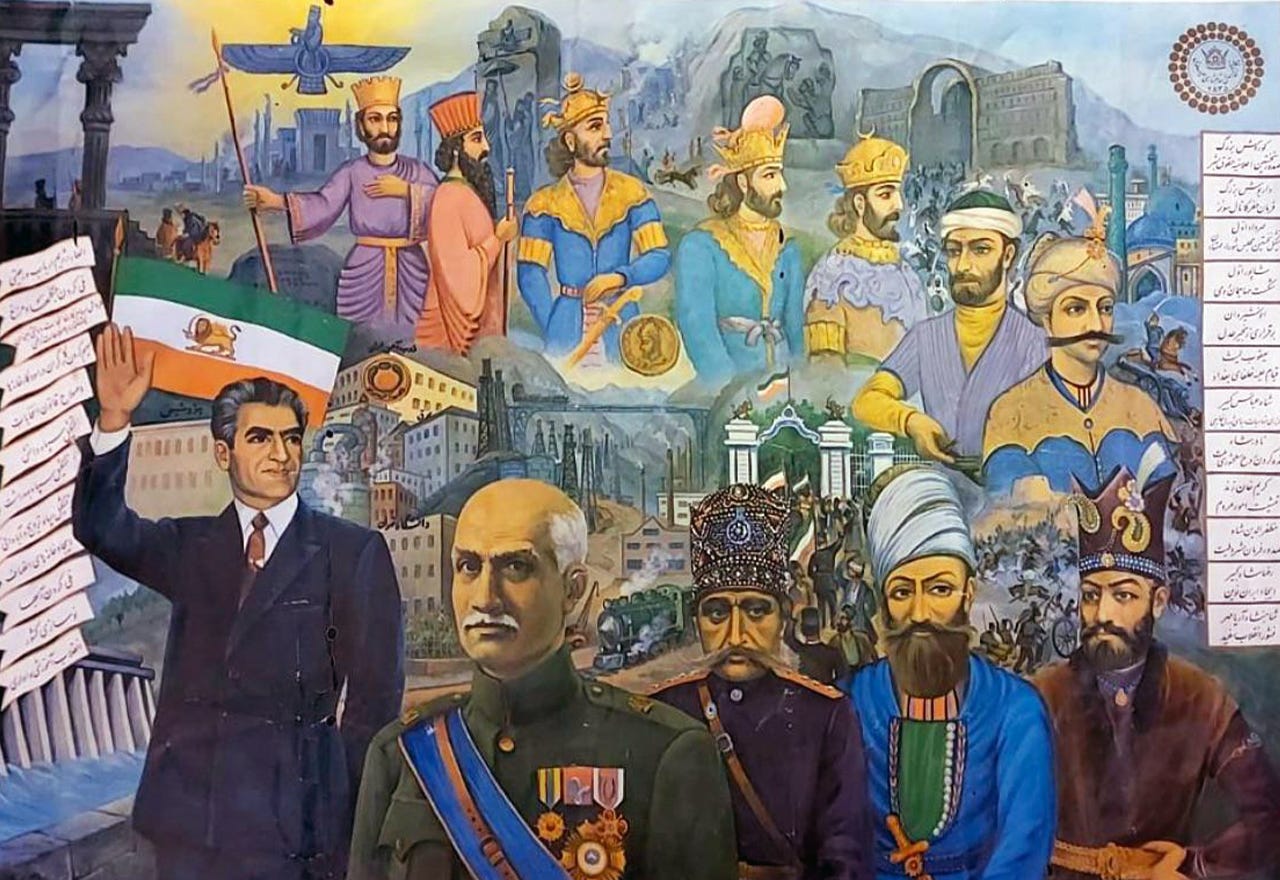
While Donald Trump is playing his cards for the upcoming election, a diverse range of reactions has emerged among Iranian opposition groups regarding his stance on Iran. Much of the opposition continues to attack one another, with Crown Prince Reza Pahlavi receiving the overwhelming share of the criticism. Meanwhile, many Iranians are being held in solitary confinement, many more have been arbitrarily arrested, and others remain at risk of execution. Notably, the Islamic Republic executed 1,634 people in 2025, accounting for 82 percent of all recorded executions worldwide. Unfortunately, the statistics for the first six months of 2026 show a further sharp increase. Yet the fate of many protesters who have been disappeared since January 2026 remains unclear to this day. Let us delve into the convergence of catastrophes in Iran, both present and historical.

Ceasefire
After almost forty days of war, a ceasefire was implemented on April 8, 2026, initially planned to last two weeks, although it was later extended until a deal acceptable to the United States was reached. The Islamic regime’s media presented the ceasefire as a victory. During the war several high-profile figures were assassinated, including Supreme Leader Ali Khamenei and, allegedly, his son Mojtaba Khamenei, who was first reported to have been severely injured and later was said to have succeeded his father. Meanwhile, the Islamic regime remains in power, continuing its long-standing rhetoric against Israel and the United States, even after being unable to hold a funeral for its leader for more than four months. The funeral was later made possible after permission was granted and arrangements were made with the United States.
The death of Ali Larijani—the secretary of the Supreme National Security Council and philosopher—made it feasible for Mohammad Bagher Ghalibaf, the spokesperson of the Islamic parliament, to establish himself as a main decision-maker. Ghalibaf has been a member of the IRGC since its early days and has been an unsuccessful candidate in presidential elections four times. He was one of the main figures during the Iran–Iraq War, which many believe led to unnecessary deaths of Iranian soldiers. Later, he served as chief of the Police Command and mayor of Tehran. During the 1999 student protests, while serving as commander of the IRGC Air Force, he was among the officials accused by some of involvement in the crackdown, during which several students were reportedly injured or killed, with some allegedly thrown from rooftops. His tenure as mayor was also marked by corruption allegations. He has been a member of the Islamic parliament since 2020, during which time he played a key role in both the Iranian–Russian treaty signed in 2025 and the Iran–China 25-year Cooperation Program signed in 2021. Many believe that the content of these agreements has led Iran to lose part of its sovereignty, along with causing significant economic damage.
Considering Ghalibaf’s background, he could be anything but a desirable representative of Iranians; however, due to his entanglement with different fundamentalist groups within the regime—which are equally corrupt—he might be able to convince the main body of regime members to comply with the agreement with the United States. In this context, some fear that Trump’s only aim is to halt Iran’s nuclear and missile programs in order to secure the safety of the West and neighboring countries in the Persian Gulf, while using the deaths of over 36,500 Iranians as a bargaining tool without addressing the deeper problems within Iran and leaving Iranians to come to terms with the Islamic regime on their own.
Particularization of Suffering
Iran is a land rich in tales, poetry, and literature. This is also reflected in its political discourse, where different groups promote their own versions of events. This was especially visible in the aftermath of the death of Mahsa Amini in 2022 while in the custody of the morality police, which led to widespread protests across Iran known as the “Woman, Life, Freedom” movement. Some estimates report that at least five hundred people were killed in connection with the subsequent unrest. Four years later, the fate of many individuals arrested during these protests remains unclear. In particular, six protesters linked to the “Ekbatan Town” case have remained in prison since then, with their fates unknown.
However, after the death of Amini, left-leaning human rights activists promoted a meticulously engineered narrative framing her death primarily as a case of Kurdish oppression. The reality is that many groups in Iran are subjected to discrimination. Before Amini’s death, in one example, Reyhaneh Jabbari was executed after, in an act of self-defense, she caused the death of a former agent of the Ministry of Intelligence. In a broader perspective, under the ideology of the Islamic Republic, national identity is often subordinated to religious identity, where Shia Islam is intended to function as the glue of an ummah. In fact, all ordinary Iranians are subjected to discrimination, though the intensity of oppression varies across groups and genders.
Most recently, the Minab incident was framed by the different groups in favor of their own narratives, including Foreign Minister Abbas Araghchi, who condemned it as a crime against humanity, accusing the United States of violating international humanitarian law. Simultaneously, Congresswoman Yassamin Ansari along with U.S. House Democrats tried to introduce articles of impeachment against Defense Secretary Pete Hegseth, accusing him of committing war crimes based on the Minab incident. Whether these developments are coincidental or part of a coordinated narrative remains an open question. It is not clear what their stances are regarding the deaths of more than 36,500 people in January 2026, the ongoing persecution of protesters, and the frequent executions of those held in captivity.
Appropriation of suffering by a single group could indeed constitute a distortion of reality, given that large segments of society are being affected. The reality is that Iranians are facing a level of brutality with no historical precedent. Even the destruction caused by the Mongol invasion in the thirteenth century is not an adequate analogy, given the intensity of the current turmoil and the indiscriminate cruelty toward the protesters. It could be seen as a continuation of the suppression imposed on Iranians by the Safavid dynasty, during which the majority of the population was forcibly converted to Shi’ism in the sixteenth century. This might have marked the beginning of injecting apocalyptic ideas into society.
The effects of the current situation will resonate throughout Iranian society for generations to come. It is not only that many families, in some cases, have lost several loved ones simultaneously, but also that their properties have been confiscated. Economically, many jobs have been eliminated, and people are experiencing significant hardship. The cost of medicine has increased sharply, and much of the available medication is of low quality, adding another layer of complexity to patient care. The educational system had already been severely compromised by COVID-19 and the war in June 2025, and the recent conflict has only exacerbated the situation. Malnutrition among a large proportion of the population due to inflation is another unfortunate reality that could lower the average cognitive potential of future generations. All of these factors are draining the capacity of Iranians to rebuild their country, and more irreversible damage will be inflicted on Iranians as long as the Islamic regime remains in power.
Iranian Mentality
The trajectory of developments in Iran and in the Middle East in general is characterized by endless cycles of violence, followed by the perpetual victimization of the survivors. The prevailing narrative traces the current tragic situation back to the overthrow of Prime Minister Mohammad Mossadegh in 1953 and overemphasizes the role of SAVAK, whose activities had drastically tarnished the reputation of the Shah Mohammad Reza in the West. However, it does not encapsulate the whole complexity of the Iranian mentality, which is intertwined with superstition, nihilism, and religion, and compounded by a lack of knowledge about the modern world. The role of Ali Shariati, Jalal Al-e-Ahmad, Reza Baraheni, and many others known in the West as intellectuals in shaping such an amalgam should be taken into account. The appearance of a charismatic figure like Khomeini, who opposed modernization yet attracted many ostensible intellectuals, indicates that Iranians have developed a particular mentality throughout history.
Many Iranians hold two striking views to delegate their own responsibility when it comes to assigning blame for the current situation, namely, Islam and Iran. On one hand, among those with secular tendencies who are inclined toward a pre-Islamic vision of Iran, Islam is presented as the sole cause, with the medieval epos Shahnameh serving as the primary source of inspiration for their ideal society. On the other hand, some opposition groups seem to have rejected the Islamic regime, while remaining inclined toward a more religious but moderate stance. They often present themselves within a human rights framework, commonly associated with left-leaning views. In their view, the concept of Iran itself is an obstacle to addressing discrimination against minorities.
Both groups have failed to recognize that today’s adversary will inevitably become tomorrow’s neighbor, even in the case of a transition to a secular government in Iran or the recognition of varying degrees of autonomy for different minorities with unclear territorial boundaries. Sustained hostility in such a context would lead to prolonged instability, given the region’s strong interdependence and the fact that neighboring states share deep historical, cultural, and religious ties. In the absence of durable external guarantees or cooperative regional frameworks, small and newly formed states would face significant challenges in maintaining stability and security.
Furthermore, neither group places sufficient emphasis on individual responsibility within Iranian society. What has emerged is a mentality shaped over centuries of common political and cultural experiences, marked by a tension between collective memory and present political frustration. This is often expressed through the idealization of the past and unrealized expectations for the future. In Kierkegaardian terms, this can be interpreted as a form of anxiety arising from an unresolved relation between possibility and actuality. Any viable political or institutional framework would need to account for this historically sedimented tension, rather than assuming a purely event-driven account of social behavior.
Iranians were driven into a more passive way of life due to the conquest of the country by the Safavid dynasty at the turn of the fifteenth and sixteenth centuries. It was reflected by the fact that the quality and quantity of men of letters, culture, and science dwindled significantly. Needless to say, the Safavids originally emerged from a Sufi order. Historically, the idea of Velayat-e Faqih (guardianship of the Islamic jurist), the main pillar of the Islamic regime, can be traced back to this era, when many Shia clerics were invited to Iran from Lebanon to strengthen the ideological backbone of the newly established Shia state.
Reincarnation of the Islamic Regime?
There is a risk that the Islamic regime might reincarnate in another form, such as a military or oligarchic dictatorship, leading to another abortive attempt by Iranians to reconcile their potential with their actuality and reclaim their country. This aim would not have been realized without addressing the underlying cause, i.e., the Iranian mentality. Iranians have not yet honestly answered the question of what was truly wrong with the Shah’s regime. In their attempt to remove him, they appealed to seemingly contradictory ideologies, ranging from Marxism and communism to Shia Islam, ultimately contributing to the emergence of revolutionary martyrology. Given the developments after 9/11, one can say that the Islamic Revolution of 1979 was the epicenter of many of the events that have unfolded to this day.
In recent years, there has been overwhelming interest in Prince Reza Pahlavi among the younger generations. However, such a burning desire for him might be just another detour, allowing Iranians to remain passive by assigning their own responsibilities to him and postponing their collective task of achieving the level of individual growth needed to develop a modern mentality and build a modern society. Time seems to have a different existence in the Middle East and Iran, and experience is a rare commodity that is not transmitted, leaving each generation prone to repeating the same set of mistakes. Under such conditions, progress will never be born.
In fact, a constitutional monarchy might be the optimal outcome of Iran’s political history. Many argue that the Islamic Revolution represented a profound deviation in the development of a modern Iranian society. During the constitutional era, which included participation from a diverse range of groups, e.g., Azeris, the central issue was not “Should Iran remain intact or should parts of it secede?” but rather “How should Iran be governed?” The concept of ethnic separation in its current form had not yet fully taken shape. Organized ethnic separatist movements gained strength in the twentieth century, particularly in the period after World War I and the formation of modern nation-states in the region. Therefore, they offer limited relevance for understanding the main political trajectory of Iran today.
The Islamic Revolution was fueled by widespread perceptions of the Shah’s regime as corrupt, repressive, and overly reliant on foreign powers, at the expense of Iran’s sovereignty and cultural identity—perceptions that, in retrospect, seem to be significantly exaggerated. Today, Iran is on the edge of becoming a failed state: no functioning economy remains, people are worn out, and the education and healthcare systems are failing. Inside Iran, people often see the problem differently from activists outside the country. What is most important for ordinary Iranians is a return to a normal life, which includes a separation between state and religion. However, what is unfolding before the eyes of millions of helpless observers is the replacement of a theocratic dictatorship with a military and oligarchic one.
Given the Shah’s mindset, one criticism is that he did not grant people sufficient political agency, while economically many Iranians experienced a comfortable life, at least in the major cities. Consequently, the majority of the population, being religious despite their Western appearance, tried to replace a secular leader with a religious one, expecting the same level of comfort after removing the Shah while remaining passive. This is more evident among the upper-middle-class population, who continued to enjoy comfortable lives until quite recently, when nuclear sanctions were introduced, although many lower-class people had been struggling for much longer.
Conclusion
After the January 2026 massacre, it might seem that Iranian society has become suicidal. Yet even the deaths of thousands of the most promising members of the younger generation have not led to a regime change. It seems that Iranians must first address the rejection of revolutionary martyrology, including the weaponization of death and the instrumentalization of suffering (shahadat), primarily promoted in the 1960s and 1970s by Shariati. Given the perceived emotional character of Iranian society, expecting the emergence of a purely rational society may not be realistic. Perhaps a more moderate framework could be built upon Friedrich Nietzsche’s idea of amor fati: the love of life as it is, understood as active rather than passive. Let us do what we can, although we know it may not lead to a desirable outcome.
Azam Jahandideh holds a PhD in mathematics from Adam Mickiewicz University in Poznań, Poland. Her primary research interest is mathematical physics, while her hobbies include philosophy, history, and literature. In her spare time, she occasionally contributes reports on Iran to the Polish press.
Tomasz Wiśniewski is a postdoctoral researcher in the Faculty of History at Adam Mickiewicz University in Poznań, Poland. He is interested in political theology, philosophy of history, and intellectual history of modernity. From March to June 2026, he was a Józef Tischner Junior Visiting Fellow at Institut für die Wissenschaften vom Menschen (Institute for Human Sciences) in Vienna.