


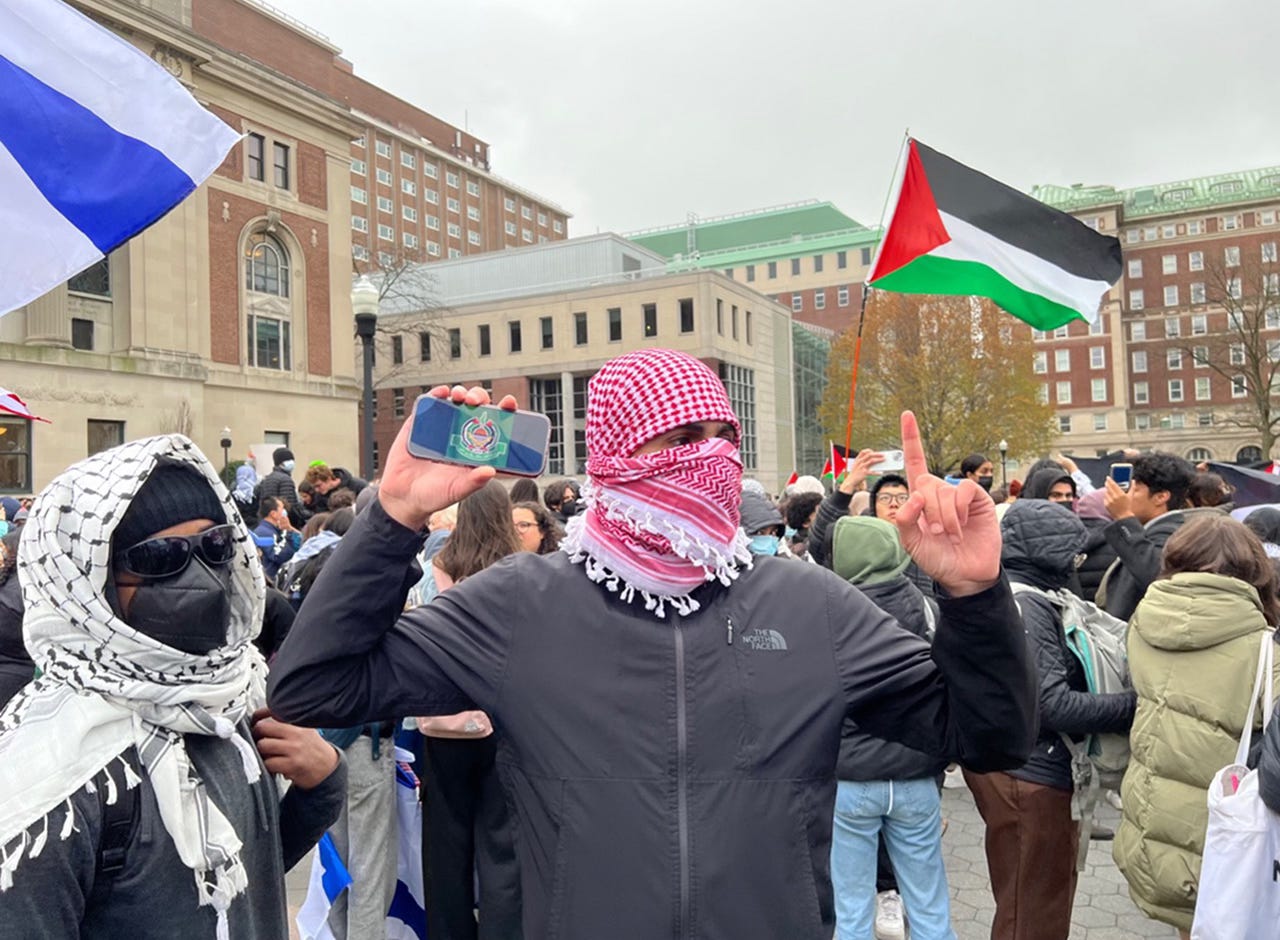
The protest movement that spread across many American colleges and universities in the wake of the Hamas attacks of October 7, 2023, received extensive press coverage—especially when the protests took place at elite institutions. It has been framed naturally with regard to the Gaza War. The federal government’s response has also been connected to the American public’s growing disenchantment with higher education. Yet one aspect of the movement has surprisingly received scant attention, if any: the disproportionate participation of women.
Casual observation of encampments on different campuses—one of the authors of this piece is from Columbia, the other from Stanford—detected a clear gender gap: many more women than men. Of course, no reliable census could be taken, but the overrepresentation of women is corroborated by the objective data of arrest lists. The students suspended after the NYPD dismantled the first encampment at Columbia on April 17, 2024, bears out a huge gender imbalance. Nearly two-thirds of the officially suspended were Barnard students, i.e., women (58 of 91). Of the 33 Columbia students suspended, only 10 were men. The nine agitators arrested on April 30, 2024, in Barnard College’s Milstein Library included only one man. At Stanford, 9 of the 13 students arrested on June 5, 2024, for occupying the president’s office were women.
Last year’s pattern of gender imbalance is continuing. The list of the arrestees from the occupation of Columbia’s library on May 7, 2025, includes 61 women and 19 men.

Were the encampments protesting the Gaza War a new women’s movement? And if so, how can we explain young women taking sides so emphatically without any criticism of the patriarchal culture of Hamas? In the Columbia encampment, there was an open display of Hamas insignia, and it is unclear if any protestors had a problem with its appearance.
We have been intrigued that no reporter or scholar has raised these gender questions. We are therefore trying to research answers by looking for hard data to explain this overrepresentation of women. To begin with, we urge that more analysis be conducted. The arrest figures only capture the extreme end of the movement, and some groups in the encampments may have—for various reasons—chosen to avoid situations where they risked arrest. In addition to the gender disparities, there are other features of the movement that require research: it is important to know the mix of undergraduate and graduate students, the racial and ethnic composition, and even more the role of international students.
However, we want to return to the issue of gender. It is striking that prior to the first inauguration of Donald Trump, there was an intense flurry of activism among women, but prior to his 2025 inauguration there was a marked absence of any similar protest movement. Unlike in 2017, young women’s recent campus organizing is not focused on traditional issues that have been important to women, like lack of access to abortion. Rather all activism has been primarily directed toward the war in Gaza. For now, we can do little more than speculate, but we hope to encourage debate and discussion of the following hypotheses that might account for the gendered profile of the movement.
1. Empathy and oppression: One could make the essentialist claim that women have a greater capacity for empathy than do men. Alternatively, one could propose the less essentialist and more psychosocial claim that women have more empathy for the oppressed because they experience (or feel or understand) oppression in their own lives. They are drawn to fighting oppression because of their experience of oppression. They do not want to see innocent people oppressed or killed.
2. Glass ceiling: Although many of the protests took place at institutions where it is fair to describe the students as privileged, female students may well see themselves as disadvantaged, facing prospects of lower earning potentials than their male peers or of glass ceilings in their careers. A preexisting grievance mentality—no matter how objectively legitimate—may be a source of subjective discontent that could translate into a predisposition to protest. Can anger about one topic be transferred to mobilization around another?
3. The gender gap: It has been established that there is a political gender gap among youth (of course the participants on campus were nearly exclusively young). In 2023, 51 percent of young (ages 18–29) women identified as Democrats, compared to only 38 percent of young men. It is likely that female students, on average, were politically further to the left, and thus were more likely to participate in protests that have a leftist character (indeed at this historical moment, right-wing protests are themselves much less likely than left-wing protests).
4. Media framing: News reports of the Gaza War have regularly announced casualty figures. There has been debate over the reliability of figures, since they have been issued by a Hamas-controlled public health department office. Hamas clearly has an interest in amplifying the public impact of casualties. Whatever the accuracy of the numbers themselves, reports have regularly referenced the number or percentage of women and children among the killed. This framing, i.e., the specific mentioning of women and child casualties, may have a particular mobilizing effect on women.
5. The humanities faculty effect: While we know (from signatures on petitions) that faculty support for the protest encampments came largely from humanities disciplines, we have no hard evidence about the academic specialization of the students. There is some suggestion, again through anecdotes, that women’s studies programs and centers acted as nodes for the protest networks. Indeed, Barnard’s administration removed a “Solidarity with Palestine” statement from the website of its Women’s, Gender, and Sexuality Studies department in October 2023. Was it the same at other women’s and gender studies programs? Was this support in the context of women’s studies linked to assignments of Judith Butler’s writings, where the gender discourse and the critiques of Israel intersect? Or are other venues in universities equally or more involved in mobilizing students? More analysis needs to be done on the catalysts of mobilization: are they the texts that are assigned or particular programs with an activist agenda, or are student organizations more important than faculty, programs, or departments?
6. Men are more involved in STEM: If the overrepresentation of the humanities among encampment-supporting faculty carries over to the students (admittedly a big if—we have to consider that student commitment may not be a result of faculty partisanship), another aspect may be that STEM students, disproportionately male, are less exposed to the humanities and therefore less exposed to the anti-Israel bias disseminated in parts of the humanities. In other words, the issue is not (only) the overrepresentation of women but (also) the underrepresentation of men. Male students have historically been more inclined to be STEM students, although that is gradually changing. Among the students arrested at Columbia for the occupation of Hamilton Hall, none were from the School of Engineering. Of the 13 students arrested at Stanford, only one was from Engineering. Engineering students may be less politicized, or more conservative, or simply too busy with problem sets and therefore without enough time to protest.
7. Appeal of patriarchy: However we explain the lower participation of men, it appears that women were present in the encampments in higher numbers. This phenomenon needs serious inquiry, since what transpired in many (though not all!) of the protests was ultimately an extended display of public support by a women’s movement—perhaps even a feminist movement—for the unquestionably patriarchal and misogynistic forces of Hamas. This implicit endorsement of patriarchy by young women echoes the failure of the more established women’s movement to condemn the rape warfare that Hamas carried out against Israeli women. Why did the encampment women feel comfortable supporting Hamas? Was there any genuine debate over this problem among the participants?
8. Gender politics/gender crisis: That presumably progressive women on campus support an anti-war movement makes sense, but their de facto support of Hamas is confounding. Indeed, in some demonstrations, Yahya Sinwar, the former leader of Hamas, was explicitly celebrated. For example, at a Columbia fraternity house on November 10, 2024, an event took place to commemorate the takeover of Hamilton Hall in the previous April. A spoken word performance of Sinwar’s last will and testament was part of the event, as described here. Perhaps the protestors found some anti-intellectual pleasure in denying that rapes took place (like old Communists who pretended there were no gulags, although they knew better). Alternatively, the possible attraction of some to the paradigm of the Hamas fighter may have amounted to a reaction against the sort of degraded masculinity they encounter in progressive environments at college (“soy boys”). Perhaps their protest was linked to anxiety about their own prospects for career and family—or was it about anger that their world had shut down during Covid?
These are only a few hypotheses, which may be proven wrong, but by presenting them, we hope to prod more discussion. It is clear that women’s leading role in the encampment movement has been obscured. The media firestorm at Columbia about the violent anti-Zionist rhetoric of one protestor, Khymani James, was noteworthy for instantly elevating one young man to the status of protest “leader.” While he had certainly been vocal online and sought attention by posting a video of himself calling for the murder of Zionists, the way journalists immediately appointed him as a leader recalled to us how the press picked and chose along gender lines during another protest movement. Historians have long recognized the central role that women of color like Ella Baker or Rosa Parks played during the long struggle for civil rights for African Americans. Ella Baker organized strategically with the younger generation of student activists through the Student Nonviolent Coordinating Committee (SNCC) to move the civil rights movement forward. However rather than promoting Baker, the media preferred to feed the public’s fascination with great men like Martin Luther King Jr. and Malcom X, keeping women in the margins. Even most references to Rosa Parks mischaracterize her as a weary old lady who just wanted a seat on the bus, rather than a long-time warrior for equality and civil rights.
With this history of the gender-biased press coverage of the civil rights movement in mind, we point out how no journalist appears to have bothered to report on the prominence of women in the Gaza War protests. Without noticing it, they cannot even begin to analyze it. Rather than continuing that erasure of women from this history, we are calling for research to understand it and to address the glaring problem: how self-proclaimed progressive women on American campuses who condemned the murder of women and children chose to align with a movement defined by misogyny in Gaza.
Topics: Israel Initiative
Rebecca Kobrin is the Russell and Bettina Knapp Associate Professor of American Jewish History at Columbia University. She is the co-director of Columbia’s Institute for Israel and Jewish Studies and was a member of its Antisemitism Task Force.
Russell A. Berman is the Walter A. Haas Professor in the Humanities at Stanford and Senior Fellow at the Hoover Institution, where he directs the Working Group on the Middle East and the Islamic World. He previously served as Senior Advisor on the Policy Planning Staff of the United States Department of State and as a Commissioner on the Commission on Unalienable Rights. He is currently a member of the National Humanities Council. He is the Editor Emeritus of Telos and President of the Telos-Paul Piccone Institute.