


When Power Turns against Belonging
There is a simple question that refuses to go away, no matter how often it is displaced by politics, ideology, or strategy. It is not a question of systems or outcomes. It is older than constitutions and more enduring than revolutions.
How does a ruler come to fear the people he claims to represent?
This is not merely a failure of governance. It is a moral break. When power turns against those from whom it draws its legitimacy, something more than injustice has occurred. A bond has been broken; one that is not written into law but carried in memory, custom, and the quiet expectation that those who rule do so in care of what they have inherited.
To govern a people is not first to command them. It is to belong to them.
Belonging is not a matter of blood or belief, but of fidelity: to the land one inhabits, to the lives entrusted to one’s care, and to the future that must remain possible for those who come after. A ruler who governs without this fidelity may retain power, but he no longer stands within the moral horizon of the place he claims as his own.
This essay grows out of my recent ABC Religion & Ethics article on Iran’s ethical reawakening but seeks to think more slowly and more fundamentally about the moral breach now shaping Iran’s political destiny.
The tragedy now unfolding in Iran is often misnamed.

Custodianship and the Moral Shape of Power
Political power always tells a story about what it believes a country is.
Some regimes understand the land as an inheritance that is received rather than seized, held in trust rather than exploited. In such traditions, authority is justified not by force or ideological purity but by care: care for the people, for the continuity of culture, and for the future that must remain open even beyond the ruler’s own time. Power here is custodial. It does not own the nation; it safeguards it.
Other regimes tell a different story. They treat the country as an instrument; something to be mobilized, reshaped, or sacrificed in service of an abstract project. In these systems, the people are no longer ends in themselves. They become means: bodies to discipline, voices to silence, lives to expend. Power, once severed from care, becomes possessive. And possession, unlike stewardship, tolerates no refusal.
The conflict in Iran is best understood through this distinction.
Iran’s deepest political imagination—formed across ancient, imperial, poetic, and later religious horizons—has long resisted ideological absolutism. Political legitimacy was never grounded primarily in doctrine, but in the capacity to hold the country together: to protect the land, dignify its people, and preserve the conditions under which life could flourish. Even when authority was flawed, it was judged against this ethical expectation. A ruler who governed against the people risked losing not only power but moral standing.
The present regime stands outside this grammar.
It does not govern as a custodian of Iran but as a proprietor over it. The country is treated as a site of permanent mobilization, its people as raw material for a revolutionary project that admits no limits. Loyalty is demanded not to the nation but to an ideological apparatus that justifies endless sacrifice while offering no political horizon beyond obedience.
This is why repression in Iran is not incidental—it is structural.
When the People Speak
A state that sees itself as the owner of the people must control appearance, speech, desire, and memory. It must regulate women’s bodies because autonomy threatens possession. It must suppress art because beauty cannot be commanded. It must distort truth because truth answers to no authority. What emerges is not merely authoritarian governance but a form of rule fundamentally at odds with the moral conditions that allow a society to recognize itself.
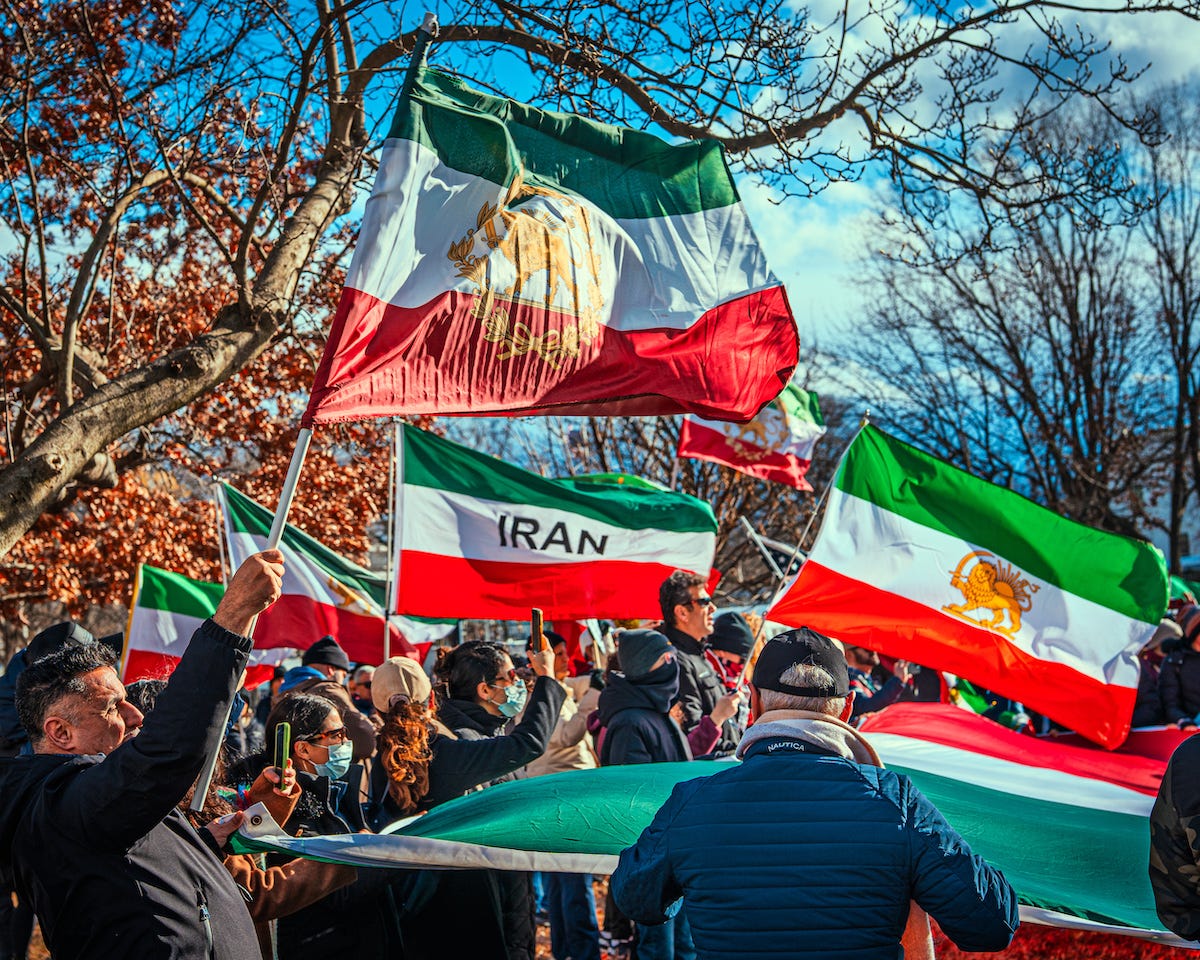
Against this, the Iranian people are not proposing a counter-ideology. They are asserting something far more elemental.
When the people begin to speak ethically, their words no longer sound like demands. They sound like recognitions. Again and again, the language returns to life, dignity, truth, and freedom. This repetition is not accidental. It signals a shared moral intuition struggling to find words adequate to its clarity.
To say “we want life” is not to propose a policy. It is to assert a limit. It is to say that power has crossed a threshold beyond which it no longer protects what it governs. The insistence on women’s freedom is not symbolic; it is diagnostic. A system that must control women’s bodies to preserve itself has already revealed how it understands the people as a whole.
These protests do not reject Iran’s moral inheritance. They appeal to it. They draw upon an ethical memory in which truth stands against falsehood, dignity against humiliation, and life against domination. This memory persists across Iran’s history: in poetry, philosophy, and ordinary expectations about what authority owes those it governs.
What the chants give voice to is not rage but recognition: a clarity that the relationship between ruler and people has become irreparable. Once this recognition takes hold, reform ceases to be imaginable. A regime that must silence its citizens to survive has already conceded that it no longer governs with their consent, nor even in their name.
Fear becomes the signature of power that no longer believes in its own legitimacy.
Ērānzamin: Belonging as Moral Test
At a certain point, political language fails; not because the stakes are too complex, but because they are too simple.
One does not need a theory of sovereignty to ask whether a leader loves his people. One does not need a doctrine of legitimacy to recognize when power has turned predatory. There are moments when history reduces itself to a single moral test, and everything else—institutions, slogans, negotiations—falls away.
To belong to a land is to recognize oneself as answerable to those who share it and to those who will inherit it. Belonging binds authority to care. It establishes a limit beyond which power may not pass without becoming something else entirely.
A ruler who murders his people in order to rule them has already declared that he does not share their world. He may occupy the land and command its institutions, but he no longer stands within its moral soil. He governs over the country, not from within it.
This is why the struggle in Iran is so difficult to misread from within and so easy to misunderstand from without. For Iranians, the question is no longer whether reform is possible within the system. It is whether those who claim authority still belong to the same ethical world as the people they govern.
And the answer, resoundingly, is no.
The West’s Difficulty with Ethical Struggles
Western responses to Iran are almost always framed in the language of management: de-escalation, engagement, restraint, negotiation. These reflexes presume a shared moral ground between rulers and ruled, a ground on which compromise remains meaningful.
In Iran, that ground has collapsed.
To treat the regime as a legitimate interlocutor is to repeat the misrecognition that sustains its power. For those risking their lives, diplomacy conducted in the name of stability does not sound pragmatic. It sounds like abandonment. Ethical struggles cannot be resolved through technocratic adjustment. They ask instead whether a form of power still deserves to exist.
This question is unsettling, particularly for political orders built on continuity and risk minimization. Yet refusing it carries consequences. Stability purchased at the expense of dignity is not stability at all, but deferred violence.
Destiny without Prophecy
History does not always announce itself with certainty. Sometimes it gathers quietly around a recognition that cannot be undone.
Iran has entered such a moment.
What is at stake is not the triumph of a new ideology, but the possibility that power might once again be reconciled with care. A people can endure hardship and imperfect rule. What they cannot endure indefinitely is being governed by those who do not love them.
A state that governs against life forfeits its claim to the future. It may persist through fear, but it cannot generate belonging. And without belonging, power becomes weight without ground—force without direction.
The Iranian people are not asking to be rescued. They are asking to be recognized.
They have remembered that belonging is not granted by power, but withdrawn from it. Once withdrawn, it cannot be coerced back into place. The world now faces a choice—not of intervention or indifference, but of recognition: whether it will continue to manage the problem or finally see the moral struggle that has already declared itself.
History will not ask who prevailed in the short term. It will ask who still loved the land enough to refuse its degradation—and who, when that refusal became unmistakable, chose to see it.
Milad Milani is Associate Professor of Religious Studies at Western Sydney University. His work explores Islamic thought, mysticism, ethics, and political theology, with particular attention to questions of authority, tradition, and modernity. He is the author of Heidegger, Ontology, and the Destiny of Islam.