

Caiaphas at the Hilton: The Friendly Federal Assassin and the Return of Human Sacrifice
by Tim Rosenberger

I.
Cole Tomas Allen, the young man who walked into the Washington Hilton on Saturday night with a shotgun, a handgun, multiple knives, and a stated intention to kill the president of the United States, gave a charming interview to ABC7 in Los Angeles in 2017. He was a Caltech senior studying mechanical engineering. He had designed a prototype emergency brake to keep wheelchairs from skidding when their wheel brakes engaged. The reporter found him gracious and articulate. The brake worked.
In the almost decade between his star turns, Allen took a master’s in computer science at Cal State Dominguez Hills, tutored high school students at C2 Education in Torrance, and was named the company’s Teacher of the Month in December 2024. The parents of his students told the Los Angeles Times he was intelligent, soft-spoken, and on the nicer side. His professor at Cal State remembered him in the front row, attentive, polite, and frequently emailing about coursework. On Saturday night, having traveled by train from Los Angeles to Chicago to Washington, he sent his family a note ten minutes before the attack. He apologized to those whose trust he had abused. He said he did not expect forgiveness. In the writings he left behind, he called himself the “Friendly Federal Assassin.”

How does the boy who built a wheelchair brake become the assassin at the magnetometer? The reporters covering the case have proposed mental illness, online radicalization, isolation. None of these answers is wrong. None is sufficient. They describe the surface, but the deeper architecture demands our attention.
Allen is the third in eighteen months. Luigi Mangione shot Brian Thompson in December 2024. Tyler Robinson killed Charlie Kirk in September 2025. Each of these young men explained himself before he acted. Each presented his act as service to the nation. Each accepted, or anticipated, his own death as the price of that “service.” The framework authorizing their reasoning is older than effective altruism, but effective altruism is its current respectable form. The corrective is older still. It is a verse of John’s Gospel that our culture has either forgotten or, having half-remembered, inverted.
II.
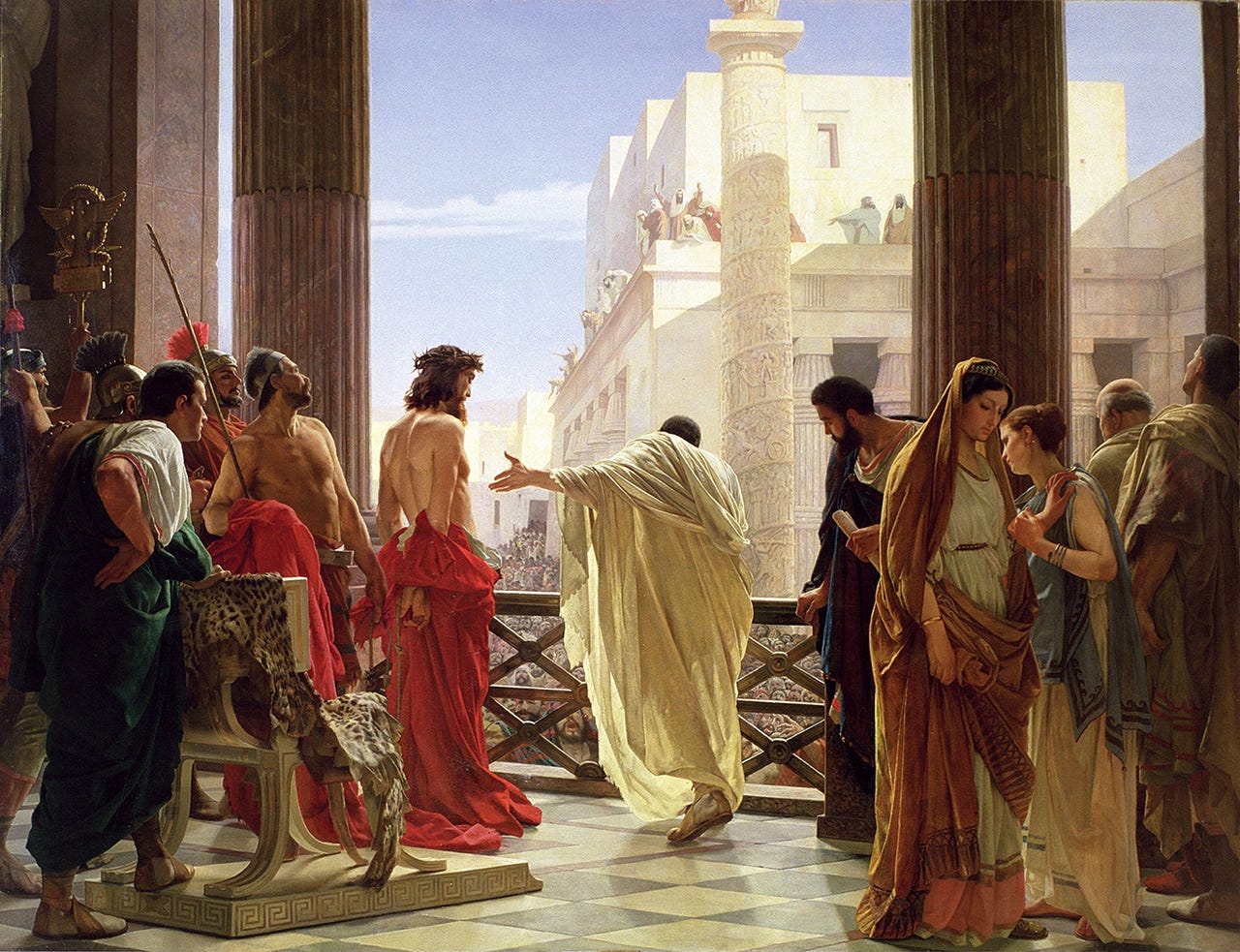
Allen, apparently obsessed with saving the nation by sacrificing its president, is a modern echo of the gospels’ Caiaphas.
“It is expedient for us, that one man should die for the people, and that the whole nation perish not.” The high priest spoke at a council convened after the raising of Lazarus, when the religious authorities had concluded that the Jesus movement, left alone, would provoke a Roman crackdown destroying the temple and the nation with it. The calculation, on its face, is prudence. It is the kind of arithmetic any administrator runs. It produced unanimity in the council and discharged a social tension that had become unbearable. The gospel writer treats the line as both prophetic and damning in the same breath.
René Girard located here the mechanism by which human societies have always discharged collective tension. Unanimous violence against an innocent victim produces social cohesion, the appearance of justice, and a feeling of relief so profound that participants experience it as a sacred event. The mechanism works in the technical sense. Cultures across history have used it. What the gospels do, on Girard’s reading, is take the side of the victim and expose the lie. Once exposed, the mechanism cannot work the same way again. The lynch mob becomes suspect even when its victim looks guilty. The persecution texts of the ancient world give way, slowly, to texts that worry about scapegoats.
This is one source of an intuition that Western societies, including their secular members, treat as bedrock: the individual is inviolable; human sacrifice is categorically forbidden; the lynching is suspect even when the lynched man looks like a villain. These intuitions are not universal. They are not present in every civilization. Aztec sacrifice, Carthaginian Tophet, the burning of widows on funeral pyres are recent on the scale of recorded history. The reason most contemporary Westerners recoil from them is not that human nature has improved. It is that our ancestors read, and we still half-remember, a particular text. The atheist horrified by ritual killing is borrowing intellectual furniture from a faith he does not profess, and may find that, absent care, that furniture may not be bequeathed to the next generation.
III.
Mangione wrote the script. Robinson and Allen are reading from it.
The Mangione manifesto reasoned, in the language it could find, from harms in aggregate to a license for individual action. The American health insurance regime kills people; therefore the executive of a major insurer must die. The math is the giveaway. The math assumes that lives are fungible, that suffering can be summed across persons, and that the sum can be set against a particular killing as its justification. Once the premises are granted, the conclusion follows. Read carefully, the manifesto is not the work of a deranged mind. It is the work of a logically consistent one, operating from premises Christianity was supposed to have rendered unthinkable.
Tyler Robinson is the harder case. The reasoning, on what we know of it, was structurally identical to Mangione’s, with different inputs. Charlie Kirk’s speech was causing harm; the harm had to be stopped. Speech replaces insurance claims; the conclusion follows along the same path. Kirk was, by any honest accounting, the most prominent voice persuading young men of his generation toward the conservative tradition. He was killed for that work, by another young man of the same generation reasoning from the same premises that had moved Mangione nine months earlier.
Allen completes the figure. The “Friendly Federal Assassin” is Caiaphas in modern dress: the same prudential frame, the same self-presentation as servant of the nation, the same willingness to absorb personal destruction as the price of the service. Allen intends, on his own account, to save the country. He accepts his own death in the bargain. That is the deeper Girardian point. The scapegoater becomes scapegoat. The cycle does not stop. The president has described the manifesto as expressing hatred for Christians; whether the text bears that out in detail is a question for the trial. The structure of Allen’s reasoning, whatever his explicit theological views, is the structure that the Christian tradition was supposed to have foreclosed.
Allen is not crazy in any legal or clinical sense. He sat in the front row. He was Teacher of the Month. He was reasoning. The reasoning leads where it leads when the prohibition is gone.
IV.
Caiaphas needed Pilate. He still does.
The Pilate of John 18 and 19 is not the architect of the killing. He examines the prisoner, finds no fault in him, says so on the record, and authorizes the killing anyway. He cannot afford the political cost of intervention. He washes his hands, declares himself innocent, and returns to administration. The killing proceeds.
The pattern of the past eighteen months on the institutional left has been the pattern of Pilate. Mainstream organs that shape liberal opinion did not endorse Mangione’s act. They did, in publication after publication, treat his manifesto as a document deserving sympathetic exegesis and his person as an object of unsettling cultural fascination. They did not endorse Robinson’s killing of Kirk. They did, with rare exceptions, treat Kirk’s death as an occasion to revisit Kirk’s rhetoric rather than to denounce the architecture of reasoning that produced his killer. They will not endorse Allen. They have already begun to amplify him. Norah O’Donnell, interviewing the president the day after the attack, read Allen’s denunciation of him aloud from the manifesto, the words “pedophile, rapist, and traitor” delivered in the measured cadence of network news, the assassin’s accusation laundered through the authority of CBS into a question the president was invited to answer. This is the work Pilate’s procurators do once the killing is underway. They give the charge a hearing. They treat the killer’s grievance as a contribution to public discourse. They will, in the days to come, find ways to write that the country’s politics had become unbearable for sensitive young men.
This is the Pilate move. It does not require approval of the killings. It requires only the choice not to intervene against the architecture that produces them. The intervention would mean naming the moral grammar of utilitarian aggregation as defective, repudiating the networks that have grown wealthy and respectable on its terms, and acknowledging that a political coalition that has lately mocked Christian moral seriousness as theocratic threat is now reaping a harvest its mockery helped to sow. The institutional left will not make the intervention. The political costs are too high. The energy of the men at the magnetometer does work, in the structure of contemporary politics, that mainstream voices would not do themselves. So, the hands are washed, the case is found wanting on its merits, and the killing proceeds.
The defense is always that these are isolated cases, lone wolves, mentally unwell young men whose acts cannot be generalized. The defense does not survive three cases reasoning from identical premises within eighteen months.
V.
The architects of the authorizing architecture are not bad people. This is the part of the argument that requires care. The casualties of a wrong idea are often the people who took it most seriously.
Peter Singer at Princeton has spent fifty years arguing, with patience and rigor, that geographic distance ought not block moral obligation and that the comparison of outcomes across persons is the proper grammar of ethical thought. The argument has produced real charity and saved real lives. It has also produced a moral grammar that lacks any categorical prohibition on the scapegoat. Singer’s frame can absorb such a prohibition only as an empirical generalization about the long-run consequences of permitting killing. It cannot ground the prohibition as inviolable in itself.
Joe Bankman and Barbara Fried at Stanford Law have done careful, humane work on responsibility and consequentialism. Their philosophical project is serious. Their son Sam took the philosophy he had inherited seriously and acted on it. Under the pressure of running an exchange in a falling market, he discovered that the architecture he had been taught could not hold a line a more ancient grammar would have held. He is a talented young man lost to a wrong formation, one of the casualties of an idea, worth another chance if the idea around him is ever named clearly enough to be repudiated.
The same charity is owed his parents and the broader effective-altruist community. They are people of conscience working on serious problems. The question their architecture cannot answer, because no consequentialist architecture can answer it from inside, is why the inviolability of the individual ought to function as a non-negotiable constraint on the aggregation of welfare. That premise was historically supplied by a religious tradition the academy has spent a generation treating as embarrassment. Stripped of the premise, consequentialism is arithmetic, and arithmetic licenses whatever the numbers favor. This is not a failure of the philosophers; it is a structural limit of philosophy unaided by what theologians used to call revelation. A generation of our most gifted young people is being formed in the architecture. Some end at FTX. A smaller number, formed in adjacent architectures with sharper edges and weaker ties, end at a magnetometer.
VI.
Allen will be prosecuted. The federal indictment names attempted assassination, interstate transport of a firearm in furtherance of a violent crime, and discharge of a firearm during a violent crime. Conviction is overdetermined. He will spend his life in federal prison.
This is necessary. It is not sufficient.
Positive law forbids the killing. Positive law cannot supply the moral grammar that makes the prohibition feel natural. Hart’s minimum content of natural law gestures toward the insight; Fuller’s morality of law gestures toward it from the other direction. The deeper Thomistic point, recovered in Pope Leo XIV’s Vatican Tribunal address last month and treated at length in these pages, is that positive law presupposes a populace that will not reason its way around it. When the populace makes the move, the law has nothing to say that the populace will hear. Allen knew the law. The law did not deter him. Criminal law’s deterrence model assumes a baseline of socialization that recoils from killing. When the socialization fails, the law can punish the killer. It cannot reach the next one through punishment alone. The genuinely persuaded man who has already accepted his own death is the case the criminal law was never built to handle.
Schmitt’s formulation belongs here. The sovereign decides on the exception. The state’s monopoly on legitimate force is the renunciation, by every other actor, of the right to decide which deaths serve the nation. When private citizens reclaim the right, the polity has either revolution or terror. The American settlement assumes that even those who hate one another will not kill each other. That assumption is doing more work than the Constitution acknowledges, and the work is not legal work.
The asymmetry should be named. Mangione, Robinson, and Allen are men of the left. The American right has its own histories of violence. In this particular moment, the active assassin script is a script of the left. The most plausible reading is that the secular left has gone further down the road of forgetting than the secular right has. The right’s secularism still trades on a residual Christian inheritance, often without acknowledging the source. The left’s secularism, especially in its technocratic and effective-altruist forms, has taken the deeper drink. The grammar of aggregate welfare without inviolable individual claims has done its work first where it took root first.
We are not going to legislate our way out of this. The criminal statutes will not do the work. Hardened protective details will reduce frequency but will not address the source of this violence. The assassination of public figures by gifted young men reasoning from utilitarian premises is not a legal problem. It is a catechetical one. The catechism that produced the Western refusal to sacrifice the one for the many was Christian. The substitutes on offer—humanism, effective altruism, technocratic liberalism—are not catechisms. They are denominational variations on the position Caiaphas took in the council. They will produce more Cole Allens. They cannot help producing them. The broader culture still benefits from the Christian inheritance while forgetting its source. Whether it recognizes what it is losing in time to recover it is the open question of our generation. All signs derived from the Hilton on Saturday night were discouraging.
Topics: Reflections & Dialogues
Tim Rosenberger is a pastor and attorney and cofounder of Excelsior Action.