


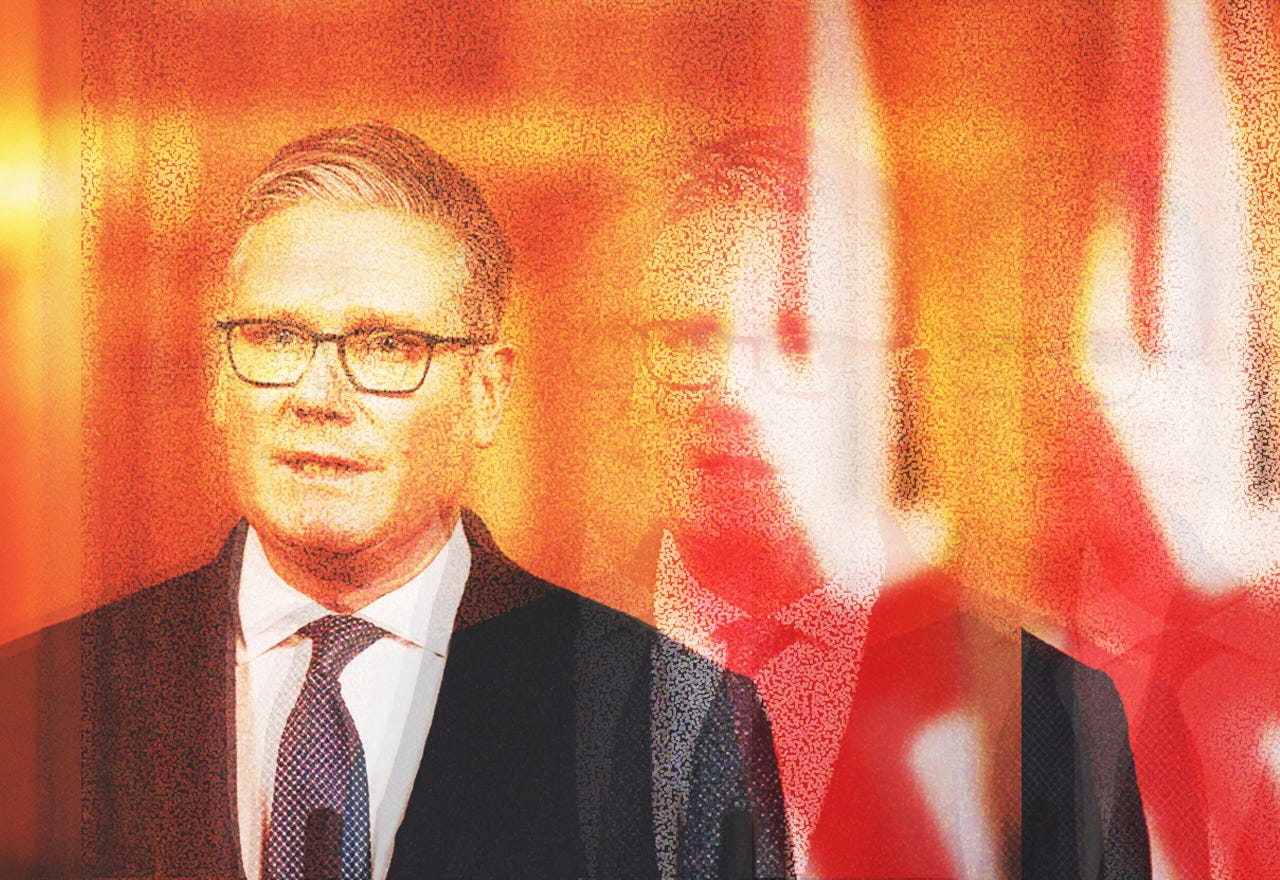
The elections in Britain on May 7th mark a tectonic shift in UK politics with implications for both Europe and the Anglosphere. After a century of two-party rule, the country’s political landscape is profoundly fragmented, mirroring the deep economic, cultural, and social divides. The country is more atomized and fractured today than even in the run-up to the Brexit referendum ten years ago. Keir Starmer will likely face a challenge as prime minister, and his successor would be the seventh since 2016. Yet successive government have failed to rebuild state capacity for renewed prosperity at home or defending national and shared Western interests against the threats from hostile foreign powers such as China or Russia.
In the English local elections, the governing center-left Labour Party and to a lesser extent the center-right Conservative Party suffered heavy losses to the radical-right populist Reform UK party and the far-left populist Green Party. Meanwhile, in the Scottish and Welsh parliamentary elections, the nationalists emerged triumphant, with Reform in second place and the Greens progressing while Labour lost dramatically and the Conservatives shed support too.

Thus, in one sense the populist backlash against progressivist technocracy continues apace. Labour, which won a landslide victory in the UK national elections less than two years ago, are losing everywhere to everyone. In their former heartlands in the North-East, North-West, and the Midlands, they are being replaced by Reform. In London and university towns, their vote is squeezed by the Greens. And in some of the so-called home counties—the wealthy middle-class regions around the capital—Labour is ceding ground to the centrist Liberal Democrats and the Conservatives, though the latter are losing to Reform in working-class areas across southern England.
Geography and social class largely coincide. Labour’s electoral coalition used to stretch from Hampstead (north London), home to Fabian-style intellectuals, to Hull (northern England), home to the industrial working class. This coalition has fractured, with parts of the progressive professional managerial class abandoning Labour in favor of the Green Party and the nationalists in Scotland and Wales, while the socially conservative ex-industrial working class have switched their support to Reform. The Conservatives are now the party of the older, more affluent voters, a small yet stable rump.
In another sense, Britain is witnessing a decomposition of mainstream parties and a realignment. The two-party system that has underpinned UK politics for two centuries—first Liberals and Conservatives, then Labour and Conservatives—has given way to a contest of five UK-wide parties (Labour, Conservative, LibDem, Reform, and Green) and three nationalist parties in Scotland, Wales, and Northern Ireland (Scottish Nationalist Party, Plaid Cymru, and Sinn Féin). We might be seeing the demise of Labour and the Conservatives as national parties, with their national share of the vote well below 20 percent each, while Reform UK got about 26 percent and, so far, has the advantage of building a relatively stable electoral coalition out of the working and lower middle classes across England and now Wales too.
But at this juncture, no party can govern on its own, and the prospect of coalition government for years to come adds to the sense of paralysis. Scotland, where the SNP has been in power for over twenty years and governed either as a minority party or in coalition with the Greens, has some of the worst public services and other economic outcomes, showing that a governing strategy of the lowest common denominator accelerates decline. Something similar applies to the Conservative/LibDem coalition in Westminster from 2010 to 2015, which gave the country the lasting damage wrought by austerity, depressing economic growth and involving draconian cuts to public services and defense spending. So far coalitions have existed within the national parties, not between them. Over time, the very legitimacy of British parliamentary democracy will be in question.
Ideologically, the defeat of centrist technocracy does not represent the demise of progressivism or the tempering of the populist right—as with Italy’s Giorgia Meloni. Instead, the energy is with two rival forms of populism—the nationalist, sovereignist populist brand of Reform versus the globalist, “inclusive” populist brand of the Greens. While Reform’s leader, Nigel Farage, led the charge for Brexit and is a staunch defender of President Trump (albeit not in favor of the Iran war), the leader of the Green Party, Zack Polanski, sides with those who accuse Israel of genocide and champions ultra-progressive causes ranging from trans-activism to the decolonization of the school curriculum. Progressivist politics is growing on the populist far left of the spectrum.
Yet this clash of the two brands of populism conceals a deeper fusion of certain libertarian with specific statist views. Both Reform and the Greens accuse the old mainstream parties of liberticide and a sustained crackdown on free speech, combined with censorship and surveillance. All this is couched in the familiar terms of elite coercive control versus popular resistance. The Greens are even more libertarian than Reform in promoting the legalization of recreational drugs and euthanasia. At the same time, both parties support statist solutions to the economic crisis, advocating vast public spending on welfare and public services in the hope of boosting the living standards of people left behind by globalization and austerity.
Moreover, each of the two insurgent forces is deeply divided. Reform oscillates between statist intervention to support its working-class voters and a Thatcherite low-tax, low-spend economy to placate its suburban middle-class support. The Greens are simultaneously appealing to socially ultra-progressive secular graduates and middle-class voters and socially more conservative Muslim voters.
It is therefore highly uncertain whether their political positioning or policy platforms command greater popular support in a general election for the UK Parliament, due by July 2029 when the current parliamentary term expires. Arguably the fusion of libertarian with statist ideas will limit their appeal among voters as time—and scrutiny—goes on. A majority of British people remain much more small-“c” communitarian in terms of family, work, and a sense of national belonging. Most people are culturally and socially moderate while wanting to see a radically different economic model that allows them and their children to flourish once more.
A broad section of the UK population are opposed to the ethno-nationalist atavism of Reform’s radical wing, who seek to deport millions of foreign-born Brits, as much as to the globalist reverse racism of Green’s militant activists, who blame the white indigenous people for all the ills of the country and the whole world.
So far, no political party or politicians seems to have grasped the sheer depth of the crisis or worked out how to confront the structural drivers. Reform UK says that the United Kingdom is broken but falls back on old ideas such as Global Britain as a buccaneering free-trade country in a world of great-power blocs and growing protectionism. It also speaks the language of the “special relationship” with the United States at a time when historically close diplomatic, military, intelligence, and economic ties are giving way to more transactional deals based on very short-term calculations rather than longer-term strategic interests.
While Reform UK has consistently criticized high levels of immigration and the associated cultural changes, it has so far failed to connect these to economic pressures. Free trade will only exacerbate the divides between globally traded service sectors and the foundational economy of non-traded goods and services. Linked to this is the reliance on importing skilled, cheap(er) labor to fill vacancies in more vocational and technical sectors such as healthcare, adult social care, construction, and adjacent activities. Crucially, Reform UK seems fully invested in the “culture wars” pitting ultra-progressive woke activists against national-populists, when a majority of voters reject identity-driven politics and do not view the underlying divisions as set in stone.
How will its current political outlook and nascent policy platform speak to the two parts of the electoral coalition that it needs to hold together and grow, i.e., working-class voters in ex-industrial towns, suburban zones, but also rural and coastal areas (who used to vote Labour), as well as lower-middle-class voters in cities and more affluent pensioners (who are disillusioned by the Conservatives)?
Amid political fragmentation, fracturing communities, and material fault lines, what’s missing from British politics is a broad UK-wide party with a vision that balances tradition with transformation. An economic model that creates value, not financial speculation or the extraction of rents, and rewards hard work. An economic model that fosters firms with a social and not only an economic purpose, such as public-interest companies, cooperatives, and mutuals that pool risk, resources, and rewards. An economic model that reduces energy costs for both households and businesses, and that replaces dependency on energy imports with real energy security based on a combination of nuclear with renewables.
A central state that devolves power and resources to local and regional tiers of government, which know better about the needs of their citizens and are accountable to them. A central state that abandons managerial micro-management with decisive action in favor of reindustrialization, affordable and good-quality public services run by organizations governed by funders, workers, and users. A central state that clamps down on rent-seeking and profiteering, invests in innovation, and deploys technology for public benefit. A central state that enforces strong borders and takes decisive action to eliminate illegal immigration.
Good government at all levels of the country to celebrate the United Kingdom’s shared history, strengthen communities, go after those preaching hate, and deal with the scourge of antisemitism and ethno-sectarian intolerance. All this requires less focus on process and rules and instead a much greater exercise of both ethical and political leadership based on courage and conviction.
For the past decade or so, Western politics has been characterized by the opposition between progressives and populists amid growing cultural and economic polarization. Today, politics is fragmented as old parties lose their popular base while new insurgent forces still struggle to command majority support. A majority politics can be built on solidarity and subsidiarity instead of diversity and coercion, the common good and flourishing rather than the right to have rights or the maximization of utility, freedom and duties instead of servitude and entitlement.
The sway of both social and economic liberalism, which was dominant for forty years, is being undermined by the intrusion of new political polarities that do not readily fit into a left–right spectrum. These new polarities concern variously common sense and common decency versus the binary of technocracy and populism, rootedness and tolerance versus mobility and the division of culture wars, the local and national versus the uniformly global or atavistic ethno-nationalism. Such and similar political polarities require a more paradoxical conception that fuses the defense of tried and tested tradition with the promotion of radical yet realistic transformation.
Britain’s much-vaunted stability and majority rule are unraveling in a world of great-power rivalry. The current capacity of the British state and the ruling establishment to offer remedies is as small as the scale of the task is big. Only a new virtuous elite combined with greater popular participation in power and wealth can reverse decades of decline and renew the United Kingdom before it breaks apart and ceases to play a vital role in the promotion of the wider West both geopolitically and civilizationally.
Topics: Beyond State and Market • Reflections & Dialogues
Adrian Pabst is Honorary Professor of Politics at the University of Kent, UK, and Deputy Director of the National Institute of Economic and Social Research. Since 2012 he has been an Associate Editor of Telos. His research is at the interstice of political thought, political economy, and political theology. He is the co-editor of Blue Labour: Forging a New Politics (2015) and the co-author (with John Milbank) of The Politics of Virtue: Post-Liberalism and the Human Future (2016). Author of several other monographs, his most recent book is Penser l’ère post-libérale (2025). Since October 2025 he has been a Member of the Pontifical Academy of Social Sciences.