


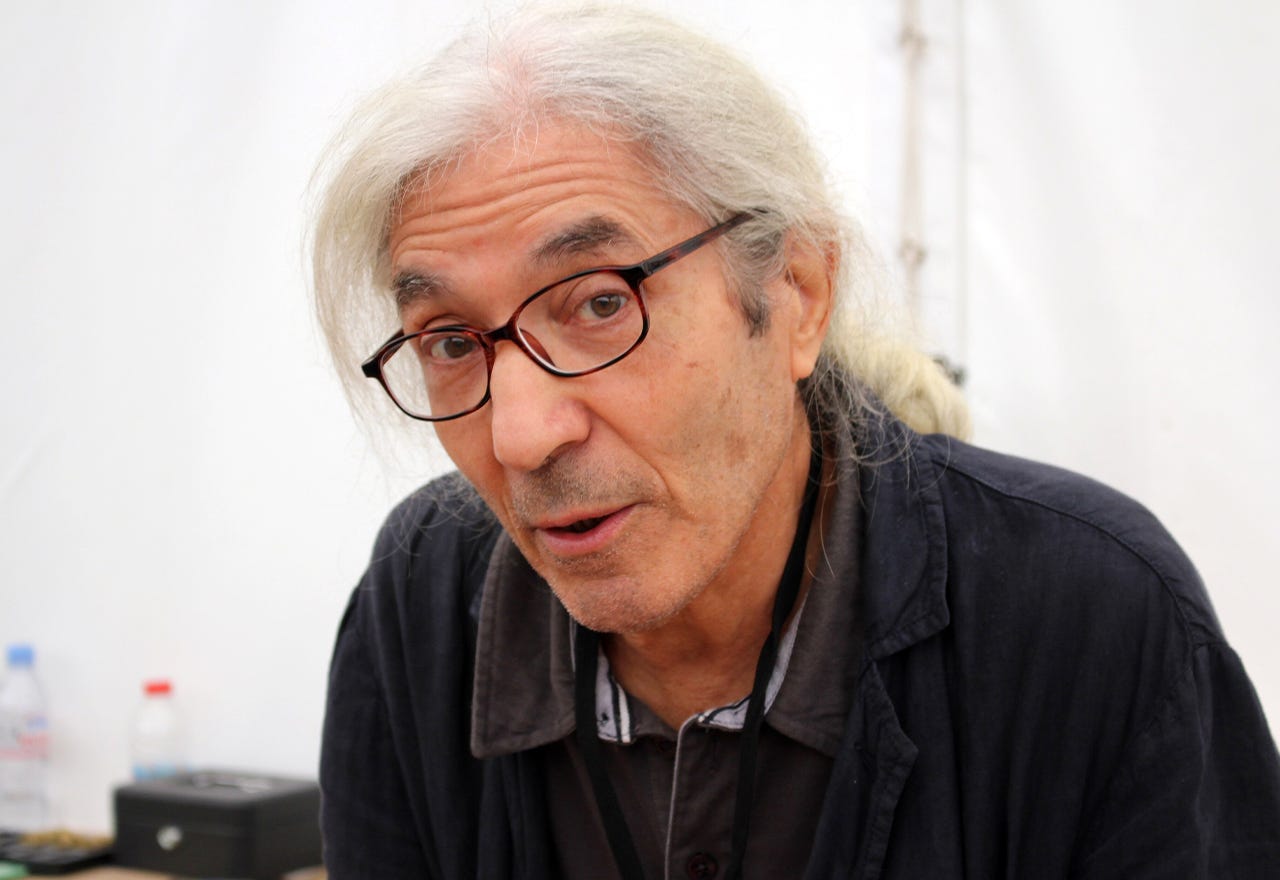
People feared for him—for his safety, even for his life—every time he returned to Algeria. And on November 16, 2024, the author Boualem Sansal disappeared upon arriving at Algiers airport. The worst was feared: the secret police of the dictatorship, the Islamists—the two once again allied, as in the past, in some dark combination? A complete blackout followed. As Rachel, the brilliant “math whiz” in his novel The German Mujahid (Le Village de l’Allemand), puts it, Boualem Sansal “entered, in a quantum manner, into a non-Euclidean space.” He became a character from his own narratives, which weave together all the threads of History between “Nazislamism” and Algerian “Stalinationalism.”
Finally, the authorities announced that Boualem Sansal had been arrested and charged with undermining state security. He was said to be in prison, then in a prison hospital; his lawyers were unable to meet with him, and concerns mounted over his health, known to be fragile. Absurdity, cynicism, arrogance, cruelty—the traits of a violent and enraged regime attacking so gentle a man: a writer, a poet, a lover of the French language and of numbers. Boualem Sansal is indeed inexhaustible when speaking about prime numbers, irrational numbers, remarkable numbers, complex numbers, real numbers. He speaks of them with tenderness and complicity; he caresses them, plays with them, and the white papercloth fills with arabesques of figures and cabalistic formulas.

And from numbers he moves to geometry and the tracing of family trees. His own genealogical tree links the two shores of the Mediterranean—from Spain to Kabylia, from Morocco to France, and even to Jerusalem, which he sometimes visits in memory of his brother Daoud-David and the “dusty old rabbi” of his novel Darwin Street. Like Mounia (another version of himself in the novel), Boualem then opens “a breach in space-time.” That, too, is something the Algerian regime cannot forgive him for: his sympathy toward Morocco, the brother-enemy, and perhaps even worse, his friendship toward Israel.
The Islamists are likewise revolted by his frequenting with Jews, whom Islam tolerates only as dhimmis (this pariah status of Jews under the caliphate and the Ottoman Empire). But they are not the only ones who want Boualem Sansal destroyed. An entire section of the Left—or those claiming to be such—the kind that prefers Sartre to Camus, attacks Boualem Sansal by accusing him of having “turned to the far right,” precisely because he stands with the luminous Algeria of Camus. This Left has chosen authoritarianism of every kind: that of the Global South, of dictators large and small, boastful or discreet, kleptocrats, bloodthirsty psychopaths, and self-proclaimed avengers driven by grievance and revenge—all of them threatening our freedom to think, to speak, to love, to live.
Throughout Boualem Sansal’s captivity, left-wing intellectuals and politicians, commentators and polemicists, essentially maintained that he had brought his fate upon himself. By criticizing the Algerian regime so openly and delivering supposedly “Islamophobic” diatribes, they argued, he had only himself to blame. And after his release, criticism—even insults—erupted once again. Caught unwillingly in a politico-editorial imbroglio, he was reproached for changing publishers and for “selling himself” to a right-wing businessman who has become the Left’s great Satan: Vincent Bolloré, who recently acquired the publishing house Grasset, the publisher that Boualem Sansal had joined a few months earlier and to which he remained loyal after the change in ownership.
This so-called “revolutionary” Left has always exercised significant influence in France. Its hold over the broader Left and over intellectual and political circles has fluctuated through the decades but has more or less endured. Today, the “radical” political Left—characterized by an aggressive Islamo-woke ideology—dominates the cultural sphere, achieving, in Gramscian terms, a form of hegemony, while its electoral performances have reached heights comparable to the communist apex of the 1950s and 1960s. Viewing violence as revolutionary in itself, this Left has replaced the figure of the proletarian with that of the “Palestinian” as the emblematic “wretched of the earth” to be defended by any means necessary, according to the Bolshevik principle that “the end justifies the means.”
The “Palestinian” is not a real individual—an Arab from Mandatory Palestine—but a mythical being who subsumes the Muslim supposedly victimized by “Islamophobia,” the Arab supposedly victimized by “systemic racism,” the immigrant, the colonized, the “dominated,” in short, supposedly victimized by the Westerner, by “the white man,” and above all by that alleged “super-white” figure, the Jew, once portrayed as an auxiliary of the French colonists in Algeria and now supposedly the Israeli “colonizer.” The absurd theory of “white privilege” has indeed produced a specifically antisemitic offshoot: echoing the hashtag #WhitePrivilege, the hashtag #JewishPrivilege appeared on Twitter in July 2020. The “foreigners” and “mixed bloods” vilified by the racist antisemitism of the nineteenth and twentieth centuries have now become the most hated “whites” in the racialized vision of a world once again radically divided by race.
Propalestinism, promoter of “Palestinian suffering,” instrumentalizes compassionate support for Palestinians—that is, for the Arabs of Palestine and their descendants, transformed into hereditary refugees cared for by the UNRWA since 1949 because the Arab states decided to preserve them as a permanent sore point. The strategic objective of propalestinism is the disappearance of the State of Israel, because the entirety of Mandatory British Palestine (that region of the defeated Ottoman Empire which the League of Nations entrusted to Great Britain for administration) is considered destined to remain Muslim and to belong exclusively to the Arabs. To achieve this aim, the tactic of propalestinism is to delegitimize the Jewish state, especially through the obsessive victimization of Palestinian populations and the demonization—literally and figuratively—of the Jew/Israeli.
Yet Boualem Sansal stands against this phantasmatic worldview promoted by woke ideology and by this propalestinism, which has today become the doctrinal core of the neo-Bolshevik Left. As an Algerian, he does not conform to the archetype of the oppressed. If he suffers oppression, it comes not from France, from its culture, language, or Enlightenment philosophy—all of which he has fully embraced—but rather, on the one hand, from the Islamist offensive that, during Algeria’s “Black Decade,” carried out a true genocide against his country’s intelligentsia and, on the other hand, from the Algerian authoritarian regime.
Thus, he became a target, particularly in France for parties such as La France Insoumise and the New Anticapitalist Party, but also for ecologists of all kinds, who have made the struggle against so-called Islamophobia one of their main causes and who, at every opportunity, defend the wearing of the veil and various Islamist communitarian demands. The Communist Party is no exception, as shown by its connections with the PFLP, a Palestinian terrorist group, and its sustained relations with Iranian intellectuals close to the regime of the mullahs. Even the Socialist Party, drifting steadily downward in its decline, follows the same path. Having defended the Islamic Revolution in Iran in 1979 and now rejoicing in the resilience of Iran’s military-religious regime after “Israeli-American” attacks, this fundamentally anti-Western and anti-democratic Left supports the Algerian regime and attacks the personalities it persecutes. Thus, Boualem Sansal—a free man even at the bottom of his prison cell—has become the ideal target for Islamo-woke leftist propaganda.
Renée Fregosi is a philosopher and political scientist, and president of the Centre Européen pour la Coopération Internationale et les Échanges Culturels (CECIEC). Her latest book is Le Sud global à la dérive: Entre décolonialisme et antisémitisme (The Global South Adrift: Between Decolonialism and Antisemitism; Paris: Intervalles Publishing, 2025).