


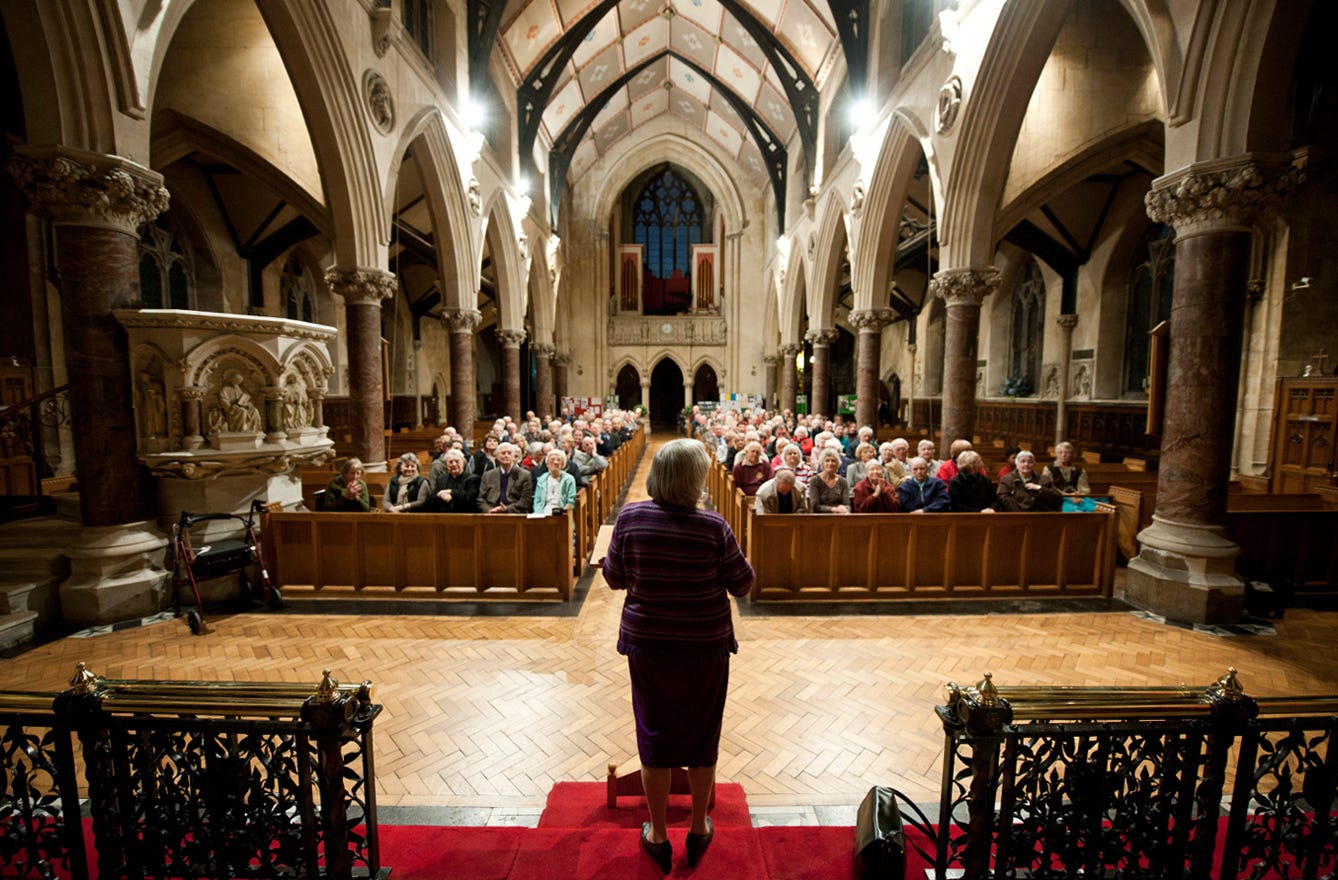
Man was created for greatness, for God himself; he was created to be filled by God. But his heart is too small for the greatness to which it is destined. It must be stretched.
—Benedict XVI, Spe Salvi
I’d be a liar if I didn’t say that an exclusion that pointed didn’t stab just a little bit. But I am a great one for saying it’s no good looking back.
—Ann Widdecombe
He was inside the house for two minutes. On the eighth of July, a man who had driven two hundred miles walked into a cottage in Haytor Vale, on the edge of Dartmoor, carrying a hammer. Ann Widdecombe was in her kitchen, eating lunch. The provisional cause of death, read out at Westminster Magistrates’ Court, was blunt force injury to the head. She was seventy-eight. She was found the next morning, after missing a television interview, which was the only appointment anyone expected her to keep.
The coverage has gone where coverage goes, to security reviews and the question of how a former parliamentarian could be so reachable. The larger question is why she was there to be reached at all.

Start with the woman, who deserves better than to become a premise. In May 1997 she stood in the Commons and said of Michael Howard, her own former boss, that there was something of the night about him, because she believed he had misled the House. It ended his leadership hopes for years. Costly candor aimed inward is the rarest kind, and she spent it on a point of truthfulness that profited her nothing. She held Maidstone for twenty-three years. She cared for her mother at home until she died. She wrote novels because she wanted to make things. In 2010 she let herself be hauled around the Strictly Come Dancing floor by Anton Du Beke while the nation laughed, a humility grave people never manage. She was unserious about herself and never once about her convictions. When David Cameron passed her over for a peerage, reportedly for being too traditional, she said it stabbed a little, and then that it was no good looking back. She was good, and I admired her.
The obvious objection is that she kept leaving. She left the Church of England in 1993 and the Conservative Party in 2019, after forty-three years. A woman who exits whenever she loses has not found a principle. She has dressed an incapacity as one.
The answer is the destination. She went to Rome, the one body in Christendom that purports to be incapable of redefining itself by vote, and one does not escape argument by moving to the institution whose theory is that certain arguments are closed. Her judgment was that the change had been constitutive rather than incidental, and that staying would have required her to call something by a name it had stopped deserving. Most of her countrymen think she was wrong, and it is not a question this essay must settle. What it needs is the thing underneath, an unusually old view of what makes an institution the thing it is, held by someone willing to be ruined by it.
What she fled was no synodal resolution. The Priests (Ordination of Women) Measure 1993 was approved by Parliament and given Royal Assent, and Parliament then compensated the clergy who resigned in conscience. There could be no faithful remnant parish for her, because an established church’s identity is fixed by statute rather than by conscience. The state defined the church and then funded the exit.
There is an English counterexample, instructive because he failed. John Wesley had every reason to leave and refused for fifty years; he published his Reasons Against a Separation in 1758 and died a priest of that church. What he built inside it is the most successful parallel community in Protestant history, and when the pulpits closed he preached in the fields and called the world his parish. That is expansion under exclusion rather than withdrawal, and the better answer to her problem. Yet four years after his death, the Plan of Pacification permitted the sacraments in Methodist chapels and the separation he had refused for half a century came anyway. A community nested inside an institution it will not leave runs on personal authority rather than jurisdiction, and lasts one founder’s lifetime. Every classical academy and intentional community now rising in Idaho and Tennessee runs on the same fuel: a founder’s authority, a founder’s energy, a founder’s remaining years. They should read the Plan of Pacification and count.
America solved heresy with land. Roger Williams did not reform Massachusetts Bay; he walked to Narragansett Bay. Penn took a charter. The Mormons walked out of the country entirely. American religious liberty is downstream of open ground as much as of argument, and the ground closed in 1893.
What remained was law, and its foundation stone is rotten. Reynolds v. United States, handed down in 1878, fifteen years before the ground closed, was wrongly decided, and the practice at issue is beside the point. What it established was the rule that religious liberty protects belief while conduct belongs to the state, a rule the opinion supported by observing that the practice was confined to Asiatic and African peoples. That is the holding’s logic, and the direct ancestor of the rule Employment Division v. Smith restated in 1990. In Fulton, three decades later, Alito, Thomas, and Gorsuch called for Smith to be overruled, and Barrett found the textual case against it compelling. Four years later, Mahmoud reached strict scrutiny by way of Yoder, around Smith rather than through it, and left the rule intact in name only.
Until then every American exit is exit by leave. In 1972 Wisconsin v. Yoder won the Amish the most complete withdrawal our law permits, and required the permission of the sovereign it sought to escape. Utah is the abject case. The Mormons left the United States altogether, crossing thirteen hundred miles to a Mexican basin in 1847; the border caught them the next year. Within fifty years Congress had dissolved their church as a corporation, seized its property, and jailed its leaders; the Manifesto of 1890 surrendered the doctrine they had crossed a continent to practice; and statehood came in 1896 on terms written into their own constitution. The jurisdiction followed them across a desert and beat them. Exit did not merely cost them something. It failed. Espinoza (2020) marks the room the partial exit enjoys, and Bob Jones (1983) marks the ceiling. There is room, but never sovereignty.
Except one. Prayer requires no charter, no Royal Assent, no favorable judgment from any court. Parliament altered a church’s doctrine by statute and could not touch it; Congress dissolved a church and seized its property and could not touch it. It is the one unconquered ground in a story whose burden is that the ground ran out, and why the Benedict Option was never about real estate. The man who proved it shares the name. In 2013 Benedict XVI laid down an office he no longer had the strength to hold, moved into a monastery inside the Vatican walls, and gave the rest of his life to prayer. He wrote until he died at ninety-five, and his 2019 essay on the abuse crisis caused as much trouble as anything he wrote while wearing the ring. Withdrawal, in his hands, was redeployment. Ann Widdecombe at daily Mass, in a country that had made her convictions a punchline, is the same fact in a smaller frame. The temptation to justify this instrumentally, prayer as fuel for activism, must be refused. Prayer is not first because it powers the rest. It is first because it is the end, and the rest follow.
England, which never had a frontier, has an old name for what a people do when exit is closed. They become recusants. You stay. You refuse conformity. You pay the fine, twenty pounds a month under Elizabeth, ruinous by design. You keep going to the wrong Mass. The Act of Settlement of 1701 stands today, so that the sovereign may marry a Catholic but may not be one, and in 1993 Ann Widdecombe converted into the one church her country’s constitution still bars from the throne. Then she stayed in that country, on Dartmoor, name on the door, taking the invitations. A polity that has made certain convictions unspeakable rather than merely wrong has taught everyone that those holding them are not quite persons, and violence against unpersons requires no organization. Whatever the Crown proves about the man in custody, the fact that matters is fixed. She stayed, and staying made her reachable.
Which brings us to the question her death forces and our culture cannot answer. What is old age for? An entire economy is trained on the old, the pharmaceutical advertising and the cruise brochures and the continuing-care campuses with their pages of golf. No group is courted more diligently as a source of revenue, and none told more plainly that its opinions are an embarrassment. The same culture that will sell a woman of eighty a stairlift will not sit still for thirty seconds of what she believes about marriage or country or God, and has coined a two-word phrase for ending the conversation. De Beauvoir held that a society’s treatment of its old exposes whatever its professed humanism is worth. Ours has resolved that they may purchase and may not speak, and the result is visible in every parish and subdivision, in men and women solvent, medicated, entertained, superfluous, whose telephones never ring. Superfluity was Arendt’s word for what totalitarian systems accomplished by design; it describes with precision a condition nobody here designed at all. They have been given everything except a reason to be here.
We have made the last third of life a reward rather than an office. That is not what leisure ever meant. Aristotle’s scholē was the condition of the activities that constitute a life, contemplation and the affairs of the city, and it stood opposed not to work but to amusement. Leisure filled with diversion is only labor working a second shift. Cicero put the political version in Cato’s mouth, that great affairs are carried not by strength or speed but by counsel, authority, and judgment, faculties age does not remove and often supplies. The old republic had an office for the old. Ours has a market segment.
The tradition knows better. Polycarp of Smyrna was eighty-six when the proconsul offered him the recantation, and his answer, that he had served Christ these many years, is remembered because of them. The strongest objection comes from inside that tradition, whose two most celebrated martyrs are young mothers. Perpetua was twenty-two with a nursing infant, and Felicity gave birth in prison days before the arena. If courage were the special province of the old, the Passio would make nonsense of the claim. But the claim is prudential rather than vocational, and Perpetua is its proof, since her greatness is measured by what made her boldness expensive, that the price fell in a currency never hers alone. The young are bound by obligations that make courage costly to people who never chose it. The old are past the mortgage, past the school fees, past the years when a child needs a living parent more than a brave one. That freedom is not a discharge but an assignment. Benedict’s word for the mechanism is exact. The heart is too small for its destiny, and must be stretched. The world sells the last decades as the contraction into comfort. They are the last chance to be enlarged.
Three things follow, and only after the praying. Stand. Widdecombe took a party spokesmanship at seventy-six with nothing left to gain, and the school board, the zoning commission, and the parish council are offices nobody wants and everybody needs, belonging to those with no career to protect. Give, while you can still be blamed for where it went. The generation holding most of the nation’s wealth means to move nearly all of it by death rather than decision, which is the parable of the rich fool. Found the school rather than endow a chair at one, and buy the building and hand the congregation the deed. And stay put. Keep the name on the door, keep taking the invitations, say the true thing under your own name in a town where everyone knows it. That is the least dramatic of the three, and the one that got her killed.
Return, then, to the table. A woman with no husband, no children, no constituency, and no obligation to be anywhere at all, at home in her own country, at lunch, still in the fight at seventy-eight. She had nothing left that the culture wanted, and she had not surrendered the one thing it could not reach. They found her because she had never once made herself hard to find.
Tim Rosenberger is a pastor and attorney and cofounder of Excelsior Action.